


Life








General




Support



Resources











Term Insurance for Below Poverty Line
Buy Term Insurance for BPL Families

I agree to the Terms & Conditions

Digit Glow Term Life Insurance

Online
Buying Process

Tax Savings
u/s 80C

Simple
Documentation
What is Term Insurance for BPL?
Term insurance for Below Poverty Line families is a low‑cost, time‑bound life insurance plan created to provide financial security to households officially classified as BPL by the Indian government.
It works like regular term insurance, offering a death benefit to the family if the insured person passes away during the policy term, but is offered at highly affordable or subsidised premiums so that even the most economically vulnerable families can access protection.
Since BPL households depend on very limited income, the sudden loss of an earning member can cause severe financial distress; hence, these plans are specifically designed to ensure financial stability during such crises.
Who are Considered Below Poverty Line (BPL) Families?
BPL identification in India is not based only on income. Instead, it uses a combination of economic and social indicators, which may vary slightly across states, and they are ones that:
- Has a very low monthly income.
- Depends on daily wages, farming, small jobs, or informal work.
- Has little or no savings.
- Often does not file income tax returns.
- Struggle to meet basic needs like food, education, healthcare, and housing.
These families are often the most financially vulnerable yet need protection the most.
Why is Term Insurance Policy Ideal for Below the Poverty Line?
For Below Poverty Line (BPL) families, financial stability is often fragile and highly dependent on the income of a member. In such households, the sudden death of an earning member can push the family into severe financial distress. This is where a term insurance plan plays a crucial role.
- Financial Protection for Dependents: BPL families often rely on a single breadwinner. If that person passes away unexpectedly, the family can be left without any means of support. Term insurance provides a lump-sum payout to the family, helping them cover essential expenses such as food, shelter, education, and healthcare.
- Affordable Premiums: Term insurance offers a high sum assured at a very low premium compared to other types of insurance. This makes it affordable for low-income families who may not have the means to pay for expensive insurance policies.
- Prevents Debt Traps: In the absence of insurance, families may have to borrow money at high interest rates or sell assets to survive after the loss of an earning member. Term insurance helps prevent such debt traps by providing immediate financial relief.
- Supports Children’s Future: The payout from a term insurance policy can ensure that children’s education and other basic needs are not disrupted after the loss of a parent.
- Government Support & Subsidies: Government-backed schemes like PMJJBY reduce insurance costs through subsidies, making it easier for the poorest families to afford coverage. Since the government supports these schemes, claim payouts are reliable, and the risk of rejection is very low.
- Simple Claim Procedure: BPL families often struggle with paperwork or legal formalities, so these plans keep the claim process straightforward. Nominees can visit nearby banks or government offices to submit basic documents. Because the requirements are minimal, claims get settled quickly.
- Promotes Social Stability: When BPL families are protected by insurance, they are less vulnerable to economic shocks, reducing the risk of falling deeper into poverty.
- No Hidden Costs or Fees: Since term insurance doesn’t have an investment component, there are no management fees or hidden charges, making it transparent and risk-free for low-income families.
- Easy to Understand: Term insurance is straightforward; it provides life cover without any investment or savings component. This simplicity is especially beneficial for those with limited financial literacy.
Illustration on Real Value of Term Insurance for BPL Families
Rajesh was a construction worker earning 10,000 per month. He bought a ₹5 lakh term policy for ₹600 per year. Two years later, he died in an accident on the construction site.
His wife receives ₹5 lakh. This money paid for his funeral, cleared outstanding debts, and the rest she put in a fixed deposit earning ₹3,000-3,500 per month in interest.
The ₹1,200 Rajesh spent on two years of insurance premiums provided his family with security for years. This is the real value of term insurance: it converts a small, affordable payment into meaningful protection for your loved ones.
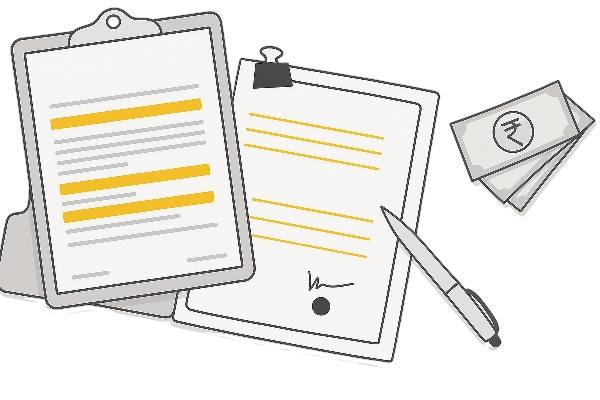
What Coverage Amount Makes Sense for Low-Income Families?
For low-income families, choosing the right term insurance coverage amount is crucial to ensure adequate protection without overburdening the budget. Here’s what makes sense:
- Basic Rule of Thumb: Most financial experts recommend a coverage amount of 10 to 15 times the breadwinner's annual income. This amount can cover immediate expenses.
- Consider Key Expenses: Low-income families should consider coverage that will replace lost income for several years, pay off any debts or loans, cover children’s education expenses, and provide for daily living costs.
- Minimum Recommended Coverage: Recommended coverage is at least ₹2 lakh. This is the minimum sum assured offered by many government schemes and covers basic needs. But the suggested ideal coverage would be ₹5-15 lakh, if affordable, as it provides more comprehensive protection.
- Balance Affordability and Need: Choose the highest coverage amount that fits comfortably within the family’s budget. Some coverage is better than none; even minimum coverage offers valuable support during emergencies.
Once you have assessed your family's needs and budget, you can buy term insurance with a suitable sum assured to help ensure your loved ones remain financially supported in your absence.
Are There Any Government Schemes for BPL Families?
Yes, there are several government schemes in India specifically designed to provide life insurance coverage to Below Poverty Line (BPL) families and economically weaker sections. Here are the key schemes:
Difference Between Term Insurance and Government Schemes for BPL Families
This comparison highlights the key differences between Term Insurance and major government-backed social security schemes such as PMJJBY, PMSBY, Ayushman Bharat, AABY, and JBY, helping individuals and BPL families understand how each option provides financial protection.
Term insurance is the most affordable type of life insurance, offering higher coverage at lower premiums, ideal for families with tight budgets. If money is extremely tight and you can only insure one person, insure the breadwinner who earns the most. Choose a sum assured that would cover essential living expenses, debts, and children’s education.
Don’t insure children first. This is a common mistake. Children don’t earn money, so their death doesn’t create financial hardship. Your income money should go towards protecting income earners.
FAQs about Term Insurance for Below Poverty Line Families
What is a term insurance policy for families below the poverty line (BPL)?
Who can buy a term insurance policy for BPL families?
Why is term insurance important for BPL families?
Is term insurance policy affordable for BPL families?
What documents are needed to buy term policy?
Do BPL term insurance policies cover accidental death?
What is the claim process for BPL term insurance policies?
Can women from BPL families get term insurance?
Is a medical checkup required to buy BPL term insurance?
Are there any age limits for buying this insurance?
How can I pay the premium for BPL term insurance?
What happens if I miss paying the premium for term insurance policy?
Will my family get the full amount if I die during the policy term?
Is there any maturity benefit if I survive the policy term?


Other Important Articles Related to Term Insurance

Renew & Download Policy Document, Check Challan, Credit Score, PUC & more
Anytime, Anywhere. Only on Digit App!

Rated App
Rated App
Scan to Download




IRDA Licensed Life Insurance Company in India - IRDAI Reg. No. 165

Sign-In to Digit Insurance
We have this phone number linked with the email ID in our database. Please login through OTP using this number or logout using below option and login again using new details.
Logout your email login