


APPROACHING A DECADE: A CLOSER
LOOK AT HOW WE ARE DOING
Featured: 18th November 2027
⏱️30 seconds Transparency Report Summary
- Nine years of Digit: 9.4 crore customers served, 48 lakh claims settled and 90 active insurance products.
- Our reach: 84,128 partners, 4,600+ employees, 100+ offices and customers served across 98.5% of India’s pincodes.
- Infrastructure we cover as Lead Insurers: 200+ engineering workshops, 150+ solar plants, 100+ road projects and 25+ IT parks.
- Gujarat flood claims: 2,109 motor claims settled by the end of H1 FY27, representing 72.5% of claims received, with ₹28.5 crore already paid.
- Peak-day scale: Highest policy issuance touched 3.5 lakh, while most number of claims settled in a single day peaked at 11,750.
- Cashless network: 23,500 garages and 10,500 hospitals across the country.
- Health cashless approvals averaged 25.1 minutes, against the 60-minute regulatory timeline.
- Health reimbursement claims were settled in an average of 2.4 days, against the 14-day regulatory timeline.
- Retail motor proposal processing averaged under 30 minutes, while retail health proposal processing averaged 5 hours 2 minutes.
- Customer grievances were closed in an average of 1 day 23 hours, while first-time resolution remained at 95%.
- What didn’t go as well: Vehicle repair approvals increased from 14 hours 44 minutes to 17 hours 39 minutes; cashless discharge approvals rose from 52.5 minutes to 63.6 minutes; motor registration and nomination changes increased from 10 minutes to 22 minutes; and retail health policy changes rose from 29 minutes to 41 minutes.
- Recognition: 12 awards across insurance, fintech, customer experience, technology and people-related categories in H1 FY27.
The simplicity of truth is unnerving. Truth or its manifested form i.e. transparency is just facts without any cake toppers.
When we began publishing our Transparency Report in 2018, the intention was to stay true to one of Digit’s core values: being transparent. Insurance already has an extensive framework of public and regulatory disclosures. We wanted to complement it by sharing information customers could more readily relate to: what happens when they make a claim, how long different processes take, how they are served and what our own experience is teaching us.
As we approach a decade of operations and publish our 15th Transparency Report, there is need to look at that journey holistically.
What We Look Like After Nine Years
In the last nine years, Digit has served over 9.4 crore customers through 90 active insurance products. We today work with 84,128 partners across the country, have over 4,600 employees across 100+ offices and have served customers in 98.5% of India’s pincodes. We have settled over 48 lakh claims since inception and on peak days, our systems have issued as many as 3.5 lakh policies and settled 11,750 claims in a single day. Two of our biggest lines of business—motor and health—are strongly supported by a network of 23,500 cashless garages and 10,500 network hospitals.
Expanding the Insurance Ecosystem
When Go Digit General Insurance Limited began, the idea was to make general insurance simpler. Today, our promoter ecosystem spans Go Digit Life Insurance and Valueattics Reinsurance, India’s first private-sector reinsurer (under the revamped regulatory framework).
General insurance protects people and businesses against risks they face today. Life insurance addresses financial responsibilities that may extend across decades, while Reinsurance helps insurers manage and distribute the risks they carry. Together, they reflect a wider view of risk and protection than the one with which the journey began.
Numbers can tell us how far we have come. But they cannot always tell us how well the business is working when tested, where it has improved, or where the experience has fallen short. In this edition, we bring the two together: stories and insights that show what happens in practice, and numbers that present progress and setbacks with honesty.
WHEN SYSTEMS GET TESTED
a. MOTOR CLAIMS SERVICING AT SCALE
Gujarat floods: Responding when many customers need help at once
Gujarat faced two rounds of flooding, affecting more than five districts. Our focus was to reach customers and keep claims process moving. While some claims remained in progress, by the end of H1 FY27, we had settled 2,109 claims, accounting for 72.5% of the motor flood claims, and paid ₹28.5 crore.
- Biggest challenge: High claim volumes across two floods, inaccessible roads, immovable vehicles and crowded garages, with earlier claims still in process.
- What helped: 65+ claims team members, field and back-office processing, home surveys for 45% of customers, towing assistance, automated RC verification through Vahan/Parivahan, and no mandatory licence checks for parked vehicles.
- What still caused delays: For total-loss claims involving hypothecated vehicles (those under an active loan), settlement required additional coordination with lenders, which took some time. Documentation for non-repair claims and parts shortages affecting ongoing repairs also added to the timelines.
- What can improve: Better parts visibility, closer coordination with financiers and workshops, and clearer updates in case of repair delays.

A similar approach helped us promptly settle flood-related claims in Assam and parts of Maharashtra during H1 FY27.
b. WHEN TIME IS OF IMPORTANCE, IT AFFECTS LIFE
Malaysia to Bengaluru: An air medical evacuation across borders
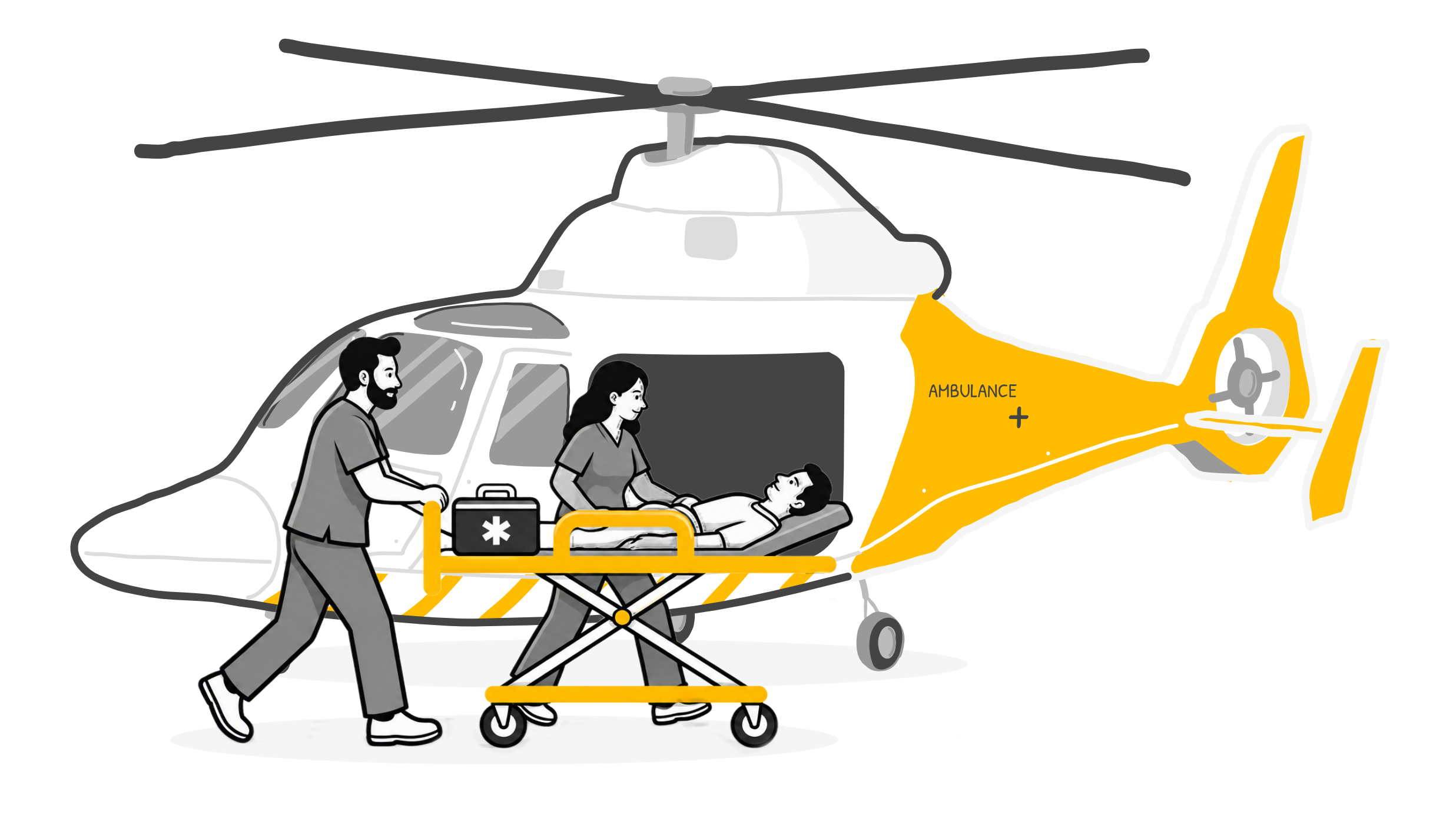
After a jet-ski accident in Malaysia, a travel insurance policy the customer bought for a little over ₹2,000 became his biggest lifeline when he wanted to be medically evacuated to continue his treatment in Bengaluru.
- Biggest challenge: Safe ICU-to-ICU transfer across countries, aircraft availability, permits, medical clearances and coordination with multiple service providers.
- What we did: Arranged air and ground ambulances, medical escorts, travel for his companion, secured the required documents, and settled a claim amounting to ₹62.2 lakh for evacuation.
- What helped: Close coordination between both hospitals, medical teams, our third-party administrator and the evacuation provider
- The outcome: The customer travelled with his companion and medical escorts from Langkawi to a Bengaluru hospital of his choice for continued treatment.
In Gujarat, the test was responding to thousands of claims amid wide spread disruption. In Malaysia, it was coordinating a time-critical medical evacuation across borders. In both, what mattered was whether people, partners, technology and processes could work together when customers needed them most.
PROTECTING HOW INDIA LIVES, WORKS AND BUILDS
A family’s protection needs are different from those of a farmer, a manufacturer or a major infrastructure project. Building a broader insurance portfolio means understanding those differences
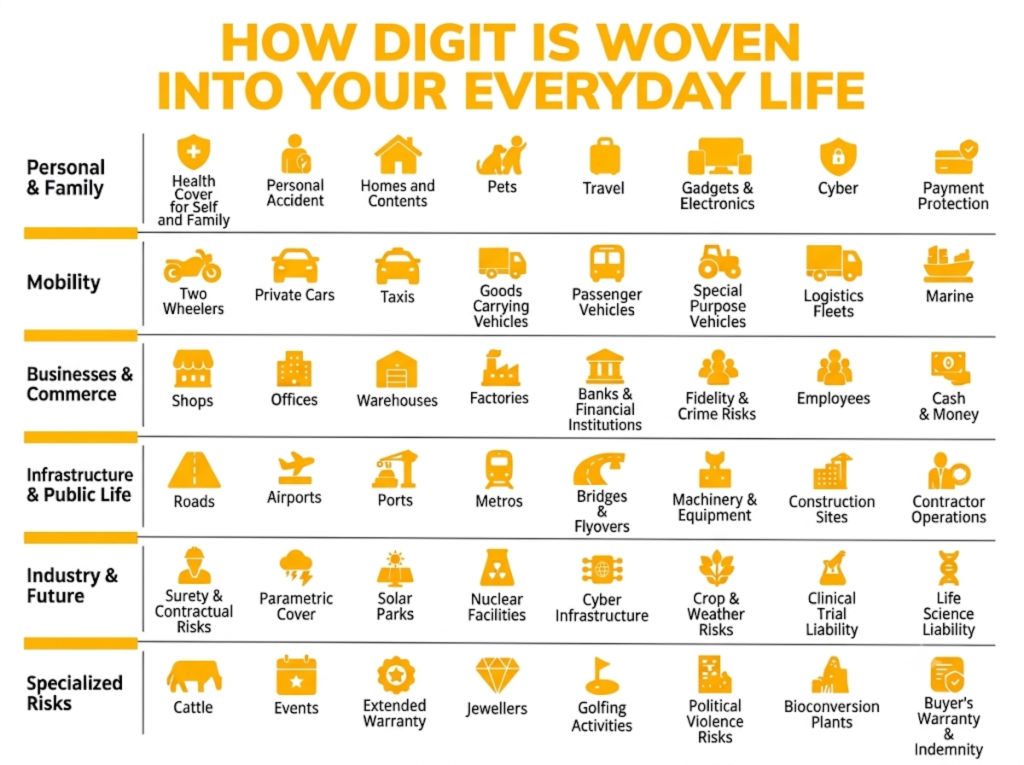
Digit now has 90 active insurance products across personal, commercial and specialised risks. These include protection for cattle, jewellery stock, cyber risks, clinical trials, industrial machinery, oil and gas drilling equipment, and construction projects.
The breadth is best understood through what those covers protect. For a household, it may be a home or a vehicle. For a business, it may be stock, equipment or liability. For a large project, it may be the infrastructure through which people travel, goods move or energy is generated.
A SHARE OF THE RISK BEHIND ESSENTIAL INFRASTRUCTURE
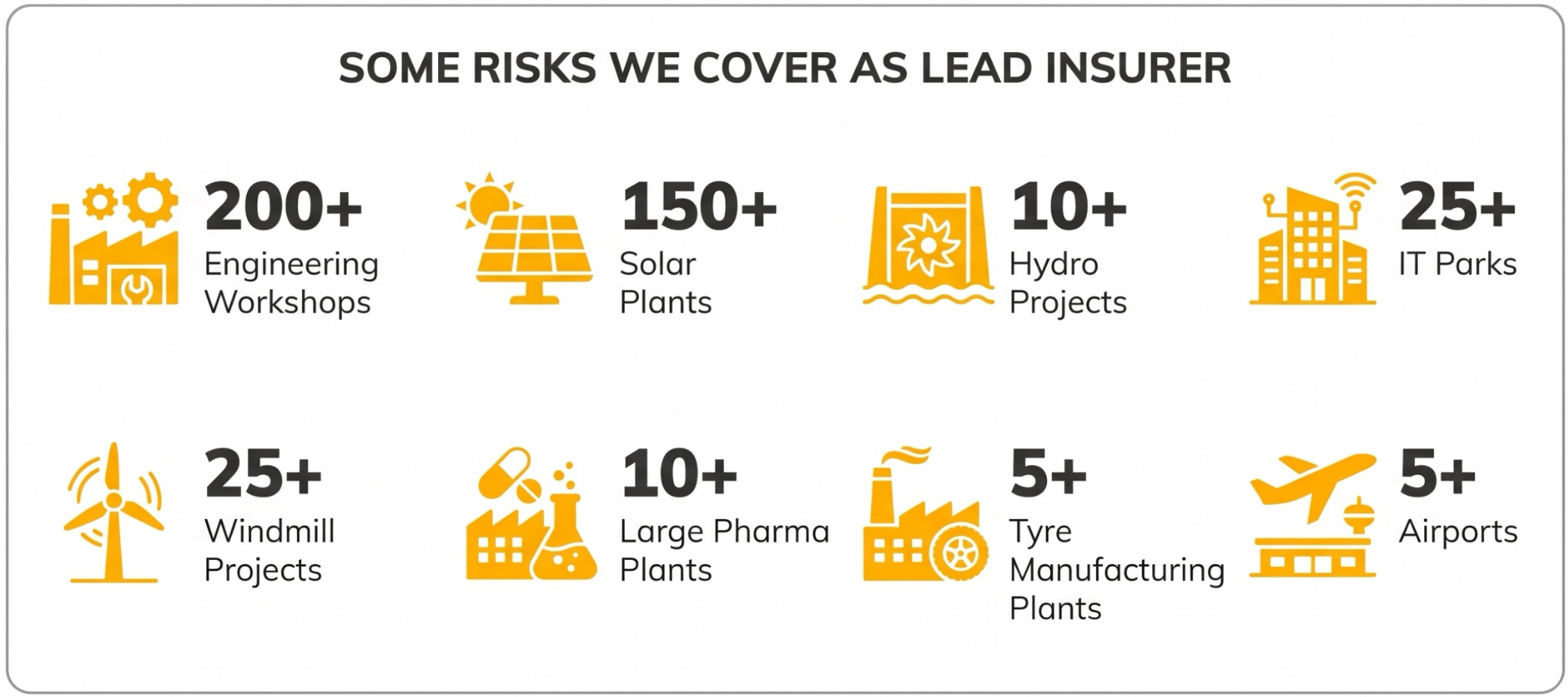
Note: The offerings referred to are active during H1 FY 2026-27 and are covered under various filed products, including Digit Standard Fire and Special Perils, Digit Industrial All Risk, and Digit My Business.
As lead insurer on some risks and participating insurer on others, Digit today covers 200+ engineering workshops, 150+ solar plants, 100+ road projects and 25+ IT parks, along with 10+ risks each across hydropower, wind energy, pharmaceuticals and logistics. Our portfolio also extends to tyre manufacturers, FMCG businesses and other large industrial operations.
Beyond this, we are also a participating insurer for various metro networks across India, major airports, one of the country’s largest floating solar projects, renewable-energy and hydro projects, semiconductor facilities, data centres, UAV drones, battery energy-storage plants and emerging EV-battery manufacturing projects. We also participate in the insurance of India’s first deep-water container transshipment port and specialised engineering and energy risks, including nuclear plants.
Each of these carry a different scale and complexity of risk. Our role also differs, depending on whether we lead the insurance arrangement or participate alongside other insurers.
COVERING RISKS BEYOND INDIA: As Indian businesses expand across countries, their need for protection travels with them. Digit covers assets located across international territories, including pharmaceutical plants, steel plants, hydropower projects and high-speed rail infrastructure, spanning both the construction phase and ongoing operations.
A CLOSER LOOK AT OUR CLAIMS PERFORMANCE
Context that matters: Insurer-level claims turnaround times are rarely available publicly. Customers therefore have little industry data to judge whether the time taken at different stages of a claim is good, poor or somewhere in between. That is why we believe these numbers should be shared.
We are sharing our claims processing timelines alongside our claims statistics and largest claims paid in H1 FY27. Where relevant, the timelines are compared with H1 FY26 and viewed against the turnaround times prescribed by the regulator. Together, these numbers offer a wider viewof how our claims systems performed.
I. WHEN HEALTH INSURANCE NEEDS TO MOVE WITH YOU

Health Claims Processing
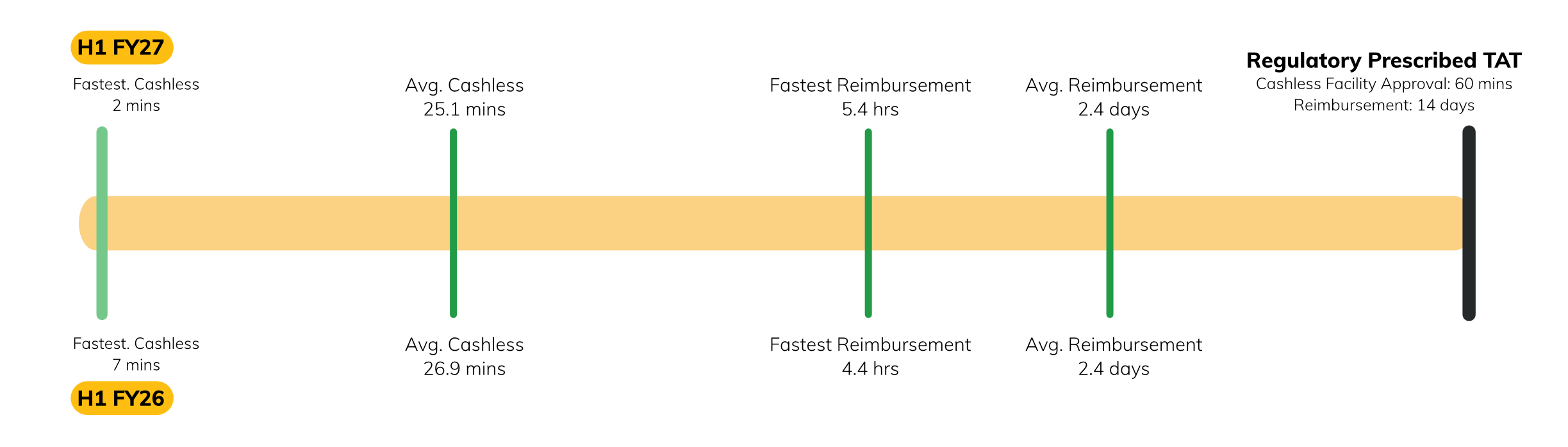
Notes: Ref from Master Circular on Protection of Policyholders’ Interests, Operations and Allied Matters of Insurers, 5th Sept 2024; Reimbursement Claims Settlement is the time taken to settle the claim after collating all the necessary claims-related documents; infographic not to scale.
Cashless facility approval averaged 25.1 minutes in H1 FY27, compared with 26.9 minutes in H1 FY26, and remained within the 60-minute regulatory timeline. Reimbursement claims were settled in an average of 2.4 days in both periods, against the 14-day regulatory timeline.
II. HOW CLAIMS TRANSLATED INTO SETTLEMENTS

Here is a look at Digit’s Claims Experience across LOBs
Form NL-37-CLAIMS DATA
As at 30 September 2026
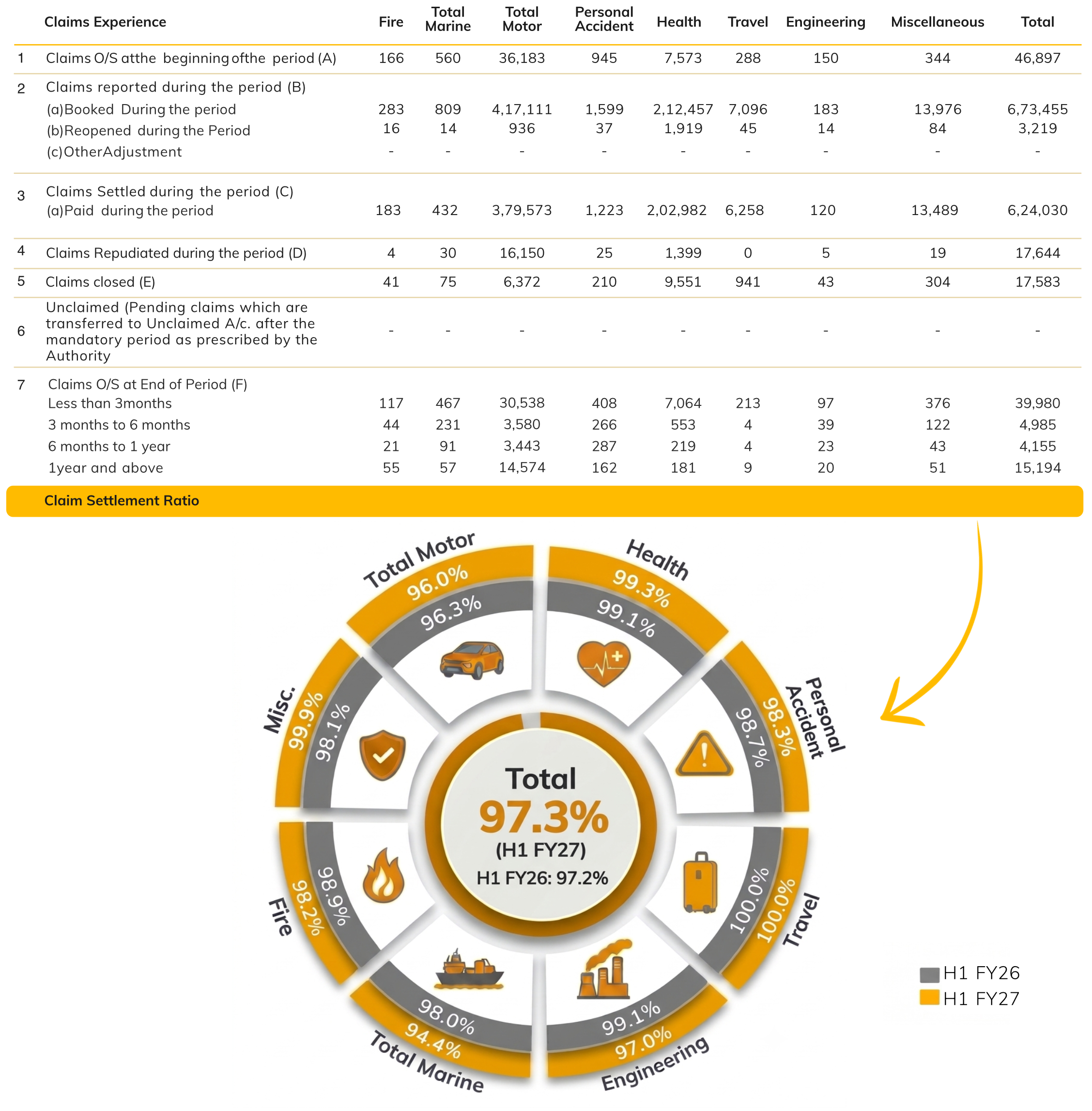
Notes: Claims Settlement Ratio = (Claims Paid + Claims Closed) /(Claims outstanding at beginning of the year + Claims Reported - Claims outstanding at the end of the year).The above information is an extract from Form NL-37 – Claims Data as at 30 September 2026 and does not constitute the complete Form NL-37 disclosure. Please refer to the complete Form NL-37 on Company website for detailed information.
HOW WE PAID THE BIGGEST CLAIMS

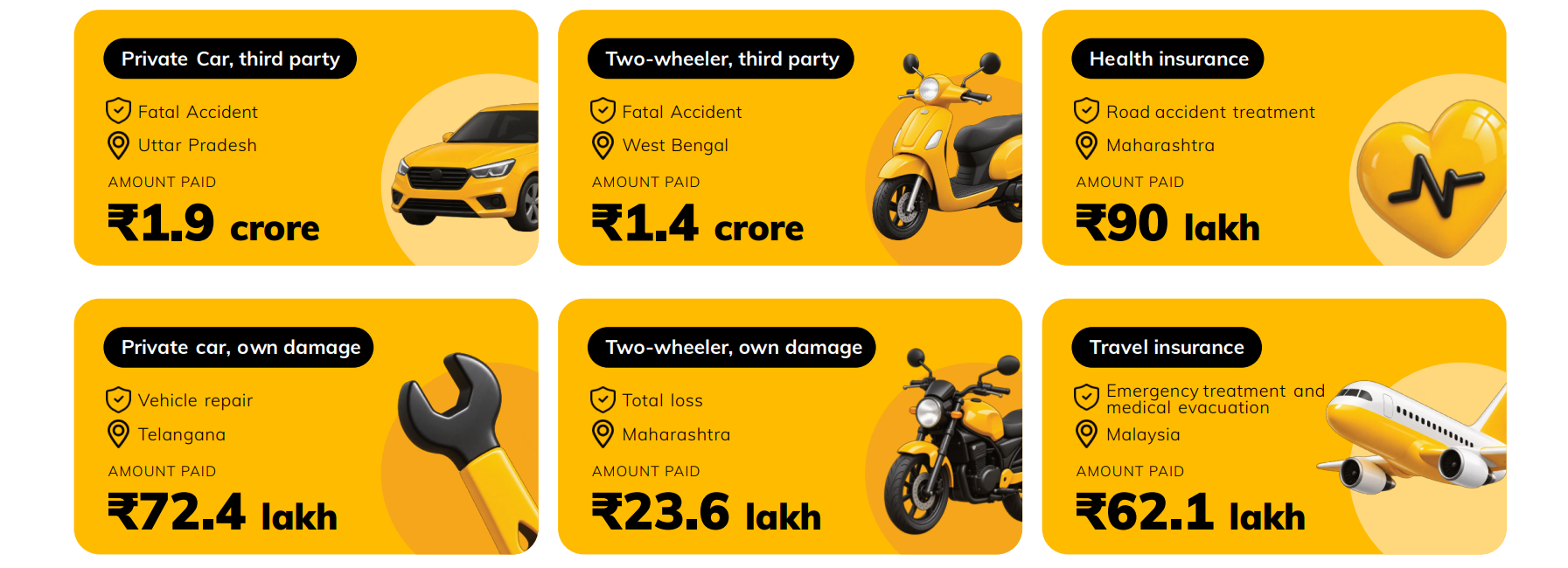
Biggest Claims Paid in H1 FY27
Across various lines of business
SERVICE TIMELINES WE BELIEVE CUSTOMERS SHOULD SEE
Let us begin with a caveat: Most of these service timelines are prescribed by the regulator, but insurer-level performance against them is not commonly available in the public domain. That leaves us without a benchmark to say whether our timelines are good, poor or somewhere in between. We are sharing them because customers should be able to see howlong these interactions take, compare our performance over time and hold us accountable when it moves in the wrong direction.
I. HOW LONG DID WE TAKE TO DECIDE ON YOUR PROPOSAL

Policy Proposal Processing Timelines
Prescribed Benchmark:
7 Days across all applicable requests*
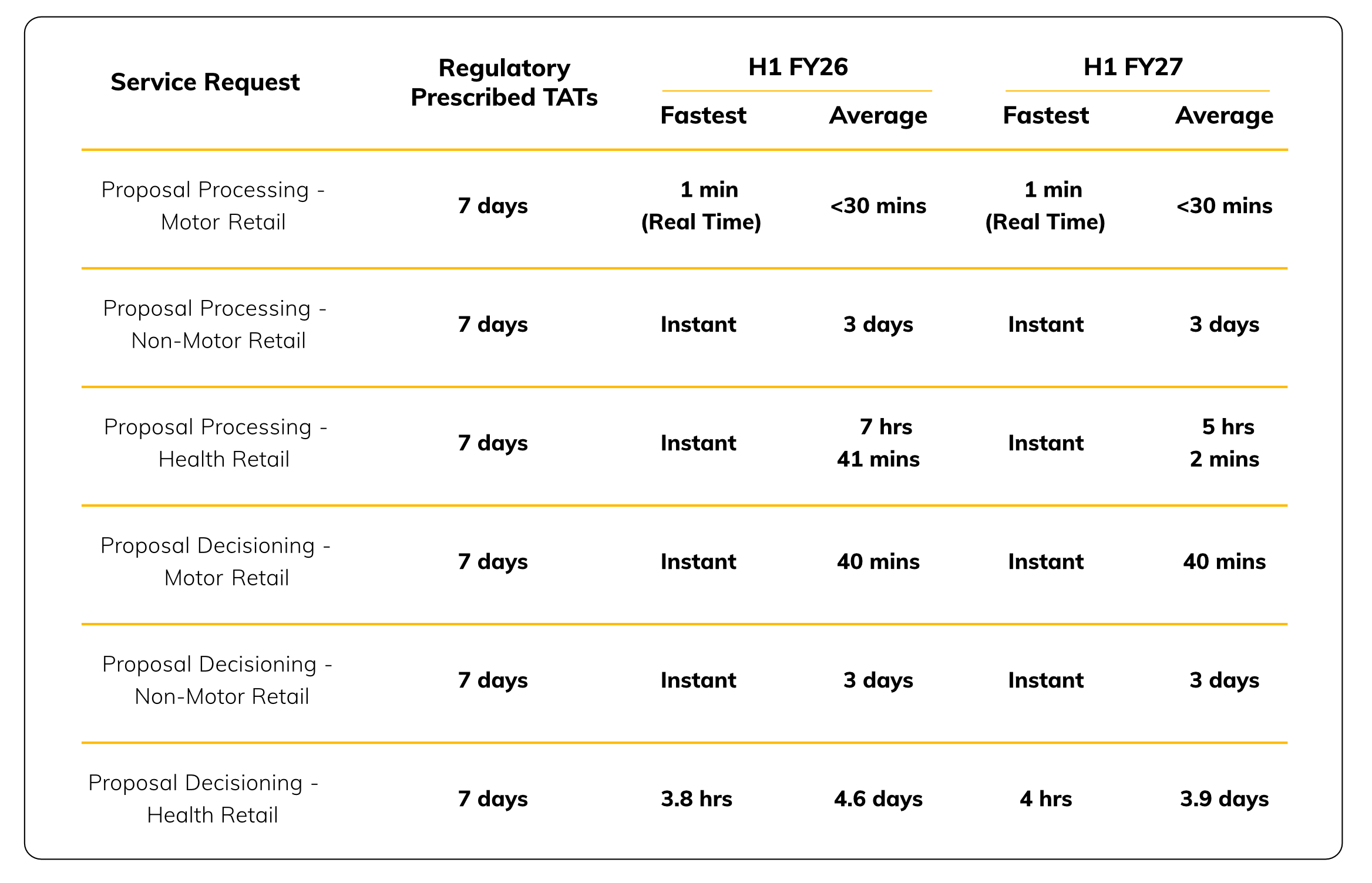
Note: TATs are based on timelines prescribed in the IRDAI (Protection of Policyholders’ Interests, Operations and Allied Matters of Insurers) Regulations, 2024 and related Master Circulars issued by IRDAI; *TAT of proposal decisioning is calculated from the date of receipt of proposal or from the date of receipt of additional requirement, whicheveris later.
II. HOW QUICKLY WE COMPLETED THE CHANGE YOU ASKED FOR

Post-Policy Service Operations
(Corrections & Updates)
Prescribed Benchmark:
7 Days across all applicable requests*
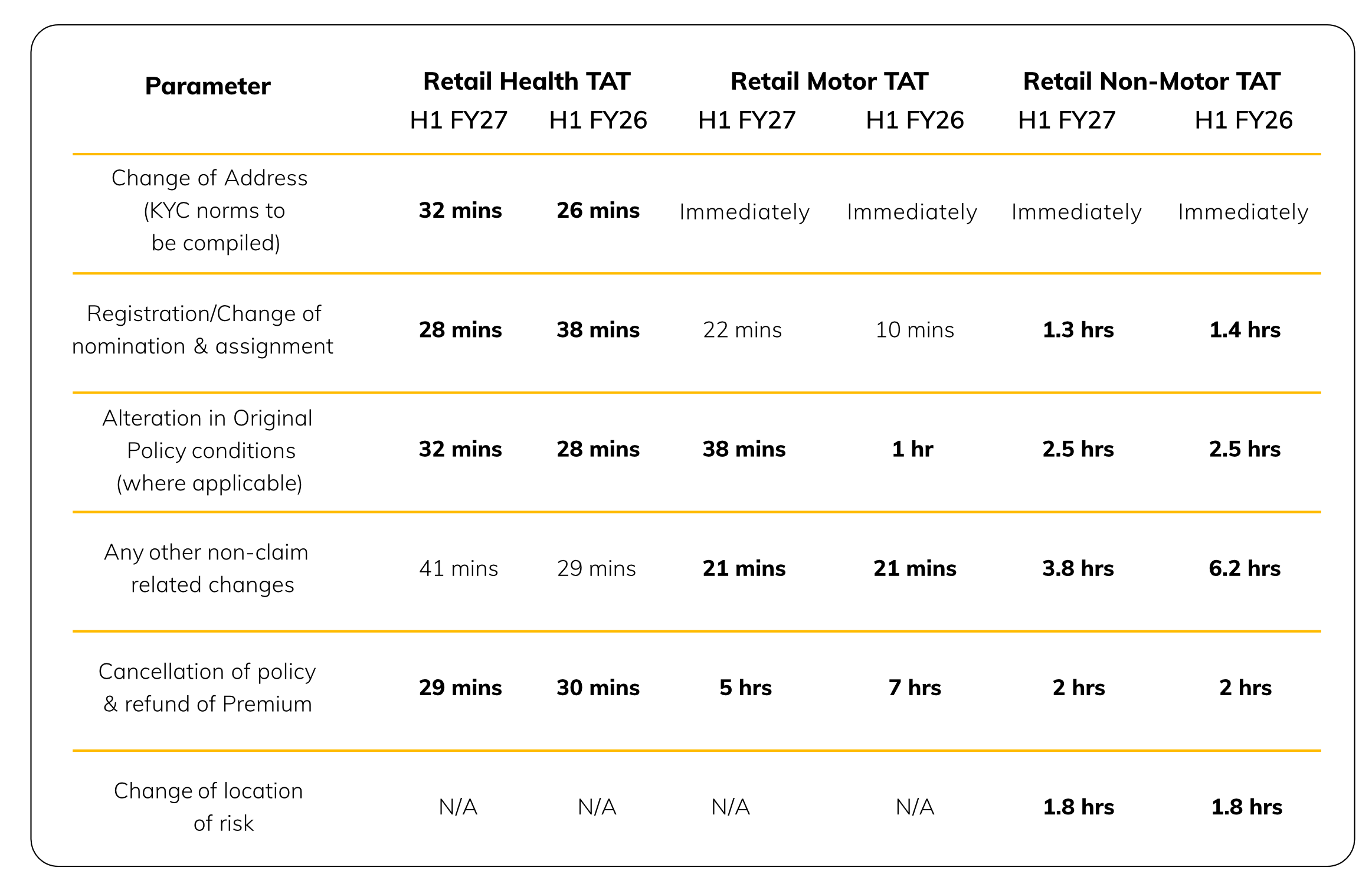
Note: TATs are measured in working hours and exclude motor ownership transfer cases. The data includes both Straight Through Processing (STP) and Non-Straight Through Processing (NSTP) cases. STP cases proceed directly from submission to a final outcome without intermediate processing steps, whereas NSTP cases may involve one or more additional steps, including document verification, approvals, customer clarification, pre-inspection, premium payment or KYC completion, as applicable.
III. SOLVING CUSTOMER CONCERNS: HOW QUICKLY WE RESPONDED

Grievance Handling & Customer Support
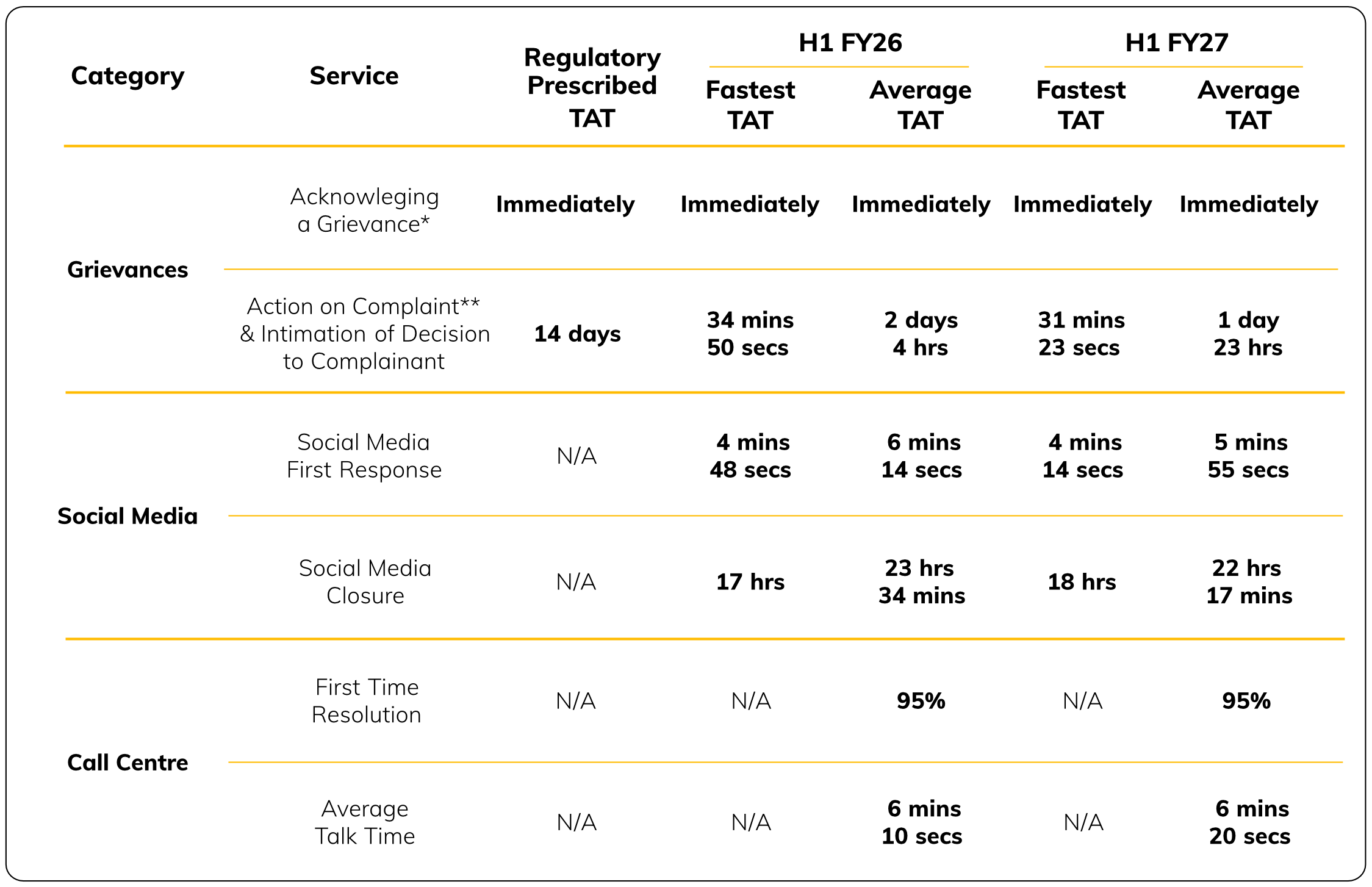
*A grievance is an expressionof dissatisfaction by a policyholder requiring redressal. It does not include general enquiries or routine policy service requests. **TAT for grievance actioning is calculated from the original date of receipt of complaint.
WHAT DIDN'T GO AS WELL &
WHAT WE ARE DOING ABOUT IT
1. WE TOOK LONGER TO APPROVE VEHICLE REPAIRS
Motor Vehicle Repair approval TAT
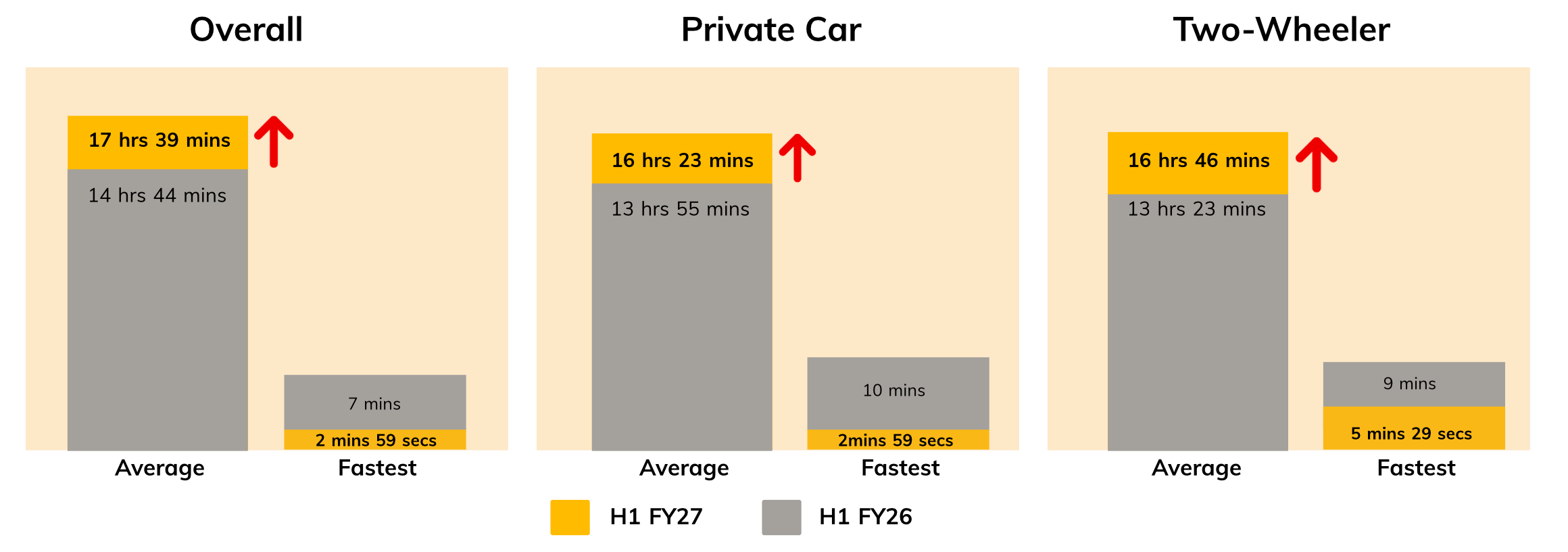
Note: Work Approval TAT refers to the time taken from the First Notice of Loss (FNOL) to issuance of the vehicle repair order. This includes claim intimation by the customer, assessment of claim admissibility, and communication of work approval to the garage for commencement of repairs.While surveys are largely conducted digitally, actual approval timelines may vary based on claim‐specific circumstances.
Vehicle repair approvals typically take 1-2 days. At Digit, we have always aimed at giving same-day approvals. In H1 FY26, our average vehicle approval TAT was 14 hours 44 minutes. In H1 FY27, this increased to 17 hours 39 minutes. Without the Gujarat flood claims, it was 16 hours 27 minutes. While the floods added overall TAT pressure, the remaining increase is ours to address.
- What affected the TAT: During the Gujarat floods, high claim volumes, inaccessible vehicles and garage congestion increased physical surveysand travel time. More broadly, a higher share of claims required physical surveys,while parts shortages and ongoing repairs added slight delays.
- What we are doing: We have introduced AI-enabled speech-to-text during vehicle inspection. For straightforward claims, this would help us complete assessments faster and issue work orders at the garage, helping reduce the overall wait time.
- What we need to deliver: Making straightforward claims approvals faster and ensuring similar turnarounds even when claim volumes rise cyclically due to nat-cat events.
2. OUR CASHLESS DISCHARGE APPROVAL TAT ROSE BY 11 MINUTES
Our average cashlessdischarge approval time increased from 52.5 minutes in H1 FY26 to 63.6 minutes in H1 FY27, largely due to higher volumes. This remains well ahead of the regulatory-prescribed three hours, but our aim is to keep the average below one hour, even as volumes rise.
- What affected the TAT: Higher volumes increased the average approval time by 11.1 minutes.
- What we need to deliver: Bring the average back below one hour and sustain it as volumes grow.
3. MOTOR TAT FOR REGISTRATION CHANGES ROSE BY 12 MINUTES
For retail motor policies, the average TAT for registration and nomination changes increased from 10 minutes in H1 FY26 to 22 minutes in H1 FY27. This remains well ahead of the regulatory-prescribed seven days.
- What affected the TAT: A change in hypothecation requires verifying documents like NOC from the previous lender, etc and those cases slightly pushed our processing timelines higher.
- What we need to deliver: Complete these checks without adding unnecessarywait time for customers.
4. RETAIL HEALTH TAT FOR NON-CLAIM RELATED CHANGES ROSE BY 12 MINUTES
For retail health policies, the average TAT increased from 29 minutes to 41 minutes in H1 FY27, although it remains well ahead of the regulatory-prescribed seven days.
- What affected the TAT: A small number of requests took significantly longer, pushing up the average.
- What we are doing: Building a human-assisted OCR flow combining AI-led document reading with human validation.
- What we need to deliver: Bring down outlier processing times and the overall average.
FINANCIALS: H1 FY27 vs H1 FY26
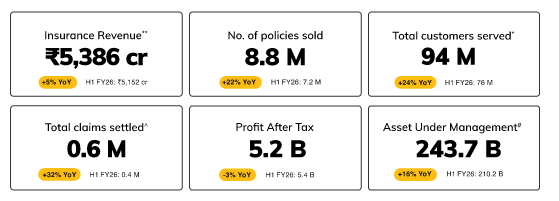
Data for the period H1 FY2026 and H1 FY2027; *Cumulative count of all customers/lives onboarded and includes without limitation persons who availed / to whom insurance coverage was extended under various insurance policies since inception. ^Claims settled since inception; #Assets Under Management includes all investments at book value plus cash and bank balance as at September 30, 2026 and as at September 30, 2025; **Insurance Revenue – Gross Earned Revenue.
BUILDING FOR WHAT LIES AHEAD
The circumstances around an insurer will keep changing. Risks will evolve, expectations will rise and some events will arrive with little warning. We cannot control all things. But what we can do is try to control the quality of the decisions we make in response to various things that come our way.
For us, that means underwriting with discipline, maintaining financial strength and deploying capital thoughtfully. It means continuing to invest in people, technology and service, while remaining clear about what is working and willing to change what is not.
Some decisions show their value immediately. Others quietly strengthen the business over time, becoming most important when circumstances turn difficult and the systems behind an insurer are truly tested.
As we move towards our tenth year, our focus remains on what is within our hands: learning from experience, making considered choices and buildinga Company that can meet its commitments today while remaining prepared for what lies ahead.
It’s almost time to wrap up the report. Let’s look at the Awards we won in the last 6 months.
RECOGNITION ALONG THE WAY
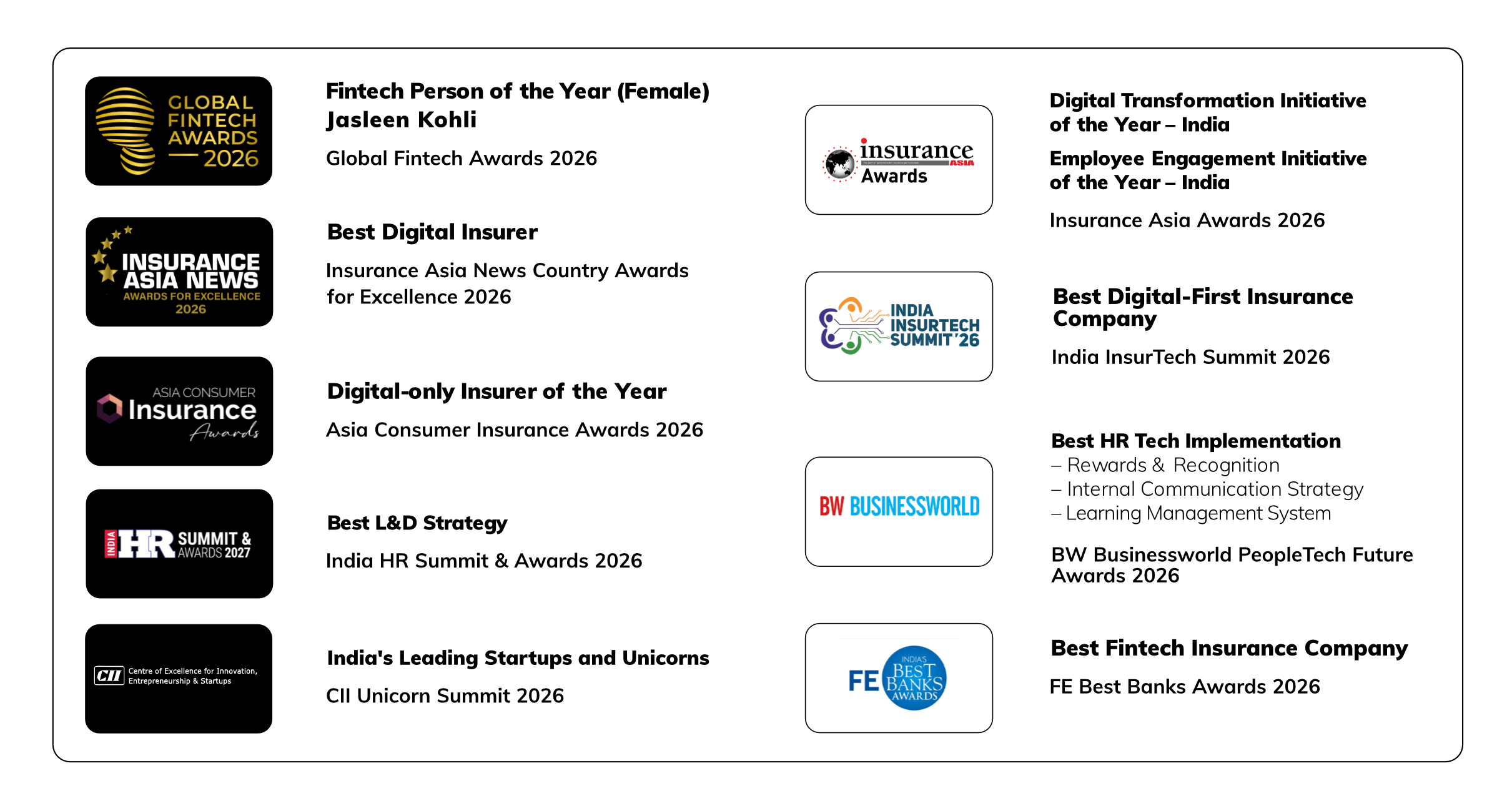
During H1 FY27, Digit received 12 awards across insurance, fintech, customer experience, technology and people-related categories. These included recognition for Jasleen Kohli at the Global Fintech Awards and the Best Fintech Insurance Award at the FE Best Banks Awards 2026.
That's it in this edition. Have a question, suggestion or something you would like us to explain in the next edition? Write to mediarelations@godigit.com.
Our next Transparency Report will follow in May 2027.
Note: Count of Network Garages, Network Hospitals, Employees, Active products, as of 30 September 2026. Count of all partners as on 30.09.2026 including POSPs, Individual Agents, Insurance Intermediaries and Motor Insurance Service Providers. Pincode List in India (Source: India Post)
