
General
Life
Accessibility Options


General

General Products
Simple & Transparent! Policies that match all your insurance needs.
 Car Insurance
 Two Wheeler Insurance
 Commercial Vehicle Insurance
 Health Insurance
 Home Insurance
 Travel Insurance
 Business Insurance
Car Insurance
Two Wheeler Insurance
Commercial Vehicle Insurance
Health Insurance
Travel Insurance
Business Insurance
Car Insurance
Two Wheeler Insurance
Commercial Vehicle Insurance
Health Insurance
Travel Insurance


Scan to download

Life

Life Products
Digit Life is here! To help you save & secure your loved ones' future in the most simplified way.
 Term Life
 Savings Plan
 Retirement and Pension Plans
 Group Life Products
 Product Documents
Term Life
Savings Plan
Retirement and Pension Plans
Group Life Products
Product Documents
Term Life
Savings Plan
Retirement and Pension Plans
Group Life Products
Scan to download

Claims

Claims
We'll be there! Whenever and however you'll need us.
 Customer Support
 Motor Claims
Health Claims
Motor Claims
Health Claims
 Marine Insurance
 Grievance Redressal
Customer Support
Motor Claims
Health Claims
Marine Insurance
Grievance Redressal
Grievance Redressal
Customer Support
Motor Claims
Health Claims
Marine Insurance
Grievance Redressal
Scan to download
 General
 Life
General
Life
Life
General
Life
Renewals
Resources

Resources
All the more reasons to feel the Digit simplicity in your life!
Exclusive Features
 Transparency Report
Others
Exclusive Features
Transparency Report
Transparency Report
Others
Exclusive Features
Transparency Report
Scan to download


Our WhatsApp number cannot be used for calls. This is a chat only number.

 Grey Scale
 Readable Text
 Reset
Reset



Bike Insurance Online, Up to 80% Off

10000+
Cashless Garages

1600 Crore+
Paid-in Claims

7 Crore+
Policies Sold
I agree to the Terms & Conditions

Buy Online for Huge Savings

Check Price

Bike insurance Online, starting ₹752
10000+
Cashless Garages
1600 Crore+
Paid-in Claims
7 Crore+
Policies Sold

No Claim Bonus (NCB) is one of the most valuable benefits to your bike insurance policy. It directly reduces your premium for every claim-free year while also influencing how you make claim decisions.

Premium Savings
You get 20–50% discount over consecutive claim-free years, lowering renewal costs significantly.

Smarter claim decisions
NCB makes you avoid small claims, sometimes paying a minor repair yourself is better than losing your discount.

Promotes careful riding
Fewer claims usually reflect safer riding and better upkeep, which helps you retain higher NCB.

Linked to you, not the bike
You can transfer your NCB to a new bike, so your claim-free history continues to benefit you.

NCB is calculated by applying your earned discount percentage to the own-damage (OD) premium, which directly reduces your final payable premium.
Here, NCB is applied only on OD premium (₹5,000), not on third-party.
Discount = ₹5,000 × 25% = ₹1,250
You pay ₹3,750 (OD) + ₹2,000 (TP)
NCB doesn’t change the base premium; it reduces your payable amount, making it the biggest lever for lowering renewal costs.
This is a key decision many riders struggle with, a quick cost-benefit check usually helps make the right call.

Yes, you can transfer your NCB when buying a new bike, because it belongs to you (the policyholder), not the vehicle.
How does it work?
When you sell your old bike, your insurer issues an NCB certificate. You can use this while insuring your new bike either with the same insurer or a new one to get the same discount on the new policy.
What to keep in mind?
Transfer typically needs to be done within 90 days
You must not retain the old policy active while using the NCB
Applies only to the own-damage premium
Your claim-free history moves with you, so upgrading your bike doesn’t mean losing your premium savings.
1. Break in Policy Renewal
NCB is valid only if the policy is renewed within 90 days of expiry. If there’s a gap beyond this period, the accumulated NCB becomes invalid, and insurers will reject the transfer request.
2. NCB Claimed Incorrectly
If the previous insurer records show that a claim was made during the policy period, but NCB was still declared at renewal, the new insurer will deny the transfer after verification.
3. Wrong Ownership Details or Mismatch
NCB belongs to the policyholder, not the bike. If the name on the new policy does not match the previous one, the NCB cannot be transferred.
4. Failure to Submit Valid NCB Proof
Insurers usually require an NCB certificate or previous policy document as proof. If the documents are missing, incomplete, or not verified, the transfer request may be rejected.
5. Policy Not Transferred During Bike Sale/Purchase
When a bike is sold, the insurance policy must be transferred to the new owner. If this isn’t done and the buyer tries to claim NCB from that policy, it will be denied.
You have to provide the following documents along with the application:

Delivery Note of Sale of Old Bike

Old Bike Insurance Policy
Booking Form of Purchasing Bike
Transfer Application

Buyer-Seller Agreement
Old RC Transfering

NCB Certificate from Insurer
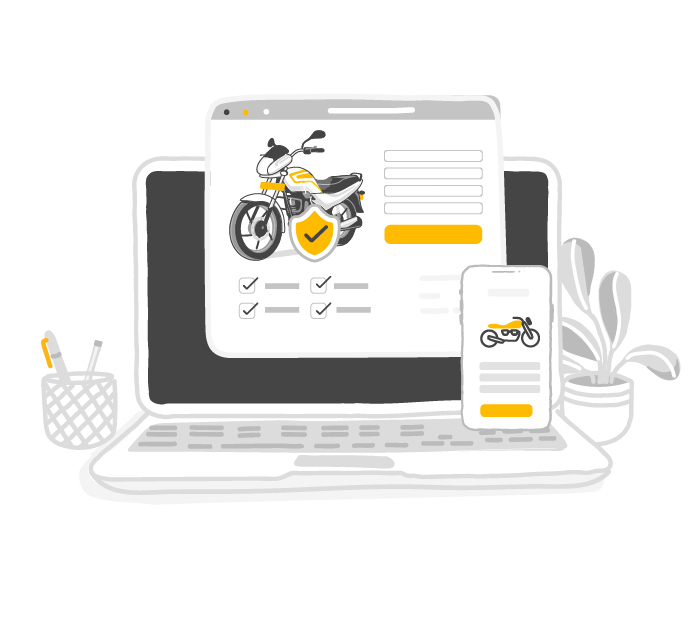
To get a No Claim Bonus (NCB) certificate, the policyholder needs to contact the insurance provider and request it. You will be required to share your policy number along with basic personal and vehicle details.. Once the insurer verifies your claim-free history for the policy period, they will issue the NCB certificate.
An NCB certificate is not typically issued at the time of buying a policy. It is generated when required especially during renewal or when switching insurers.
Your No Claim Bonus (NCB) is reset to zero as soon as you make a claim during the policy period regardless of how many claim-free years you’ve accumulated or which year of the policy you’re in.
What many riders miss:
If you’ve opted for an NCB Protection add-on cover, you can make a limited number of claims without losing your accumulated NCB. This means your discount remains intact despite a claim, subject to the terms of the add-on.

Yes, but only if your policy includes an NCB Protection add-on. Typically, any claim you make during the policy year resets your No Claim Bonus to zero. However, if you opt for an NCB Protect add-on, you can raise a limited number of claims usually one without losing your accumulated NCB discount.
That said, this benefit is not unconditional. Insurers usually set specific terms, such as:
A cap on the number of claims allowed in a year
Eligibility criteria (for example, a minimum number of prior claim-free years)
Applicability only under comprehensive policies
What many customers overlook:
NCB Protection doesn’t mean “unlimited claim safety.” It’s a controlled buffer, use it wisely for high-value claims. For minor damages, paying out of pocket can still make more sense to preserve both your NCB and future eligibility for the add-on.
The NCB Protection add-on comes at an additional cost over your base bike insurance premium; it cannot be purchased as a standalone cover. You can only opt for it with a comprehensive or standalone own-damage policy. In most cases, the cost of this add-on typically ranges from around 5% to 10% of your base premium, though this can vary depending on the insurer, your bike profile, and your claims history.
While the extra premium may seem small, it protects a much larger benefit, your accumulated NCB, which can go up to 50% discount on premium over time. That’s why, for many riders, the cost of this add-on is justified, especially once they’ve built a higher NCB.

Following are the cases where NCB add-on will not be applicable in two-wheeler insurance:
When the number of claims has exceeded the allowed number under the NCB Protection add-on.
When fraudulent damage-related claims are raised or if there is any discrepancy in the facts regarding a claim.
NCB will be cancelled if the bike insurance policy is expired or not renewed within 90 days of the expiry or stipulated date.
If you try to include or remove the NCB Protection cover mid-term.
Another condition for NCB is that your two-wheeler must be repaired in the insurance company’s network garage.
You should consider it if:
You have built a high NCB (35%–50%)
You ride frequently
Repair costs for your bike are high
You may skip it if:
Your NCB is low (0–20%)
You rarely use your bike
You can afford small repairs yourself
In short: It helps protect a high NCB from being reset.
Below are the mistakes that one should avoid related to NCB in bike insurance:
Raising claims for small repairs
Assuming NCB applies to total premium
Missing renewal deadlines
Not collecting NCB certificate
Thinking NCB belongs to the bike
Ignoring add-on terms
The following are some important things to know about No Claim Bonus in bike insurance in India:
So, the next time you are in the mood for some bike racing, remember there is a No Claim Bonus waiting for you on the other side of self-control. Also worth remembering is the fact that this reward is transferable to new vehicles and new insurers.
Pro Tip: Keep Your NCB. Let go of small change. In other words, in the long run we have seen that making a claim for small damages to the vehicle, that is totally affordable, will make you lose on a substantial chunk of discount on your premium, because the NCB, on even making a single claim will switch back to zero, which looking at the larger picture, will be a bigger financial loss. So, it is best to keep your NCB alive and settle minor damages without raising a claim.



Content Writer
Storyteller at heart, Manasvi brings 4 years of content and marketing experience to Digit. Whether it's writing SEO-optimised articles or a researched and insightful blog, she strives to transform ideas into creating impactful and engaging content.


Product Head - Motor
Mayur specializes in motor insurance and is responsible for overseeing the development and management of motor insurance products. With expertise in product strategy and market analysis, he focuses on developing customer-centric insurance solutions.





