General
Life
Accessibility Options


General

General Products
Simple & Transparent! Policies that match all your insurance needs.
 Car Insurance
 Two Wheeler Insurance
 Commercial Vehicle Insurance
 Health Insurance
 Home Insurance
 Travel Insurance
 Business Insurance
Car Insurance
Two Wheeler Insurance
Commercial Vehicle Insurance
Health Insurance
Travel Insurance
Business Insurance
Car Insurance
Two Wheeler Insurance
Commercial Vehicle Insurance
Health Insurance
Travel Insurance



Scan to download

Life

Life Products
Digit Life is here! To help you save & secure your loved ones' future in the most simplified way.
 Term Life
 Savings Plan
 Retirement and Pension Plans
 Group Life Products
 Product Documents
Term Life
Savings Plan
Retirement and Pension Plans
Group Life Products
Product Documents
Term Life
Savings Plan
Retirement and Pension Plans
Group Life Products

Scan to download

Claims

Claims
We'll be there! Whenever and however you'll need us.
 Customer Support
 Motor Claims
Health Claims
Motor Claims
Health Claims
 Marine Insurance
 Grievance Redressal
Customer Support
Motor Claims
Health Claims
Marine Insurance
Grievance Redressal
Grievance Redressal
Customer Support
Motor Claims
Health Claims
Marine Insurance
Grievance Redressal
Scan to download
 General
 Life
General
Life
Life
General
Life
Renewals
Resources

Resources
All the more reasons to feel the Digit simplicity in your life!
Exclusive Features
 Transparency Report
Others
Exclusive Features
Transparency Report
Transparency Report
Others
Exclusive Features
Transparency Report

Scan to download


Our WhatsApp number cannot be used for calls. This is a chat only number.

 Grey Scale
 Readable Text
 Reset
Reset




10000+ Cashless Garages
1.5 Cr+ Policies Sold


Check Price

Car insurance Online, Up to 90% Discount
It's a Brand New Car
A gear is a rotating circular machine component with cut teeth or cogs. It meshes with another toothed part to transmit or convert torque and speed. Sometimes, two or more gears mesh with each other to transmit speed and torque from one shaft to another. This combination is a gear train or an assembly having toothed wheels.
Navigate through this article to learn what is a gear train, its types and its applications.
Gear trains are a collection or assembly of gear wheels that transmit or convert motion easily from one shaft to another. Ordinary gear trains have a compound and simple gear trains. In addition, there are epidemic gear trains that provide relative motion between gear axes.
A gear train might consist of any or all components, such as a spiral, spur, bevel, etc. In an ordinary gear, the axes of none of these gears move relative to the frame.
Some gear train examples include ‘differential’ used in automobiles, engines, clocks, gearboxes, lathes, etc.
Almost every component that functions with mechanical power has a gear train. Below are situations when a gear train is essential:
Manufacturers who want to calculate a particular velocity ratio require a gear train.
A gear train is necessary to significantly reduce mechanical advantage or velocity.
The distance between the two shafts is not long or short enough for a single big gear. It is when gear trains are necessary.
Depending on the wheel arrangement, you will find several types of gear trains available in the market. Learning about the gear train types helps design these components. So, the types of gear trains are as follows:
One of the simplest designs of gear trains, this component transmits motion from one shaft to another when the distance between the two is minimal. A simple train will have one gear on every shaft. Often, the distance between two gears is large. In such a situation, the motion from one gear to another might be transmitted by any of the following two methods:
By allowing a large-sized component, or
By providing one or more intermediate elements.
Components of a Simple Gear Train
Below are the components of a simple assembly:
Driven Gear: It is an output gear in this assembly. It sits on an output shaft to transmit power. Manufacturers always keep this at the end of the gear arrangement.
Driving Gear: It is a component that receives the motion or power in this arrangement. This power transmits to the input gear from the input shaft on which this gear sits.
Idler Gear: These components are intermediate gears. Idler gears function in the process of connecting gears located at larger distances. Additionally, they can change the spinning of an output shaft. Depending on the shaft length, there might be more than one gear.
Characteristics
The characteristics of simple gear trains are as follows:
In this design, gear axes stay locked or fixed in position with the frame.
Each gear sits on its shaft, which is a distinct feature of this type of train.
Gears appear in the form of a series.
Pitch circles help to depict the gears.
Advantages
The following are the advantages of this assembly:
It is easy to transmit power to a greater or minimum central distance.
Idlers can direct rotation in any desired direction in this assembly.
A simple gear train transmits large amounts of power without causing any default.
Applications
The applications of the simple gear train are as follows:
Automobile gearboxes
Heavy-duty presses
Lathe machines
Simple gear trains are applicable in ‘all-wheel-drive off-road vehicles’. It allows a differential when switching between front-wheel and rear-wheel drive.
A compound gear train is an arrangement that uses multiple components on a single shaft which are compound gears. It allows them to achieve a higher gear ratio. The main purpose of this gear train type is to transfer power over short distances. Therefore, this assembly has idler gears that reduce the distance between the driving and driven gears.
Components of a Compound Gear
The following are the components used in the arrangement of the compound gear train:
Idler Gears: You will find idler gears in a compound train assembled to get a specific rotational direction at the output shaft. Moreover, it helps to transmit power to a certain centre distance between the input and output shafts.
Output Gear: An output gear is where the power transmits when this component sits on an output shaft.
Input Gear: An input gear is a primary gear that gets power from an input shaft.
Compound Gear: Compound gear indicates using one or more components on the same shaft and allowing them to spin in a similar direction.
Characteristics
Below are the characteristics of a compound gear arrangement:
More than two gears can sit on a single shaft.
Like the simple arrangement, gear axes stay fixed in position with the assembly.
Each gear sits on its shaft.
Gears are in the form of a series in this assembly.
Advantages
Below are the advantages of such an arrangement:
You can obtain higher gear ratios in this assembly easily.
This arrangement uses smaller gears, making this component more compact.
This arrangement can reduce a higher speed with a shorter distance between the input and output shafts.
You will receive higher transmission efficiency due to the absence of slip.
Applications
Following are the applications of such an arrangement:
Watches and Clocks
Milling, Lathe, and Drilling machine gearbox
Valve timing mechanism
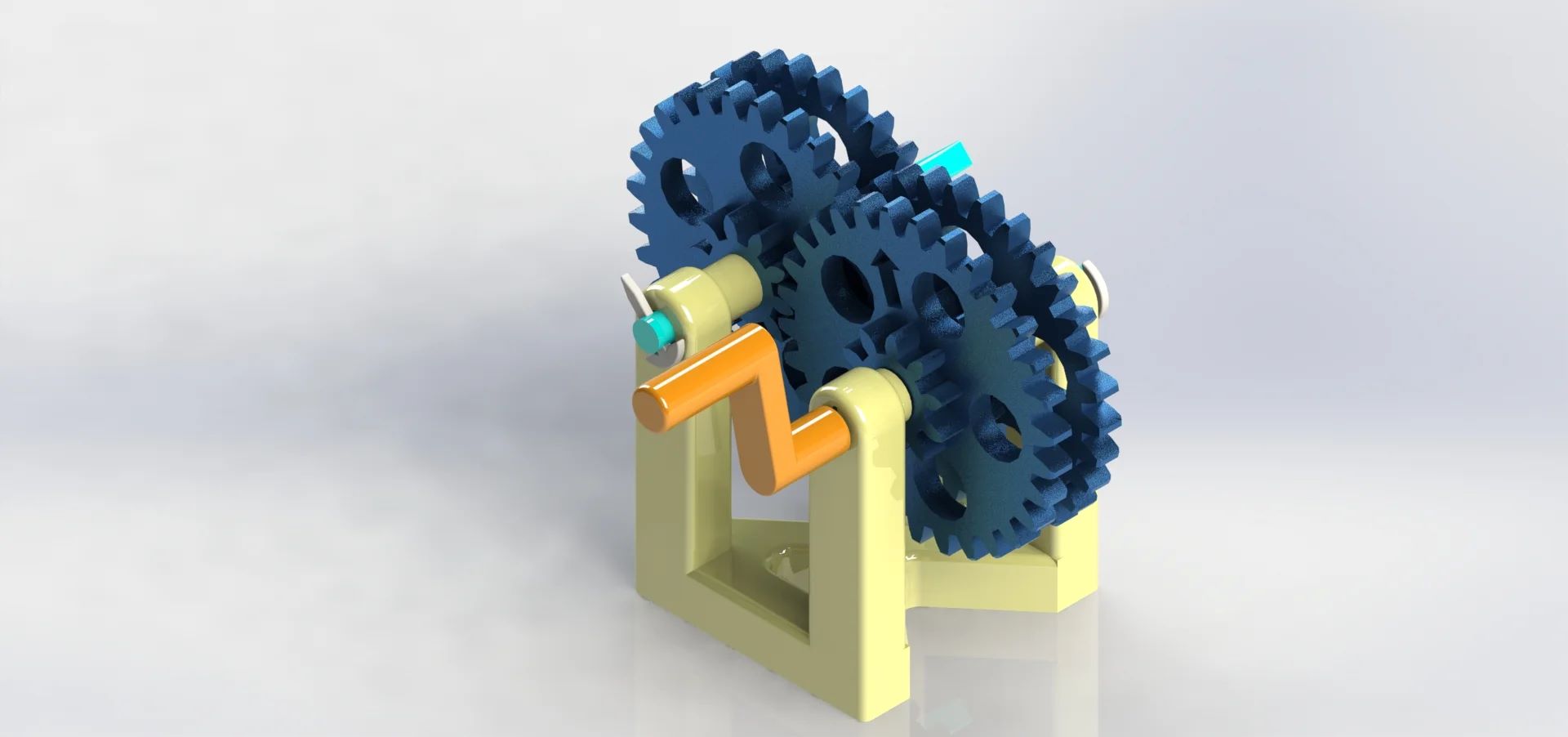
A reverted gear train is an arrangement where the first and last gear axes are co-axial. In this design, gear one appears as driving gear two in the other direction. Since gears two and three connect to the same shaft, they become compound gears. It means that gear three rotates in the same direction as gear two.
Components of a Reverted Gear Train
A reverted gear train consists of four double spur gears. Each has a gear ratio of 3:1.
Characteristics
The characteristics of a reverted gear assembly are similar to a compound one. However, there is an exception.
The axis of shafts on which the first and last gear sits coincides properly.
They help in changing the speed or power output. However, the space for accommodating several gears is limited.
When two gears sit on the same shaft, one of these components must be loosely placed.
The distance between the centres of these two gears in each pair must be similar.
The gear transmission ratio is evaluated similarly to a compound gear train.
Advantages
The following are the advantages of this arrangement:
Gear trains are capable of fitting between co-axial shafts.
A reverted gear train can receive a higher gear ratio within less space.
Applications
Below are the applications of the reverted gear train:
Lathe mechanism
Vertical drill machine
Automobile transmission
Car transmissions
Clocks
Industrial Gearbox
An epicyclic or planetary gear train is a gear system that consists of one or more planet components spinning around a central sun gear. Due to its high torque capacity and compact design, manufacturers use this gear type in heavy industrial machinery and automotive transmissions.
Components of an Epicyclic Gear Train
The following are the four components of this gear type:
Sun Gear: A sun gear is a middle component consisting of a fixed axis of rotation. These planet pinions spin around the sun gear mesh with a lather. A shaft of this component serves as a power transmission input from the engine.
Ring Gear: Ring gear is the outermost component that shapes like a ring. Its inner section includes teeth cut at an angle. It helps them to mesh with the outer teeth of planet gears. Ring gears will provide faster speeds than other components when it is in speed.
Planet Gear: Planet gears spin around their axes, and sun gear engages between the sun and ring gear. Pinion gears sit on planet gear. So, to transfer the necessary torque, these components engage continuously with the ring and sun gear.
Planet Carrier: Axles are connected to the planet carrier that spins around the sun's gear axis when planet gears start spinning around it. A planet carrier allows for regulating the gear ratio of an epicyclic gear component.
Characteristics
Below are the features of an epicyclic gear train:
The axis of one of the participating gear's shafts spins with other components.
This gear has two gears that sit appropriately so that one gear's centre rotates around the other's centre.
A carrier engages the centres of two gears and spins the planet and sun gear components so that pitch circles roll without slippage.
Advantages
Planetary or epicyclic gear trains provide multiple benefits discussed below:
You will find a higher reduction ratio in a smaller space.
It helps to transfer higher torque.
The efficiency of its transmission is much higher.
The input and output shafts of these components are always co-axial.
These gear trains provide less vibrations in comparison to other gear trains.
Applications
Below are the applications of these gear trains:
Automatic gear transmission system of electric vehicles, cars, and mopeds
Lathe machines and wristwatches
Robotic systems in grippers, robotic arms, and other mechanisms
Mixers, conveyors and cranes
Marine propulsion and mechanism and aircraft engines
Pulley blocks and hoists
Gear trains allow a larger centre distance between the driving and driven shafts and ensure control of the spinning direction-driven gear. It also facilitates an enhanced transmission ratio with components of smaller sizes in a lesser space.
Besides, a gear train can be examined using the virtual work principle to show that its torque ratio is equivalent to the speed or gear ratio of the gear train.
Explore Insurance Coverage for Your Vehicle