General
Life
Accessibility Options


General

General Products
Simple & Transparent! Policies that match all your insurance needs.
 Car Insurance
 Two Wheeler Insurance
 Commercial Vehicle Insurance
 Health Insurance
 Home Insurance
 Travel Insurance
 Business Insurance
Car Insurance
Two Wheeler Insurance
Commercial Vehicle Insurance
Health Insurance
Travel Insurance
Business Insurance
Car Insurance
Two Wheeler Insurance
Commercial Vehicle Insurance
Health Insurance
Travel Insurance


Scan to download

Life

Life Products
Digit Life is here! To help you save & secure your loved ones' future in the most simplified way.
 Term Life
 Savings Plan
 Retirement and Pension Plans
 Group Life Products
 Product Documents
Term Life
Savings Plan
Group Life Products
Product Documents
Term Life
Savings Plan
Group Life Products

Scan to download

Claims

Claims
We'll be there! Whenever and however you'll need us.
 Customer Support
 Motor Claims
Health Claims
Motor Claims
Health Claims
 Marine Insurance
 Grievance Redressal
Customer Support
Motor Claims
Health Claims
Marine Insurance
Grievance Redressal
Grievance Redressal
Customer Support
Motor Claims
Health Claims
Marine Insurance
Grievance Redressal
Scan to download
 General
 Life
General
Life
Life
General
Life
Renewals
Resources

Resources
All the more reasons to feel the Digit simplicity in your life!
Exclusive Features
 Transparency Report
Others
Exclusive Features
Transparency Report
Transparency Report
Others
Exclusive Features
Transparency Report
Scan to download


Our WhatsApp number cannot be used for calls. This is a chat only number.

 Grey Scale
 Readable Text
 Reset
Reset



Tyres constitute an integral part of vehicles. They are not just the black rubber materials the car stands on but are essential as they determine the safety, handling, and overall performance.
Safety and performance on the road require that the tyres undergo routine check-ups and should be replaced before they reach their safety limit.
Through this article, we have compiled the important things to know about summer and winter tyres, which will help you make the correct choice for your wheels!

Table of Contents

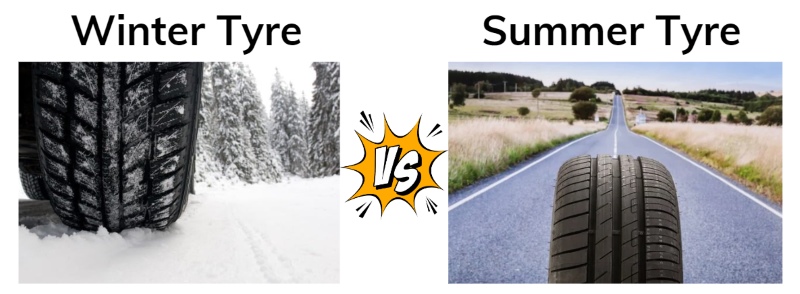
Tyres designed especially for cold temperatures are winter tyres. The rubber material of these tyres can endure temperatures below seven degrees Celsius. Also known as snow tyres, these tyres have soft rubber compounds with wider gaps in tread patterns than regular tyres.
Summer can take temperatures to high degrees. This would result in hot streets, which can influence the quality of the tyres on your vehicles. Tyres that are created particularly for the summer season are summer tyres. They are made with a high-quality, tough rubber compound to run easily over hot streets.
Summer tyres constitute a better rate of synthetic rubber compounds than regular or natural rubber, which gives them hardness.
The following table distinguishes between summer tyres vs winter tyres.
Winter tyres have a quality grip due to their tread depths. Below are some of the features of winter tyres.
Winter tyres constitute a higher percentage of natural rubber than synthetic rubber.
Due to the high concentration of natural rubber, they are not for high temperatures. Hence, their performance is highest during winter.
The tread life of such tyres is not as long as summer tyres. They usually run for four to six seasons, but depending upon the severity of winters and driving style, the lifespan can also be reduced or increased.
Winter tyres have excellent traction, i.e., grip, over mud and snow. It is due to the number of sipes engraved on these tyres.
Summer tyres have great grip and excellent handling over dry and wet roads. Find some features of summer tyres below.
Summer tyres are hard as they constitute more synthetic rubber than natural rubber.
Since synthetic rubber is cheaper than natural rubber, these tyres are economical.
Due to its design components, summer tyres are resistant to aquaplaning, thus providing more safety while driving.
They provide high fuel efficiency as the tyres roll with less friction, which saves energy.
Temperature affects the efficiency of the operations of the tyres and is a crucial factor to consider. Summer and winter tyres use different types of rubber meant for performance in significantly different conditions.
Summer tyres have stiffer rubber and do not deform easily, as they are designed to be used in warmer climates.
Below seven degrees Celsius, the compound of a summer tyre becomes too rigid to provide good traction with cold, wet, or snowy surfaces.
By contrast, the winter tyres have a softer rating than the summer tyres and do not stiffen as the temperatures drop. This flexibility of winter tyres enables better vehicle handling in snow and ice.
The aggressive tread design with many biting edges in the form of sipes also increases winter tyres' traction because it clears the water.
Yet, it is a relation with disadvantages as well. Winter tyres become progressively softer and wear out much faster at higher temperatures.
Thus, the temperature defines the right choice of tyres for a car, and the surface significantly affects traction. Summer has tyres that work best during warm weather, while winter tyres are well-recognized during the cold seasons. This way, the tyre is fit for the climate of the seasonal circumstances to enhance safety and efficiency on the road.
Mixed with silica for better traction in wet settings as well as lower fuel consumption and better performance during rainy periods, summer tires use a tougher rubber compound compared to all-season or winter tires. Such compound gives them better grip on dry or wet roads especially when the temperatures go up.
The pattern on the rubber of a tire for summer driving has been generated keeping in view its water drainage abilities and steering. Summer tire patterns usually contain higher longitudinal lines that serve for water dispatching so there is no danger for them when taking turns. Moreover, it is possible that this type of tire may feature tougher indentures which are meant to enhance adhesion when going round curves.
3D Sipes refer to minuscule slides or incisions made in the tread blocks with intention to enhance traction on wet pavements. There are sipes that increase the tire’s contact with the road surface and help in removing water which are made by the creation of biting edges. The performance of the tire is kept constant throughout its lifespan, because 3D sipes remain further apart when the tire wears out.
Some manufacturers today are including noise canceling technology in their summer tires, a move that will drastically cut down on the amount of noise heard in the vehicle cabin from roads thereby enhancing riding.
Unlike summer tires that use softer compounds for warm weather grip, winter tires utilize a special rubber compound that stays flexible even in frigid temperatures (below 7°C). This flexibility allows the tire to maintain good contact with the road for better traction on ice and snow. Silica is a common component that enhances elasticity at low temperatures.
Winter tires boast a unique tread pattern compared to their summer counterparts. Here's what makes them winter-worthy: Siped patterns on tread blocks are small incisions made in tire rubber for increased biting edges which increase traction on icy surfaces. When tires move by turning, the small incisions called sipes spread out so that no snow or water accumulates on the tire-road interface. Variations include sipe designs resembling spider webs optimized for maximum bite.
Tyres are a subjective choice, depending on the region you live in, what climate it has, and the rules and regulations about them. If the area has mild temperatures with no extreme winters, you can choose summer or all-season tyres for your vehicle. Whereas, if the place experiences harsh winters with snow and ice, winter tyres are the best choice for you.
Tyres should be purchased after considering several factors, such as your driving habits, local climate, the brand of the tyres, local laws, warranty period of tyres, etc.
Along with the changing seasons, replacing summer and winter tyres is advised. The difference between winter and summer tyres is that winter tyres are designed to be used in cold climates and when the roads are snowy, while summer tyres are suitable for use in hot and dry conditions.
It can be attributed to the fact that by using appropriate tyres during the particular season, the driver has an assurance that they have control over the car.
One can easily distinguish between summer tyres and winter tyres by their appearance. Winter tyres have a robust, thick, and aggressive look, while summer tyres have a lean appearance and do not appear thick or aggressive.
Winter tyres also have identification logos or prints, like the “M+S” mark depicting mud and snow.