Digit App

Accessibility Options

arrow
Grey Scale
Readable Text
Reset
hamburger
×
Digit Insurance Logo
Powered By Digit
general-insurance
mobile-img

Check Pending Challans Online

desktop-img

Differences Between Radial and Bias Tyre

What is a Radial Tyre?

What is a Bias Tyre?

Difference Between Radial and Bias Tyre

Both the tyres have the same purpose. However, they have major significant differences. Some of them are mentioned below: 

Feature Radial Tyres Bias Tyres
Material Made with steel belts and synthetic polyamide fabric. Made with nylon, polyether, and softer rubber material.
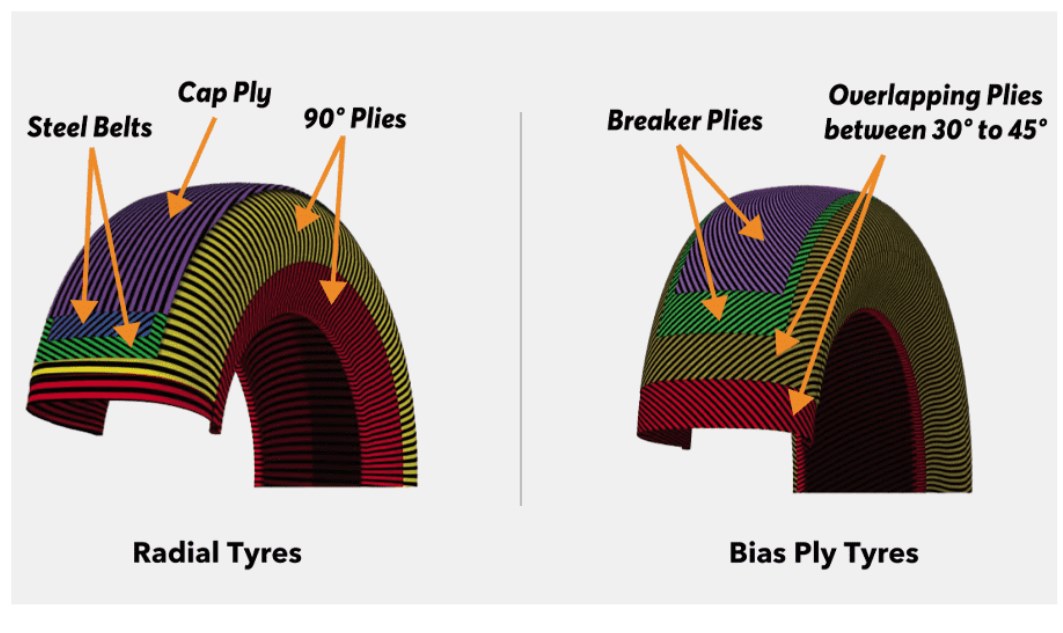
Construction The cord plies work at 90° to the direction of travel and are parallel. The cord plies cross over and form a crisscross pattern.
Sidewall Flexibility Flexible sidewall, providing smoother traction. Stiffer tyres, and more rigid. 
Usage Better for high-performance vehicles. Mostly used for heavy-duty vehicles.
Durability More durable and longer lifespan. Prone to more wear and tear.
Fuel Efficiency Better fuel-efficiency. Less fuel-efficiency.
Cost More expensive due to advanced construction. More affordable.
Repair A little complex to repair. Easy repair.
Off-road Complexity Not made for off-road activities. Ideal for off-road activities.

Advantages of Radial and Bias Ply Tyres

Radial Ply Tyres Bias Ply Tyres
Radial tyres have enhanced fuel efficiency due to lower rolling resistance. Bias tyres have more sturdy sidewalls, making them ideal for off-roading purposes.
These tyres provide more traction and stability, especially at higher speeds. Bias tyres don’t get punctured easily due to thicker sidewalls. 
Radial tyres have a longer tread life, which is cost-effective in the long run. These tyre’s thicker sidewall absorbs shocks and offers more flexibility on uneven, rough roads.
Radial ply tyres create less heat, which reduces the risk of tyre damage. Bias ply are more affordable and have reduced initial costs.

Disadvantages of Radial and Bias Ply Tyres

Radial Ply Tyres Bias Ply Tyres
The initial cost of buying these tyres is high. If you do not use them for a long time, they do not offer viability and value for money.  These are less durable than radial tyres, hence their short lifespan.
There are high risks of sidewall damage caused by its unique construction. Vehicle handling while having these tyres becomes difficult.
If the treads in these tyres are hardened, they will generate loud noise.  Bias Ply tyres are not expected to be much fuel efficient like Radial Ply tyres.
For off-roading, radial tyres are not ideal and do not provide the appropriate traction. Bias tyres are more susceptible to overheating due to shorter and wider contact patch.

How to Check if You Have a Bias or Radial Tyre?

FAQs about Radial Tyre vs Bias Tyre

Can you mix radial and bias tyres?

up-arrow

Experts do not suggest mixing two types of tyres as it leads to faster wear of tyres, vehicle instability, poor handling and control, and loss of traction. 

Experts do not suggest mixing two types of tyres as it leads to faster wear of tyres, vehicle instability, poor handling and control, and loss of traction. 

When should we use bias ply tyres?

up-arrow

You must use bias-ply tyres when you have an old vehicle, or you majorly drive your car on uneven roads and off-road conditions. If you are driving a modern, new-age car, these tyres are not recommended.

You must use bias-ply tyres when you have an old vehicle, or you majorly drive your car on uneven roads and off-road conditions. If you are driving a modern, new-age car, these tyres are not recommended.

Can you patch bias tyres?

up-arrow

Yes, you can patch a Bias tyre by using a strong adhesive and following the tyre manufacturer's repair guidelines. Usually, you must remove the tyre, clean the puncture area, and patch the affected area. 

Yes, you can patch a Bias tyre by using a strong adhesive and following the tyre manufacturer's repair guidelines. Usually, you must remove the tyre, clean the puncture area, and patch the affected area. 

What type of tyre is safer?

up-arrow

Radial tyres are safer than bias ply tyres as they provide better control and traction with the road surface. 

Radial tyres are safer than bias ply tyres as they provide better control and traction with the road surface. 

Do radials last longer than bias?

up-arrow

Yes, the lifespan of radial tyres is greater than that of bias ply tyres. These have hard belts that wear down slower than the bias tyres. These are more resistant to potholes and shocks, leading to less or slower wear. 

Yes, the lifespan of radial tyres is greater than that of bias ply tyres. These have hard belts that wear down slower than the bias tyres. These are more resistant to potholes and shocks, leading to less or slower wear. 

How long do bias tyres last?

up-arrow

Generally, a bias tyre has a lifespan ranging between 40,000 and 60,000 miles. However, their durability depends on several factors, such as road conditions, frequency of usage, etc. 

Generally, a bias tyre has a lifespan ranging between 40,000 and 60,000 miles. However, their durability depends on several factors, such as road conditions, frequency of usage, etc. 

Which tyre is best for a bike, radial or bias?

up-arrow

Radial tyres are better at dispersing heat than Bias Ply tyres. As a result, you can drive at high speeds without worrying about durability, safety, and comfort. Therefore, radial tyres are better than bias tyres for bikes. 

Radial tyres are better at dispersing heat than Bias Ply tyres. As a result, you can drive at high speeds without worrying about durability, safety, and comfort. Therefore, radial tyres are better than bias tyres for bikes. 

What is the disadvantage of a Bias tyre?

up-arrow

Bias tyres usually have a short operational lifespan, possess poor fuel efficiency, etc. These drawbacks make this tyre an unpopular choice among new car buyers.

Bias tyres usually have a short operational lifespan, possess poor fuel efficiency, etc. These drawbacks make this tyre an unpopular choice among new car buyers.

Are bias tyres good for highway driving?

up-arrow

Bias tyres are not good at dispersing heat at high speeds and do not work well on asphalt roads. Therefore, bias tyres are not an ideal option for highway driving. 

Bias tyres are not good at dispersing heat at high speeds and do not work well on asphalt roads. Therefore, bias tyres are not an ideal option for highway driving. 

Can radial tyres be tubeless?

up-arrow

Radial tyres can be both tubeless and tubed. These spread and flex easily to provide better stability and control. 

Radial tyres can be both tubeless and tubed. These spread and flex easily to provide better stability and control. 

Do bias tyres save fuel?

up-arrow

Bias tyres are not a fuel-efficient option as they have high rolling resistance. Therefore, radial tyres should be your go-to option to save on fuel consumption. 

Bias tyres are not a fuel-efficient option as they have high rolling resistance. Therefore, radial tyres should be your go-to option to save on fuel consumption. 

Which tyre is more fuel-efficient?

up-arrow

Radial tyres are the most fuel-efficient tyres as the vehicle using these tyres requires less effort and traction to accelerate or move forward. In other words, it provides low rolling resistance. 

Radial tyres are the most fuel-efficient tyres as the vehicle using these tyres requires less effort and traction to accelerate or move forward. In other words, it provides low rolling resistance. 

Which is better, Bias Ply or Radial?

up-arrow

The choice of a tyre depends on your needs and driving preference. Generally, people prefer radial tyres due to their wide range of benefits for new vehicles. Bias tyres are good for old vehicles and off-road driving. 

The choice of a tyre depends on your needs and driving preference. Generally, people prefer radial tyres due to their wide range of benefits for new vehicles. Bias tyres are good for old vehicles and off-road driving. 

Are all tubeless tyres radial?

up-arrow

Radial tyres can both be tubed and tubeless with different sidewalls. All tubeless tyres are the type of radial, but all radial tyres are not tubeless. 

Radial tyres can both be tubed and tubeless with different sidewalls. All tubeless tyres are the type of radial, but all radial tyres are not tubeless. 

Which type of tyre is best on wet surfaces?

up-arrow

Radial tyres are the most appropriate option in the rainy season or on wet surfaces as they provide a better grip and prevent the vehicle from skidding on wet surfaces.

Radial tyres are the most appropriate option in the rainy season or on wet surfaces as they provide a better grip and prevent the vehicle from skidding on wet surfaces.