General
Life
Accessibility Options


General

General Products
Simple & Transparent! Policies that match all your insurance needs.
 Car Insurance
 Two Wheeler Insurance
 Commercial Vehicle Insurance
 Health Insurance
 Home Insurance
 Travel Insurance
 Business Insurance
Car Insurance
Two Wheeler Insurance
Commercial Vehicle Insurance
Health Insurance
Travel Insurance
Business Insurance
Car Insurance
Two Wheeler Insurance
Commercial Vehicle Insurance
Health Insurance
Travel Insurance


Scan to download

Life

Life Products
Digit Life is here! To help you save & secure your loved ones' future in the most simplified way.
 Term Life
 Savings Plan
 Retirement and Pension Plans
 Group Life Products
 Product Documents
Term Life
Savings Plan
Retirement and Pension Plans
Group Life Products
Product Documents
Term Life
Savings Plan
Retirement and Pension Plans
Group Life Products

Scan to download

Claims

Claims
We'll be there! Whenever and however you'll need us.
 Customer Support
 Motor Claims
Health Claims
Motor Claims
Health Claims
 Marine Insurance
 Grievance Redressal
Customer Support
Motor Claims
Health Claims
Marine Insurance
Grievance Redressal
Grievance Redressal
Customer Support
Motor Claims
Health Claims
Marine Insurance
Grievance Redressal
Scan to download
 General
 Life
General
Life
Life
General
Life
Renewals
Resources

Resources
All the more reasons to feel the Digit simplicity in your life!
Exclusive Features
 Transparency Report
Others
Exclusive Features
Transparency Report
Transparency Report
Others
Exclusive Features
Transparency Report
Scan to download


Our WhatsApp number cannot be used for calls. This is a chat only number.

 Grey Scale
 Readable Text
 Reset
Reset



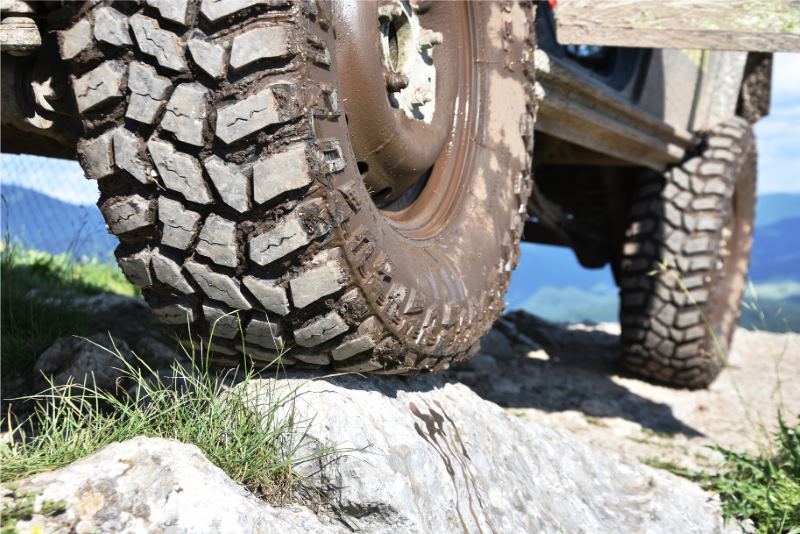
Off-road tyres are unique automobile parts for the terrain beyond the road system. These tyres have attributes that make them stick and drive through different terrains, including mud, rocks, sand and snow.
In mud tyres, structure, pattern and rubber are designed and manufactured to afford the best traction, wear and tear and to provide higher performance in such harsh terrains. Read this blog post to learn how off-road tyres work, the types of off-road tyres, and how to choose the right off-road tyre for your vehicle.

Table of Contents

Off-road tyres are designed for cars that go through rough terrains and are hard to manoeuvre.
The tyres have deep tread patterns, and ideal walls are reinforced well to give good traction, abrasion, and protection from punctures.
These tyres are designed to cling to soft-tangible terrains like lime, sand, rocks and gravel. The off-road tyres are mounted on Sports Utility Vehicles, pick-up trucks, and other special-purpose off-road automobiles.
Off-road tyres are closely related to providing traction when the soil is relatively soft, as in the case of mud, sand or rock. Different contact patterns and deep and aggressive tread patterns are the primary mechanisms of off-road tyres. The far-apart arranged tread blocks actively bite the ground and do not slip.
Sidewall extensions also help to improve the patch and give additional protection when they face any obstacle. Although all these features are handy when the car is being used off-road, it compromises the contact area between the tyres and the road on a paved surface.
The nature of the terrain determines the appropriate types of off-road tyres.
These tyres are designed for highway and off-road use, providing satisfactory ride comfort and off-road capabilities; it has a tread pattern with intermediate-sized voids for both surfaces.
M/T tyres perform well in soft mud as the large and additional aggressive tread blocks help to eject the mud and cling to the ground. Mud tyres are ideal for heavy off-roading terrains.
These kinds of tyres produce more moderate off-road traction than an M/T tyre while having quite bearable road-shoving ability.
Therefore, the option of a tyre, i.e. suitable for us, is determined by our preferences and the frequency of off-road activities.
Off-road tyres are counted as part of vehicle accessories and originate from specific use requirements. These are the tread, carcase, bead, breaker, and sidewalls.
The tread pattern offers grip/traction and wear and tear.
The carcase is of several plies, takes the load, and deforms when the load is exerted on the tyre. They help in the base of the tyre to the rim.
Breakers are installed to enhance the capability of the treads to resist punctures and cuts.
The sidewalls shield the inner structure and allow flexibility.
Choosing the right off-road tyres is critical in establishing vehicle safety, performance, and durability. Consider safety, handling, durability, terrain, and tyre size when choosing an off-road tyre.
It is good to emphasise the tyres whenever one is planning to have off-road adventures. Here are a few things to consider:
Tyre limits are relevant with off-road vehicles as far as they are going because when one exceeds them, it can lead to the failure of the tyres, which may result in an accident.
One soon wears them or even punctures them if one drives with them at high speeds or travels in bumpy places. Tyre pressure is also relevant when it comes to tractions and safety.
Tyre size plays a crucial role for off-road because it defines the ground clearance, the amount of grip your car can get off the ground and how well your vehicle can handle itself in terrain, which is not ideal. Larger tyres are usually beneficial in performance but can alter the car’s manageability and fuel consumption.
Gearing is crucial because it assists in matching the power of the engine to the surface type. The first gear gives more torque and slippage to override the incline or any obstacles on the path. The second gear is reserved for flatter terrains and high speeds. The correct gear ratio keeps the right power for a smooth driving experience.
The tyre pressure should be kept low when off-roading is possible as this reduces the tyre’s rolling circumference and increases the contact area with the ground, increasing traction when it is on sand or mud. It also facilitates the buffering of shocks as this can protect the vehicle and passengers in rough terrains.
While increasing or decreasing from one speed to the other, off-roading can be unsafe. It makes it difficult to control your vehicle, especially in the sandy area. It increases the likelihood of skidding off the ground, hitting an object or rolling over.
Now that you know what are off-road tyres, you must invest in a good quality and the right type of off-road tyre which suits your off-roading adventures. Off-road tyres are designed with lots of precision to manoeuvre through rough terrains.
Owing to these features, one can describe them as possessing highly resistant constructions, rather ambitious tread patterns, and highly specialised materials. With the revelation of this type of tyre’s construction and usage, motorists can employ related information to maximise the enjoyment of off-road driving.