General
Life
Accessibility Options


General

General Products
Simple & Transparent! Policies that match all your insurance needs.
 Car Insurance
 Two Wheeler Insurance
 Commercial Vehicle Insurance
 Health Insurance
 Home Insurance
 Travel Insurance
 Business Insurance
Car Insurance
Two Wheeler Insurance
Commercial Vehicle Insurance
Health Insurance
Travel Insurance
Business Insurance
Car Insurance
Two Wheeler Insurance
Commercial Vehicle Insurance
Health Insurance
Travel Insurance



Scan to download

Life

Life Products
Digit Life is here! To help you save & secure your loved ones' future in the most simplified way.
 Term Life
 Savings Plan
 Retirement and Pension Plans
 Group Life Products
 Product Documents
Term Life
Savings Plan
Group Life Products
Product Documents
Term Life
Savings Plan
Group Life Products

Scan to download

Claims

Claims
We'll be there! Whenever and however you'll need us.
 Customer Support
 Motor Claims
Health Claims
Motor Claims
Health Claims
 Marine Insurance
 Grievance Redressal
Customer Support
Motor Claims
Health Claims
Marine Insurance
Grievance Redressal
Grievance Redressal
Customer Support
Motor Claims
Health Claims
Marine Insurance
Grievance Redressal
Scan to download
 General
 Life
General
Life
Life
General
Life
Renewals
Resources

Resources
All the more reasons to feel the Digit simplicity in your life!
Exclusive Features
 Transparency Report
Others
Exclusive Features
Transparency Report
Transparency Report
Others
Exclusive Features
Transparency Report
Scan to download


Our WhatsApp number cannot be used for calls. This is a chat only number.

 Grey Scale
 Readable Text
 Reset
Reset



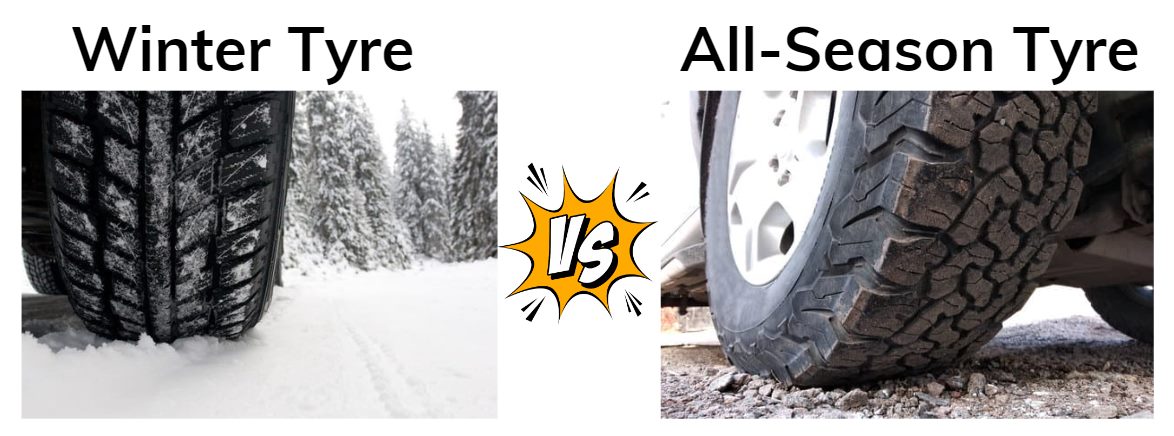
As winter approaches, a common question worries drivers: what type of tyres are suitable for icy and cold roads? Understanding the difference between winter and all-season tyres is essential to selecting the best tyres for your driving needs.
It is affected by several factors: the material, tread pattern, performance, etc. It is crucial to choose the right tyres to ensure your safety and that of your loved ones.
This blog post combines the essentials of winter and all-season tyres.

Table of Contents

Winter tyres are specially designed tyres for vehicles to operate in cold climates. The high concentration of rubber content in these tyres makes them softer and more compliant in cold weather. Winter tyres have a deeper tread with more aggressive cuts.
They provide the extra grip and stability you need to navigate safely through cold and snowy conditions. Winter tyres are suitable for regions where temperatures constantly remain below 7 degrees Celsius. These tyres become essential when the weather witnesses heavy snowfall, ice, and wet roads.
All-season tyres are designed to compromise between summer and winter capabilities, offering a level of functionality across various temperature ranges. They offer a balance for year-round use. A notable feature of such tyres is their wide and deeper tread design.
Now that you have a basic idea about winter tyres and all-season tyres, let us understand the differences between them:
In the constant tussle between snow tyres and all-season tyres, we need to know the benefits of each type to make the final decision. Winter tyres have the following benefits.
The soft rubber material and aggressive tread pattern make the propulsion of tyres on snow, ice, and wet roads smooth, enhancing the vehicle's safety and keeping the handling under control.
Winter tyres help your car stop much quicker on ice and snow. These tyres can prevent accidents since you will have more space to stop if the brakes are applied suddenly!
These tyres give the vehicles more grip. This grip makes it easier to steer and control your car, even when the roads are slippery and snowy.
As the name suggests, they are custom-designed to increase efficiency in cold weather. Winter tyres stay soft and flexible during temperatures as low as seven degrees Celsius.
In some cases, these tyres can also increase fuel efficiency because of their reduced rolling resistance.
The advantages of all-season tyres are listed below.
These tyres provide great grip on wet and mild snow-covered roads. This grip makes them perfect for places that experience milder snowfall.
They may not be the absolute best in extreme heat or cold, but they provide adequate performance for drivers in most climates.
All-season tyres are also cost-effective.
The cost of the right seasonal tyre depends on what kind of vehicle you have and which category tyre you choose. The categories include budget, mid-range, and premium tyres.
For instance, a budget option from Apollo costs between ₹2,500-₹6,000.
Moreover, choosing a premium tyre from a brand like Michelin costs between ₹8,000-₹20,000.
So, the complete cost comes down to your requirements and preferences.
Different tyre brands have their technologies that make them unique and stand out. Here are a few examples:
All-season tyres perform well on Indian roads and reduce the need for seasonal tyres. Here are a few examples of different all-season tyres and various technologies:
Now that we know what all-season and winter tyres are, their benefits, and more, let's consider the factors before purchasing tyres.
Local laws are the first thing to be considered. Every country has a different set of rules for tyres. You must be aware of the tyre requirements and the government's specifications.
The climate of your area is another deciding factor. Switching to winter tyres is crucial for optimal safety in cold weather regions with snow and ice.
Know the requirements for your vehicle. You can consult a professional regarding the tyre suitable for your automobile.
Finances are another thing to keep in mind while going shopping for tyres. Winter tyres are more costly as compared to summer or all-season tyres. So, if you are under a budget (and not restricted by local law), you can choose all-season tyres.
Before making your purchase, be sure to check for reliable and reputable brands of tyres. Refer to the manufacturer's manual for your tyre's specific features and warranty coverage.
Other additional factors you may consider are fuel consumption, desired performance, treadwear warranty, road conditions of your region, and annual mileage.
Now that we have seen winter tyres vs all-season tyres, one thing is clear: they have their merits. The best choice depends on the climate and your driving habits. If the region faces harsh winters with snow and ice, winter tyres are non-disputably the best choice for ultimate safety.
In milder climates, all-season tyres provide a convenient compromise. However, their grip on icy roads pales in contrast to dedicated winter tyres. Local weather patterns and factors such as budget, local laws, etc., should be considered to make a safe choice for your vehicle.