General
Life
Accessibility Options


General

General Products
Simple & Transparent! Policies that match all your insurance needs.
 Car Insurance
 Two Wheeler Insurance
 Commercial Vehicle Insurance
 Health Insurance
 Home Insurance
 Travel Insurance
 Business Insurance
Car Insurance
Two Wheeler Insurance
Commercial Vehicle Insurance
Health Insurance
Travel Insurance
Business Insurance
Car Insurance
Two Wheeler Insurance
Commercial Vehicle Insurance
Health Insurance
Travel Insurance


Scan to download

Life

Life Products
Digit Life is here! To help you save & secure your loved ones' future in the most simplified way.
 Term Life
 Savings Plan
 Retirement and Pension Plans
 Group Life Products
 Product Documents
Term Life
Savings Plan
Retirement and Pension Plans
Group Life Products
Product Documents
Term Life
Savings Plan
Retirement and Pension Plans
Group Life Products

Scan to download

Claims

Claims
We'll be there! Whenever and however you'll need us.
 Customer Support
 Motor Claims
Health Claims
Motor Claims
Health Claims
 Marine Insurance
 Grievance Redressal
Customer Support
Motor Claims
Health Claims
Marine Insurance
Grievance Redressal
Grievance Redressal
Customer Support
Motor Claims
Health Claims
Marine Insurance
Grievance Redressal
Scan to download
 General
 Life
General
Life
Life
General
Life
Renewals
Resources

Resources
All the more reasons to feel the Digit simplicity in your life!
Exclusive Features
 Transparency Report
Others
Exclusive Features
Transparency Report
Transparency Report
Others
Exclusive Features
Transparency Report
Scan to download


Our WhatsApp number cannot be used for calls. This is a chat only number.

 Grey Scale
 Readable Text
 Reset
Reset



Summers in many regions can go to extreme temperatures. In such scenarios, it is crucial to maintain our vehicles for the heat. The motors can get heated quickly in hot weather, making them unsuitable for driving. Therefore, it should be a practice to keep the parts of our vehicles under proper maintenance.
Type and quality are some things that should be taken as a priority while choosing tyres for your vehicles. Several factors should be considered, especially when selecting all-season or summer tyres.
Through this article, we have compiled the necessary details about tyres, the difference between summer tyres and all-season tyres, and some of the frequently asked questions.

Table of Contents

Tyres that can accommodate the roads for suitable driving all year are called all-season tyres. They offer the best performance in areas with mild climates and do not experience extreme hot or cold temperatures.
Summer can bring extremely soaring temperatures. This would result in hot roads, which can affect the quality of the tyres on your vehicles. Tyres that are crafted especially for the summer season are summer tyres. They are made with a high-quality hard rubber compound to run smoothly over hot roads.
They constitute a higher percentage of synthetic rubber compounds than natural rubber, which provides them with hardness. The following section discusses the features of summer tyres to provide a detailed description.
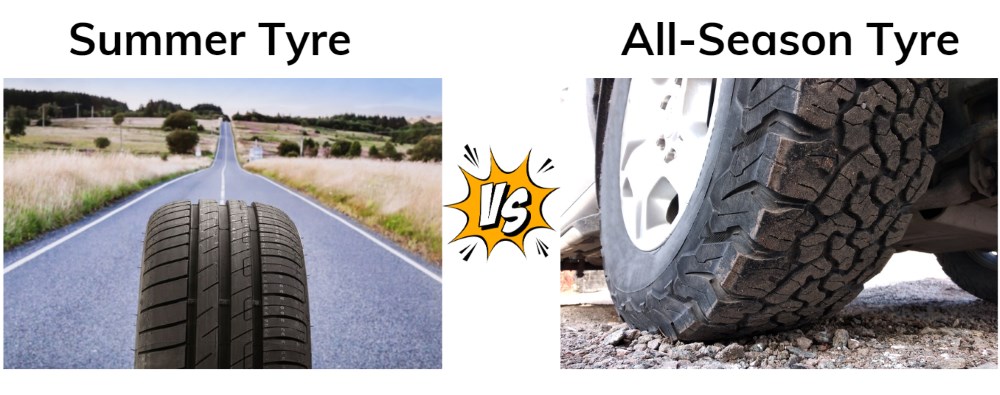
Summer tyres vs all-season tyres are best understood by comparing their physical appearance and features:
All-season tyres have elements of summer and winter tyres, making them suitable for vehicles to drive during hot and cold weather.
All-season tyres have a medium tread depth.
Traction, or grip, of such tyres do well during mild weather. However, they are not recommended for use during extremely hot or cold temperatures.
A notable feature of such all-season tyres is that they can handle the roads during the weather. Hence, you are saved from changing wheels every season.
These tyres provide value for your money, especially if you are looking for economical tyre options.
The following section discusses the features of summer tyres to gain a better understanding of what summer tyres are:
They offer excellent control over wet and dry roads.
The percentage of synthetic rubber elements is higher in summer tyres than any other tyre, which provides it with the desired toughness.
The tread patterns they leave are in block shape.
Their tread depth is the lowest amongst any type of tyre.
They are made with a notable feature of aquaplaning, which does not allow water to seep into tyres on wet roads.
The cost of fitting the right seasonal tyres depends on the car model, tyre size, and the service centre. Find an estimated cost breakdown of different seasonal tyres for your reference.
The costs are low for small cars, hatchbacks, and sedans while higher for SUVs.
The cost of four all-season tyres varies based on factors such as tyre size, quality, and your car’s specifications.
On average, you can expect to spend around ₹3,000 to ₹9,000 per tyre for all-season tyres in India.
Installation typically includes mounting the tyres on your car’s wheels and balancing them. Installation costs vary by location and service centre but usually range from ₹500 to ₹1,500 per tyre.
Wheel alignment costs around ₹1,000 to ₹2,000.
On average, the total cost for fitting all-season tyres on all four wheels would be approximately ₹12,000 to ₹40,000.
The wheel alignment and installation costs usually stay the same for summer tyres. The difference lies in the tyre cost, which may lie between ₹3,000 to ₹10,000 per tyre.
Hence, the total cost for fitting summer tyres on all four wheels would be ₹12,000 to ₹46,000.
Summer tyres come with several components and technologies that enhance their performance. Some of the qualities in summer tyres are given below:
This technology enhances braking performance by optimising the contact between the tyre and the road. It allows vehicles to stop more quickly on both wet and dry surfaces. It ensures increased safety and control.
Mileage technology minimises fractures caused by rough road conditions by enhancing tread elasticity and flexibility. The increased durability of the tread translates to a longer tyre lifespan.
This reduces the stiffness of the compound. It allows the tread blocks to flex and efficiently remove water from the road surface. The tyre features additional gripping edges, facilitating water evacuation and maintaining traction. This results in improved braking performance in wet conditions.
Larger ribs at the centre of the tread are designed to ensure higher stiffness. It provides enhanced stability. This structural feature helps maintain consistent contact with the road, improves control and reduces tyre deformation.
All-season tyres also have several technologies and features that enhance their performance. Here are some standard all-season tyre technologies that can help your vehicle in all seasons:
Smart Tread Technology enables the tyre to adapt seamlessly to seasonal changes and ensures consistent yearly performance. By dynamically adjusting its properties, this technology maintains optimal grip and handling in hot and cold temperatures.
Eco Plus Tread Technology reduces rolling resistance and allows your vehicle to travel further on less fuel. This technology enhances fuel efficiency by optimising the tyre's interaction with the road surface.
The High-density 3D Blade Sipe System delivers exceptional traction across all road conditions, including snow and ice. This advanced system incorporates siping patterns that improve grip by creating more biting edges, enhancing stability and control.
Aqua Control Technology maintains high resistance to aquaplaning throughout the tyre’s lifespan. It features grooves that evolve to continuously manage water dispersion continuously, ensuring effective performance in wet conditions and reducing the risk of hydroplaning.
The choice between summer and all-season tyres can be easily decided based on several factors.
If you live in a region that experiences extremely harsh summers with mild or no winters, then summer tyres are the best option.
However, all-season tyres combine summer and winter tyre features; hence, if you live where you occasionally require both features, go for all-season tyres.
There are several things to consider before investing in a quality set of tyres; safety and durability should be the priorities. Rising temperatures during summer can quickly make the roads too hot for tyres having low-quality rubber. It can degrade the driving experience, damage the tyres, and risk the safety of the driver and passengers.
Therefore, for extreme conditions, it is always advised to use season-specific tyres to ensure safety and well-being.
Summer tyres should be selected based on the region's climatic conditions. Brand and rubber quality should also be considered when selecting summer tyres.
The ideal conditions for summer tyres are shallow tread depths, block patterns, and fewer sipes.