General
Life
Accessibility Options


General

General Products
Simple & Transparent! Policies that match all your insurance needs.
 Car Insurance
 Two Wheeler Insurance
 Commercial Vehicle Insurance
 Health Insurance
 Home Insurance
 Travel Insurance
 Business Insurance
Car Insurance
Two Wheeler Insurance
Commercial Vehicle Insurance
Health Insurance
Travel Insurance
Business Insurance
Car Insurance
Two Wheeler Insurance
Commercial Vehicle Insurance
Health Insurance
Travel Insurance



Scan to download

Life

Life Products
Digit Life is here! To help you save & secure your loved ones' future in the most simplified way.
 Term Life
 Savings Plan
 Retirement and Pension Plans
 Group Life Products
 Product Documents
Term Life
Savings Plan
Group Life Products
Product Documents
Term Life
Savings Plan
Group Life Products

Scan to download

Claims

Claims
We'll be there! Whenever and however you'll need us.
 Customer Support
 Motor Claims
Health Claims
Motor Claims
Health Claims
 Marine Insurance
 Grievance Redressal
Customer Support
Motor Claims
Health Claims
Marine Insurance
Grievance Redressal
Grievance Redressal
Customer Support
Motor Claims
Health Claims
Marine Insurance
Grievance Redressal
Scan to download
 General
 Life
General
Life
Life
General
Life
Renewals
Resources

Resources
All the more reasons to feel the Digit simplicity in your life!
Exclusive Features
 Transparency Report
Others
Exclusive Features
Transparency Report
Transparency Report
Others
Exclusive Features
Transparency Report
Scan to download


Our WhatsApp number cannot be used for calls. This is a chat only number.

 Grey Scale
 Readable Text
 Reset
Reset



When prioritising the performance of your car, car tyres are one of the most critical components you should be looking at. It is important to understand the lifespan of car tyres in order to guarantee safety and maintain optimal driving conditions.
There are certain factors that you need to keep in mind to prolong their longevity. This will not only maximise tyre life but also save you money and offer you a pleasurable drive.
This article includes the key elements that affect tyre lifespan, tips for checking tyre condition, and maintenance advice that are necessary to ensure you get the most out of your car tyres.

Table of Contents

The average lifespan of tyres varies depending on various factors. Typically, the average lifespan of car tyres ranges between 40,000 to 60,000 kilometres. High-performance tyres designed for sports cars may wear out faster; needing replacement after 20,000 to 30,000 kilometres. Whereas, some tyres with proper care can exceed 80,000 kilometres.
It is recommended to avoid reckless driving, hard braking, sudden acceleration, and sharp turns as this may reduce the longevity of tyres.
Driving on well-maintained roads are crucial to maintain the durability of your tyres. Steer away from driving on rough or uneven roads that will deteriorate the condition of your tyres.
With proper maintenance you can significantly improve your tyre conditions. These include balancing, correct alignment, and regular rotations of your tyres.
The rubber compound of tyres are affected by extremes of temperatures. Hence, to improve the longevity of your tyres, it's important to shield them from extreme temperatures - both hot and cold, as well as from UV rays and ozone.
You adhere to the manufacturer’s recommended load limits. Overloading your vehicle as this will cause them to wear out more quickly.
Opting for tyres made from better materials will make the tyres last longer than the cheaper options. Investing in reputable brands can be beneficial in the long run.
Constant high-speed driving generates more heat, which will accelerate your tyre wear. Hence, maintain moderate speeds to preserve the tyre life.
In order to measure the tread depth of your tyre, use a tread depth gauge. If it is below 1.6mm, it indicates that the tyre needs replacement.
Check tyre pressure regularly. Under-inflated or over-inflated tyres can cause uneven wear and affect handling.
Regularly check for cuts, punctures, cracks, or embedded objects in the tyre.
Bulges or blisters can deteriorate tyre conditions. Examine the weak spots that could cause tyre failure.
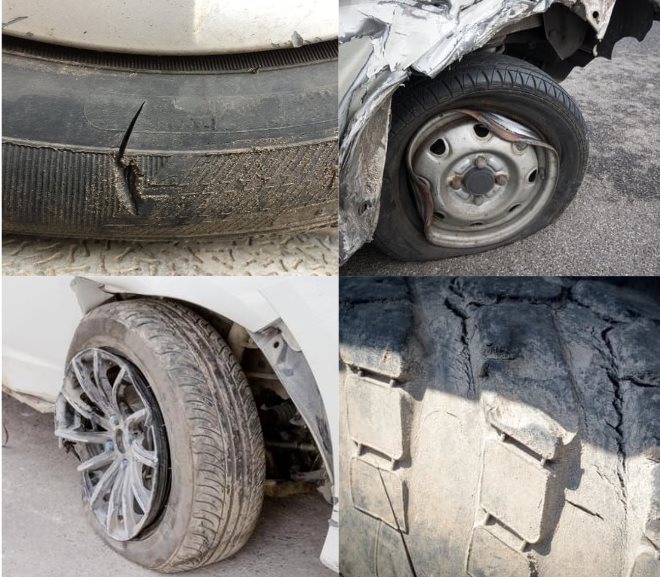
Tyre damages are extremely common. It's important to recognize different types of tyre damage and their causes as it lets you to take proactive measures to prevent such issues. It helps you to maintain your tyres, ensuring a better driving experience.
Let's explore some common types of tyre damage and their causes:
Tyre punctures are very common; occurring when tires encounter sharp objects or debris on the road. It is crucial to inspect and repair them promptly to prevent potential leaks.
This type of tyre damage is caused when the tyre’s rubber blocks roll over the road surface. Minor heel-and-toe wear is not something to be concerned about. However, if you are somebody who frequently covers long distances on highways, it is something you need to watch out for.
This type of tyre wear usually goes unnoticed until it becomes severe. They typically result when the axle is improperly aligned or the wheel sizes are incorrect.
Generally resulting from rapid acceleration in urban areas, center tyre wear is often associated with modern mid-range cars and high-performance vehicles.
Sidewall dimples are usually harmless. That being said, inspecting them is important to rule out any underlying issues and prevent further damage in the long run.
Tyre bulges are generally caused when tyres experience severe impact. They indicate internal structural damage. If you notice tyre bulges on your tyre, it is important to have them repaired by a professional.
Ideally, you might have to change your car tyres every 4-5 years. However, it is possible that you have to change the tyres earlier than that, based on several factors such as:
A bulge in a tyre indicates damage to the internal cords. This is often caused by the impact of the tyre with a pothole or curb. It's important to be aware that a tyre with a bulge is no longer safe to use and needs replacement.
Some guidelines to be followed include ensuring that the tyre pressure is kept within the recommended level. Low tyre pressure may lead to early wearing of the tyres and excessive consumption of fuel.
It is important to rotate your tyres after every 40,000 to 60,000 kilometers.
Wheel alignment and balancing needs to be inspected and from time to time. Misalignment results in irregular wearing of the tyres.
Ensure that you do not overload the tyres beyond the manufacturer’s recommended limit to avoid straining the tyres.
Do not engage in aggressive driving. Avoid sudden stops and make gentle turns to extend tire lifespan.
If you suspect that your tyres are damaged due to cuts or puncture, get them inspected by a professional.