General
Life
Accessibility Options


General

General Products
Simple & Transparent! Policies that match all your insurance needs.
 Car Insurance
 Two Wheeler Insurance
 Commercial Vehicle Insurance
 Health Insurance
 Home Insurance
 Travel Insurance
 Business Insurance
Car Insurance
Two Wheeler Insurance
Commercial Vehicle Insurance
Health Insurance
Travel Insurance
Business Insurance
Car Insurance
Two Wheeler Insurance
Commercial Vehicle Insurance
Health Insurance
Travel Insurance


Scan to download

Life

Life Products
Digit Life is here! To help you save & secure your loved ones' future in the most simplified way.
 Term Life
 Savings Plan
 Retirement and Pension Plans
 Group Life Products
 Product Documents
Term Life
Savings Plan
Retirement and Pension Plans
Group Life Products
Product Documents
Term Life
Savings Plan
Retirement and Pension Plans
Group Life Products
Scan to download

Claims

Claims
We'll be there! Whenever and however you'll need us.
 Customer Support
 Motor Claims
Health Claims
Motor Claims
Health Claims
 Marine Insurance
 Grievance Redressal
Customer Support
Motor Claims
Health Claims
Marine Insurance
Grievance Redressal
Grievance Redressal
Customer Support
Motor Claims
Health Claims
Marine Insurance
Grievance Redressal
Scan to download
 General
 Life
General
Life
Life
General
Life
Renewals
Resources

Resources
All the more reasons to feel the Digit simplicity in your life!
Exclusive Features
 Transparency Report
Others
Exclusive Features
Transparency Report
Transparency Report
Others
Exclusive Features
Transparency Report
Scan to download


Our WhatsApp number cannot be used for calls. This is a chat only number.

 Grey Scale
 Readable Text
 Reset
Reset



The main types of health insurance plans in India include individual health insurance, family floater plans, senior citizen health insurance, critical illness insurance, maternity health insurance, group health insurance, top-up/super top-up plans. These plans are designed to meet different healthcare needs, age groups, and life stages.
Each type offers unique benefits, coverage, and eligibility criteria. Understanding the different types of health insurance can help you choose a plan that matches your age, family size, budget, and long-term health requirements.
I agree to the Terms & Conditions

Get Exclusive Porting Benefits
Check Prices

Buy Health Insurance, Up to 20% Discount
Port Existing Policy

9000+
Cashless Hospitals

3.8 Crore+
Lives Insured

8 Lacs+
Claims Settled
Different health insurance policies are designed for different purposes. Some plans cover an individual, some protect an entire family, while others provide specialised coverage for senior citizens, critical illnesses, maternity expenses, or accidental injuries.
Understanding these policy types can help you choose coverage that best matches your healthcare needs.
Health insurance plans in India are available in different forms to meet the varying healthcare needs of individuals, families, senior citizens, and people seeking protection against high medical expenses. Here are the seven major types of health insurance plans available in India:

Individual Health Insurance
An Individual Health Insurance provides coverage for a single person under the policy. The insured receives a dedicated sum insured that can be used for covered medical expenses such as hospitalisation, surgeries, daycare procedures, and other eligible treatments.
For example, if you have an Individual health policy with a sum insured of ₹3 lakhs, you can claim up to ₹3 lakh anytime when needed. You can also buy individual plans for your spouse and kids. In this case, each person covered will have a seperate sum insured of ₹3 lakhs.
Best suited for: Young professionals, self-employed individuals, and people who want exclusive health coverage.
Features of Individual Health Insurance:

Family Floater Health Insurance
A Family Floater Health Insurance covers multiple family members under a single policy. Instead of having separate policies for each member, the entire family shares one common sum insured in health insurance.
A family floater health insurance plan is beneficial because the premium is comparatively lower than the individual health insurance policy. This policy can cover you, your spouse, your children, and your parents.
For example, if you have a family floater health insurance of ₹5 lakhs for yourself, your wife and parents, your whole family will share this amount.
Best suited for: Young families with spouses, children, and dependent parents.
Features of Family Floater Health Insurance:

Group Health Insurance
A Group Health Insurance policy is designed for employers, organisations, or associations to provide health coverage to their employees or members. The policyholder is typically the organisation, while the members receive insurance benefits under the group policy.
These plans often provide immediate coverage without extensive medical examinations and can help employees manage medical expenses at a lower cost. However, the coverage usually remains linked to the organisation and may end when a person leaves the group.
Best suited for: Employees in companies, members of associations, or organisations.
Features of Group Health Insurance:

Senior Citizens Health Insurance
Senior citizen health insurance is a type of health insurance designed for individuals aged 60 years and above. It helps cover medical expenses that become more common with age, including hospitalisation, surgeries, treatments for age-related illnesses, and other covered healthcare costs.
A Senior Citizen Policy will offer coverage for cost of medicines, hospitalisation arising out of accident or illness, pre and post hospitalization and treatment. Along with these, some other benefits, like Domiciliary Hospitalisation and psychiatric benefits, are also covered.
As per the IRDAI circular, dated 30th January 2025, insurers cannot increase premiums for senior citizen health insurance plans by more than 10% in a financial year without prior approval from the regulator. Also, there is no age limit for senior citizen health insurance which means any seniors can now buy a senior health policy at any age.
Best suited for: Individuals aged 60 years and above looking for dedicated health coverage in their retirement years.
Features of Senior Citizen's Health Insurance:

Maternity Health Insurance
A Maternity cover in health insurance can be bought as a separate health insurance or as an add-on that helps cover medical expenses related to pregnancy and childbirth.
Newly married couples or families who are planning a baby in the coming years should buy this policy. It covers child-delivery (including medically necessary terminations), infertility expenses and coverage for the newborn baby up to its first 90 days. The maternity cover has a minimum waiting period of 2-4 years.
Best suited for: Couples planning to start a family.
Features of Maternity Health Insurance:
Disclaimer: Currently, at Digit, we are not offering any Maternity coverage with our Health Insurance.

Critical Illness Health Insurance
Critical illness insurance provides a lump-sum payout if the insured is diagnosed with a covered critical illness mentioned in the policy. Common covered conditions may include cancer, heart attack, stroke, major organ failure, paralysis, and other serious illnesses.
Unlike a regular health insurance policy that reimburses hospital expenses or settles bills directly, a critical illness plan pays a fixed benefit amount once the claim conditions are met. The amount can be used for treatment, recovery expenses, household costs, loan repayments, or income replacement.
It will be wise to buy this policy if you have had a family history of some diseases. Other than the lump sum amount, a critical illness policy reimburses you the cost of care and hospitalization expenses. You can also avail the benefits of complementary health check-ups.
Best suited for: Individuals with a medical history or those seeking extensive protection.
Features of Critical Illness Health Insurance:
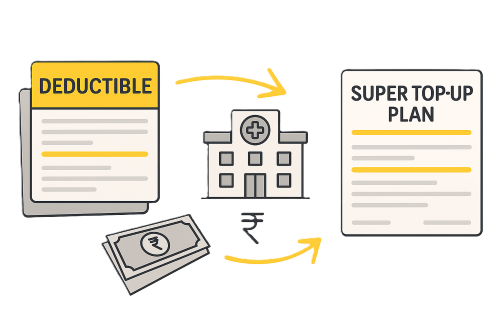
Super Top Up Health Insurance
Super top-up health insurance is a health insurance plan that provides additional coverage once a specified deductible amount is crossed during a policy year. It is designed to enhance your existing health insurance coverage and protect you from large medical expenses without significantly increasing your premium.
For example, if you have taken a cover for ₹15 lakhs and it has a deductible of ₹3 lakhs, then you will have to bear claim up to ₹3 lakhs out of your pocket. The amount over and above this will be paid by the insurer.
Best suited for: Individuals with limited employer health coverage.
Features of Super Top-Up Health Insurance:
Many health insurance plans offer optional covers and add-ons that can enhance your coverage beyond the standard policy benefits. These add-ons in health insurance help enhance your policy by providing extra coverage for specific healthcare needs. While they are commonly purchased as add-ons, some insurers may also offer them as separate insurance plans.
Disclaimer: The Add-Ons offered by various insurance companies vary from one another. Contact the insurer to find out all the information regarding the Add-Ons that your insurer offers. Currently, at Digit, we are only providing a Consumable Cover add-on.

Choosing the right health insurance plan isn't just about your current health. Your age, family responsibilities, income, and future healthcare needs all play an important role in determining the coverage that's right for you.
~ For Young Adults and Working Professionals: Start early with an Individual Health Insurance plan to lock in lower premiums and complete waiting periods sooner.
~ Married Couples and Young Families: A Family Floater plan can provide cost-effective coverage for multiple family members under a single policy.
~ Planning for Parenthood: Buy a Maternity Health Insurance cover well in advance.
~ Individuals with a Family History of Serious Illnesses: Consider adding Critical Illness Insurance for extra financial protection against major health conditions.
~ Above 60+ Years of Age: Choose a Senior Citizen Health Insurance plan that offers adequate coverage, manageable co-payments, and access to a strong hospital network.
So, review your health insurance needs whenever there is a major life change, such as getting married, becoming a parent, changing jobs, or entering retirement.

Vivek Chaturvedi
CMO & Head of Direct Sales
Buying health insurance is important, but choosing the right health insurance plan is equally crucial. Every individual has different healthcare needs based on factors such as age, family size, medical history, lifestyle, and budget.

Helps Manage Rising Healthcare Costs
Healthcare expenses continue to increase rapidly. The medical inflation has increased between 11% - 15% in 2026 (1). This can be due to advancements in medical technology, specialised treatments, and higher hospital charges. The right health insurance plan can help you cope with these rising costs.

Reduces Out-of-Pocket Medical Expenses
The right health insurance plan can help cover a significant portion of your healthcare costs, including hospitalisation, surgeries, daycare procedures, and other covered treatments. This reduces the amount you need to pay from your own savings.

Supports Different Life Stages
Your health insurance requirements change over time. A family floater plan may be suitable when raising children, while senior citizen health insurance can offer more relevant coverage during retirement. Selecting the right plan helps ensure your coverage evolves with your changing needs.

With multiple types of health insurance plans available in India, choosing the right one can be challenging. The ideal health insurance plan should not only fit your budget but also provide adequate coverage for your current and future healthcare needs.
Before purchasing a policy, it is important to evaluate several factors to ensure you get the best value and protection.
From individual and family floater plans to senior citizens, maternity, critical illness, and super top-up policies, different types of health insurance are designed to address different healthcare needs and life stages.
Understanding how each plan works can help you choose coverage that aligns with your age, family structure, health risks, and financial goals. Ultimately, the best health insurance plan is one that provides adequate protection for your specific needs while offering long-term financial security and peace of mind.
Individual health insurance and employer-sponsored health insurance (group health insurance) differ based on premium, coverage, and cost. Let’s understand them:
There are many benefits of purchasing maternity health insurance, which include:
Supplement health insurance coverage is the additional coverage you add to your regular health insurance plan. Some of it’s advantages include: