
General
Life
Accessibility Options


General

General Products
Simple & Transparent! Policies that match all your insurance needs.
 Car Insurance
 Two Wheeler Insurance
 Commercial Vehicle Insurance
 Health Insurance
 Home Insurance
 Travel Insurance
 Business Insurance
Car Insurance
Two Wheeler Insurance
Commercial Vehicle Insurance
Health Insurance
Travel Insurance
Business Insurance
Car Insurance
Two Wheeler Insurance
Commercial Vehicle Insurance
Health Insurance
Travel Insurance



Scan to download

Life

Life Products
Digit Life is here! To help you save & secure your loved ones' future in the most simplified way.
 Term Life
 Savings Plan
 Retirement and Pension Plans
 Group Life Products
 Product Documents
Term Life
Savings Plan
Retirement and Pension Plans
Group Life Products
Product Documents
Term Life
Savings Plan
Retirement and Pension Plans
Group Life Products

Scan to download

Claims

Claims
We'll be there! Whenever and however you'll need us.
 Customer Support
 Motor Claims
Health Claims
Motor Claims
Health Claims
 Marine Insurance
 Grievance Redressal
Customer Support
Motor Claims
Health Claims
Marine Insurance
Grievance Redressal
Grievance Redressal
Customer Support
Motor Claims
Health Claims
Marine Insurance
Grievance Redressal

Scan to download
 General
 Life
General
Life
Life
General
Life
Renewals
Resources

Resources
All the more reasons to feel the Digit simplicity in your life!
Exclusive Features
 Transparency Report
Others
Exclusive Features
Transparency Report
Transparency Report
Others
Exclusive Features
Transparency Report

Scan to download


Our WhatsApp number cannot be used for calls. This is a chat only number.

 Grey Scale
 Readable Text
 Reset
Reset




Farming continues to be the backbone of India’s economy with nearly 46 – 47% of India’s workforce still dependent on agriculture (1). Despite this, farmers face the constant threat of crop losses due to unpredictable weather, pests, and natural disasters. To address these challenges, the Government of India launched Pradhan Mantri Fasal Bima Yojana (PMFBY).
It is one of India’s main crop insurance schemes, designed to protect farmers from the financial losses caused by various reasons. The scheme offers affordable premiums, extensive coverage and quick claim settlements which help farmers focus on better crop production without the fear of crop failure.
The Pradhan Mantri Fasal Bima Yojana (PMFBY) is the Government of India’s main crop insurance scheme, launched in 2016 to provide financial protection to farmers against crop losses.
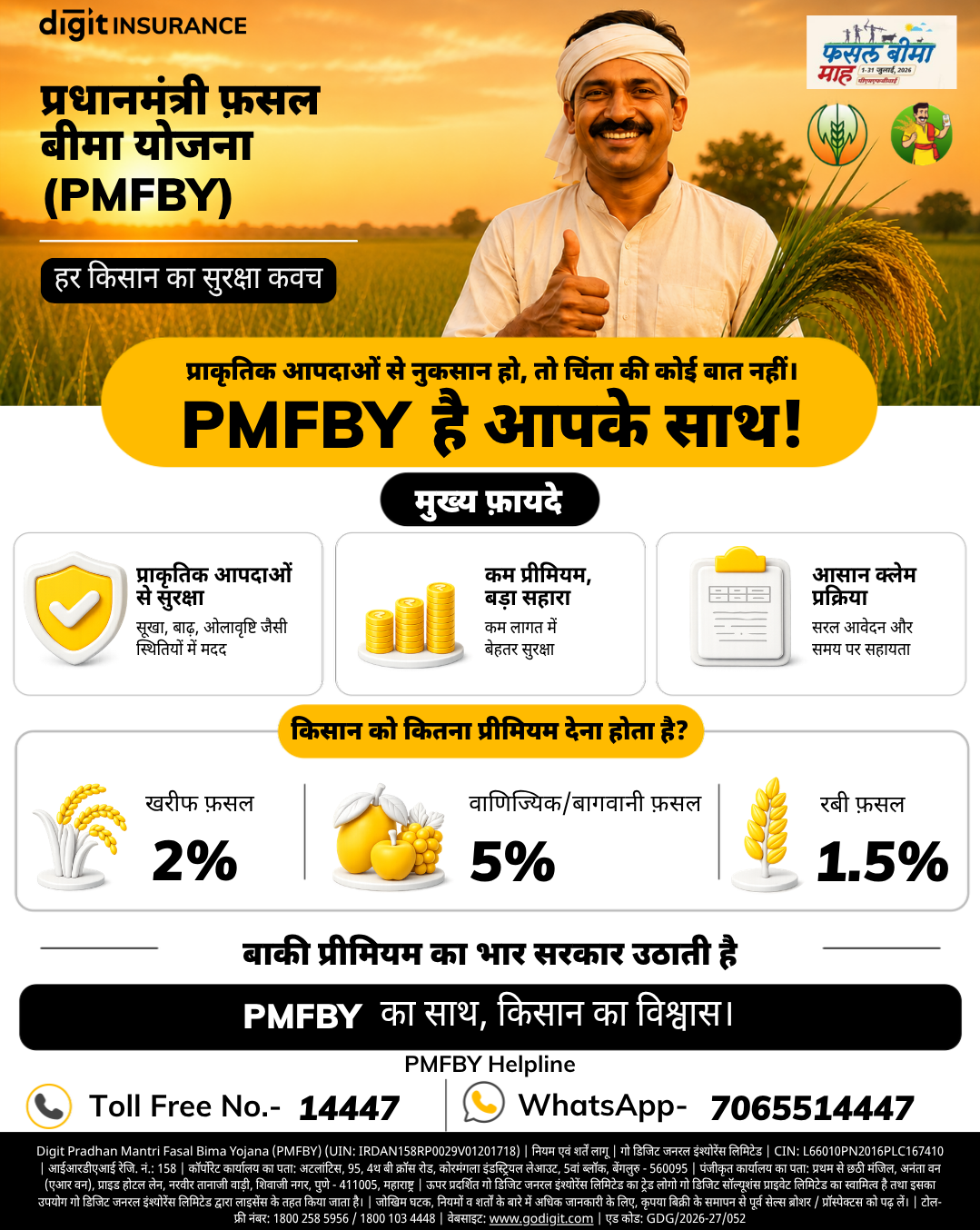
Many times, crops are damaged because of reasons like too much rain, no rain, storms, pests, or diseases. PMFBY helps farmers in such situations by giving them financial support. Under this scheme, farmers must pay a very small premium, which is:
The rest of the amount is paid by the government. If a farmer’s crop gets damaged, they receive compensation based on how much loss has happened.
The PMFBY scheme was created to reduce the risks farmers face every season and to make farming more secure and sustainable. Its objectives focus on protecting farmers from financial loss and helping them continue their agricultural activities with confidence. Here are some of the other objectives of PMFBY:
The Pradhan Mantri Fasal Bima Yojana (PMFBY) offers several benefits that help farmers feel safe and protected during the farming season. Here are the main advantages of PMFBY:
To get crop insurance under the Pradhan Mantri Fasal Bima Yojana (PMFBY), farmers need to meet a few basic conditions. Here’s a simple and clear list:
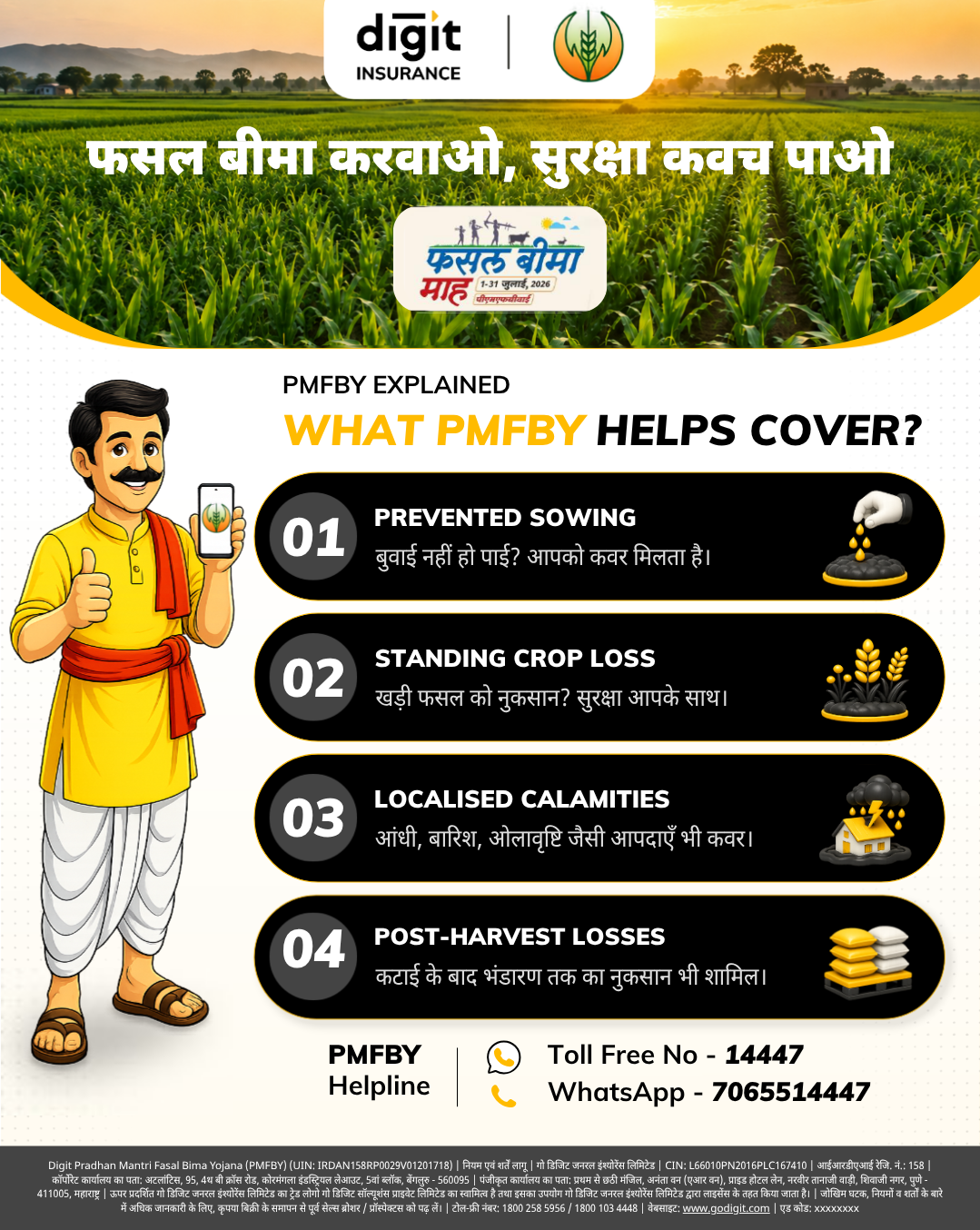
The Pradhan Mantri Fasal Bima Yojana provides wide protection to farmers against many types of crop losses. Here’s what is included:
Sometimes seeds fail to germinate because of very little rain or other weather issues. PMFBY covers losses during sowing and gives compensation if farmers are unable to plant their crops. If most insured farmers in a specified area intend to grow and have spent money but cannot be sown due to adverse weather, they get compensation up to 25% of Sum Insured.
Insurance cover will be provided to the farmers for immediate relief in case of adverse seasonal conditions during the crop season by floods, prolonged dry spells, severe drought etc., between the period from 30 days from start of onset of sowing and up to 15 days before the onset of harvest time, (as per the crop calendar notified by the States/UT Governments) wherein the expected yield during the season is likely to be less than 50% of normal yield.
If the crop gets damaged due to unseasonal rain, hailstorms, or cyclones within 14 days after harvesting, PMFBY provides financial support. This is helpful when harvested crops are left in the field for drying.
The scheme also covers damage caused by local events like hailstorms, inundation (waterlogging), or landslides. This allows farmers to claim insurance even if only a small part of their field is affected.
If the actual yield per hectare of the insured crop for the insurance unit (calculated on basis of requisite number of CCEs or a combination of CCE & technology derived yield estimates, as the case may be) in insured season, is lower than the minimum (threshold) yield set for that season, compensation may be provided to the insured farmer growing that crop in the same insurance unit.
While PMFBY offers wide coverage, there are certain risks and situations where the scheme does not provide compensation. These exclusions help ensure that only genuine, unavoidable losses are covered:
PMFBY does not cover any crop loss caused by riots, malicious damage, theft, acts of enmity, and destruction by domestic or wild animals. These losses are considered avoidable or non‑natural and therefore fall outside the scheme.
Any damage resulting from war or war‑like situations and nuclear risks or radiation is excluded from compensation. These events fall under high‑risk categories not covered by agricultural insurance.
PMFBY only covers post‑harvest losses when the crop is left in “cut & spread” condition in the field for drying. It does not cover:
A notified area is a region officially declared by the State Government for PMFBY coverage for specific crops and seasons. Only farmers growing crops within this notified area are eligible for insurance benefits. If a farmer is outside this zone (non-notified area), their crop losses are not covered, and they cannot claim compensation under PMFBY.
PMFBY follows a low and fixed premium rate for farmers. These premium rates ensure crop insurance remains affordable, especially for small and marginal farmers, while still providing high‑value protection against crop losses.
According to the PMFBY guidelines, the farmers pay:
Note: The premium percentages shown above are the maximum amounts farmers are required to pay under PMFBY. If the actuarial premium rate (the actual insurance cost calculated by the insurer) is higher, farmers will still pay only the capped rate, depending on the crop. The remaining premium amount beyond these caps is paid jointly by the Central and State Governments as part of the PMFBY subsidy structure.
To apply for PMFBY, non-loanee farmers need to submit a few essential documents. Here are the required documents:
Farmers can easily apply for PMFBY with just a few documents and crop details. The application process differs slightly based on whether you are a loanee farmer or a non-loanee farmer. Loanee farmers are those who have taken a crop loan for a notified crop from a bank or financial institution, while non-loanee farmers are those who have not taken a crop loan but wish to voluntarily enrol for crop insurance coverage.
Here are step by step procedures to apply for PMFBY for loanee and non-loanee farmers:
The scheme is optional for all farmers including farmers who have been sanctioned short-term Seasonal Agricultural Operations (SAO) loans though Kisan Credit Card (KCC) for the notified crops from defined Financial Institutions (hereinafter referred to as Loanee farmers).
Existing Loanee farmers who do not want to get covered under the scheme have the option of opting-out from the Schemes by submitting requisite declaration to loan sanctioning bank branches any time during the year but at least seven days prior to the cut-off date for enrolment of farmers for the respective season. All those farmers who do not submit the declaration would be essentially covered.
There is no need for the insured farmer to intimate the insurance company losses due to prevented sowing, as this will be a widespread calamity and assessment is based on area approach. This benefit is triggered when majority of farmers are unable to sow their crop because of weather conditions. The details are as below:
This cover pays for the shortage in yield of the insured crop compared to Threshold Yield (TY) on area approach.
If the Actual Yield (AY) of the insured crop in the Insured Unit (IU) is less than Threshold Yield of the insured crop in the IU, then all the insured farmers in the Insurance Unit growing the same crop are assumed to have suffered the loss.
The claim is calculated as: ((Threshold Yield - Actual Yield) / Threshold Yield) * (Sum Insured)
Where,
This cover is to provide immediate relief to farmers in case of any widespread calamity or adverse season, wherein the expected yield during the season is likely to be less than 50% of normal yield.
To avoid complications, farmers should carefully understand the terms of their insurance policy and ensure they submit their claims correctly and within the prescribed guidelines.
In case a farmer is unhappy with the claim decision or faces difficulties during the claims process, they can approach the government’s dedicated grievance cell. Reach out to Digit at grievance.agri@godigit.com or call the Krishi Rakshak Portal Helpline: 14447 for further assistance and support.
The Pradhan Mantri Fasal Bima Yojana (PMFBY) has become important for millions of farmers across India. By offering crop insurance and protection against unpredictable weather, pest attacks, and other natural risks, the scheme helps farmers secure their income and continue farming with confidence.
Overall, PMFBY plays a vital role in strengthening India’s agricultural stability and ensuring that farmers receive timely support when they need it the most.
Source:
Manpower Details
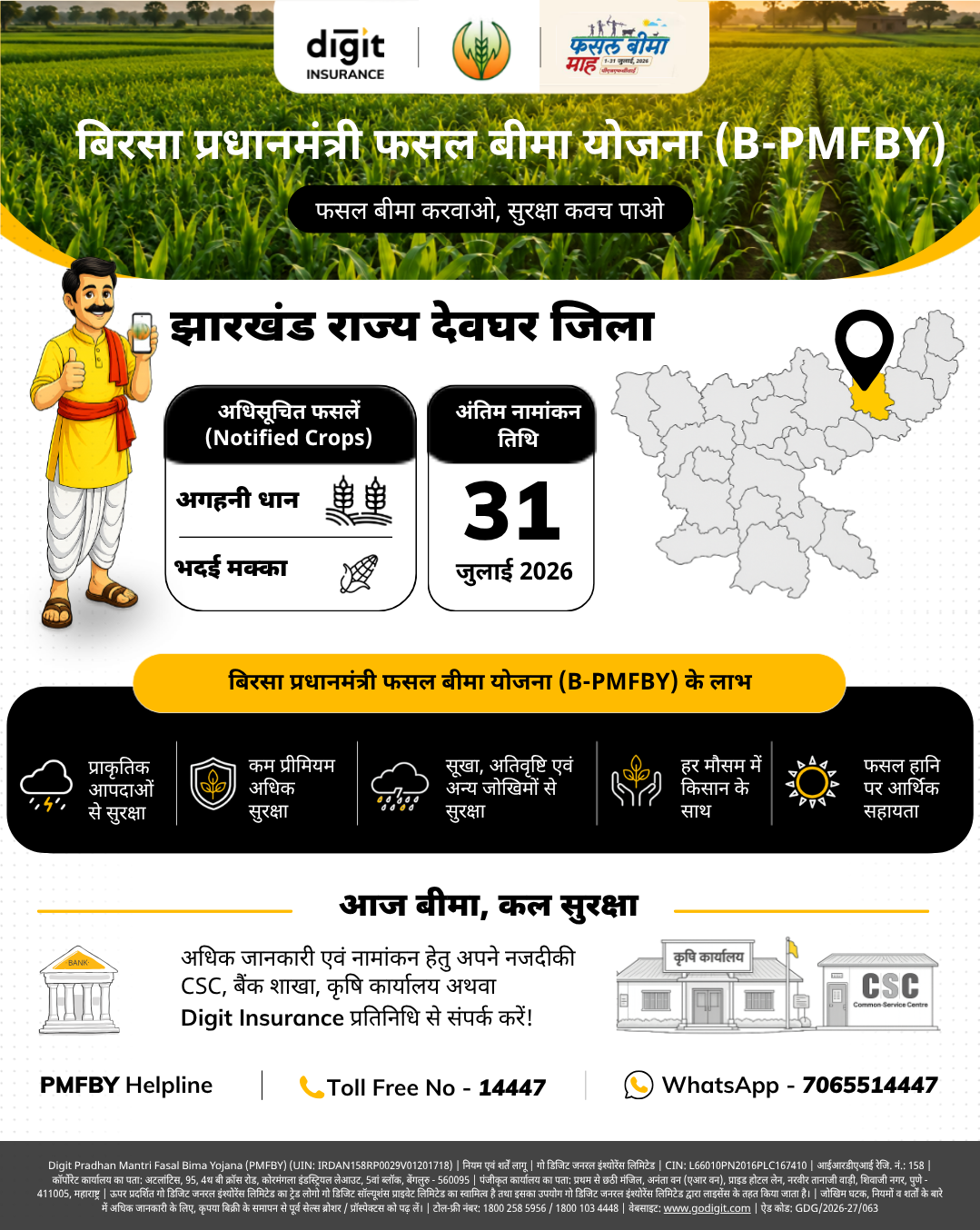
State Name: Jharkhand
District: Deoghar
State Head Details –
District Level Manpower Details -
Deadlines vary by state and crop season, but are typically
However, states may modify dates as per crop calendars.
PMFBY covers a wide range of natural risks that cause yield loss. These include:



