General
Life
Accessibility Options


General

General Products
Simple & Transparent! Policies that match all your insurance needs.
 Car Insurance
 Two Wheeler Insurance
 Commercial Vehicle Insurance
 Health Insurance
 Home Insurance
 Travel Insurance
 Business Insurance
Car Insurance
Two Wheeler Insurance
Commercial Vehicle Insurance
Health Insurance
Travel Insurance
Business Insurance
Car Insurance
Two Wheeler Insurance
Commercial Vehicle Insurance
Health Insurance
Travel Insurance


Scan to download

Life

Life Products
Digit Life is here! To help you save & secure your loved ones' future in the most simplified way.
 Term Life
 Savings Plan
 Retirement and Pension Plans
 Group Life Products
 Product Documents
Term Life
Savings Plan
Retirement and Pension Plans
Group Life Products
Product Documents
Term Life
Savings Plan
Retirement and Pension Plans
Group Life Products

Scan to download

Claims

Claims
We'll be there! Whenever and however you'll need us.
 Customer Support
 Motor Claims
Health Claims
Motor Claims
Health Claims
 Marine Insurance
 Grievance Redressal
Customer Support
Motor Claims
Health Claims
Marine Insurance
Grievance Redressal
Grievance Redressal
Customer Support
Motor Claims
Health Claims
Marine Insurance
Grievance Redressal
Scan to download
 General
 Life
General
Life
Life
General
Life
Renewals
Resources

Resources
All the more reasons to feel the Digit simplicity in your life!
Exclusive Features
 Transparency Report
Others
Exclusive Features
Transparency Report
Transparency Report
Others
Exclusive Features
Transparency Report
Scan to download


Our WhatsApp number cannot be used for calls. This is a chat only number.

 Grey Scale
 Readable Text
 Reset
Reset




10000+ Cashless Garages
1.5 Cr+ Policies Sold


Check Price

Car insurance Online, Up to 90% Discount
It's a Brand New Car
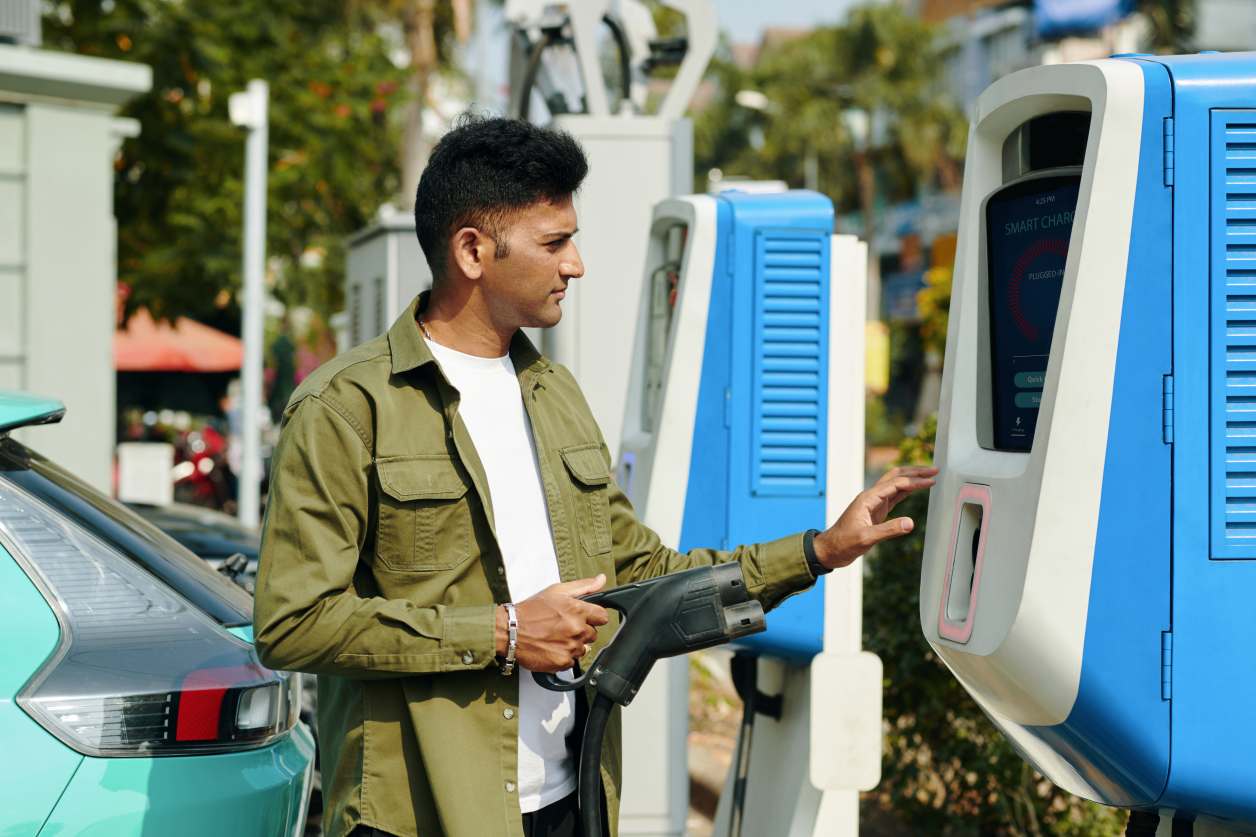
With electric vehicles (EVs) on the rise, the biggest question for owners remains—where should you charge your car? Should you opt for the convenience of home charging or the flexibility of public charging stations?
Let’s explore home charging vs public charging for your EV in detail. This will help you decide which option works best for you.

Table of Contents

EV charging is defined as the procedure of supplying electricity to the battery of an electric vehicle so that its motor can be turned on. In the same way that traditional vehicles have to rely on petroleum, an electric vehicle requires electricity for smooth functioning.
Charging an EV can take place in various locations, including home garages and public charging stations specifically constructed for electric vehicles.
The charging system consists of connecting some specialised devices to an EV's battery and supplying it with electricity. EV charging types are divided into two categories: home EV charging and public EV charging.
Home EV charging is the most convenient option for many EV owners, as it allows them to recharge their vehicles overnight in the comfort of their homes. This usually requires a Level 1 or Level 2 charging setup, depending on the EV owner's preference and the electrical infrastructure available.
Public EV charging refers to charging stations outside the home but accessible to all EV owners. These charging stations are usually found at parking lots, shopping malls, highway rest stops, and other public places.
Public charging stations provide a vital network for EV drivers who need to recharge their vehicles while on the road, especially during long trips or when home charging is inaccessible.
Let’s discuss the key types of home EV charging in the following table to help you navigate your charging needs:
Here is a tabular explanation of the types of public EV charging systems:
Here’s a tabular representation summarising the cost comparison between home charging and public charging for electric vehicles (EVs) in India:
Both home and public charging have their advantages. Here’s a breakdown to help you decide:
Both home and public charging have their own set of drawbacks. Here’s a tabular explanation:
Following are the major differences between home EV charging and public EV charging:
Charging an electric vehicle always consumes energy differently than in a conventional car, but environmental effects vary depending on the source of energy used to charge the vehicle.
If you charge an EV using renewable sources, like solar energy or wind power, the carbon footprint will be diminished even more. In fact, charging a vehicle with electricity generated from fossil fuels will result in higher emissions. When it comes to home charging, it utilises clean, renewable energy through solar panels and further reduces the environmental impact.
However, the public EV charging stations vary in terms of their energy sourcing. Some use fossil fuels, while others use renewable energy. Hence, it is important to consider the electricity mix in your area when evaluating the environmental impact of your car charging choices.
Several common challenges in EV charging include:
Charging stations can be unreliable, with equipment malfunctions, out-of-service stations, and inconsistent charging performance.
Charging speeds can be slow, especially in urgent situations, though upgrading to higher voltage outlets can improve this.
Risks of electric shock at charging stations exist, though proper maintenance of equipment can mitigate this danger.
Often, there may be a shortage of charging stations, making it difficult to find one when needed.
The rapid expansion of charging stations may lead to issues like voltage fluctuations, power quality problems, and grid instability.
Sometimes, compatibility issues may arise between different vehicle models and charging stations.
There may be communication gaps between grid operators and charging station providers, affecting service reliability.
You should choose between home and public charging based on your location, driving habits, and infrastructure. If your daily commute is short and you can easily have a reliable home charging facility, you can charge your vehicle at home. It is the most convenient, cost-effective, and environment-friendly way.
On the contrary, if you often go on long trips or live in an apartment without access to EV charging, you will require public charging. House and public electric vehicle charging both have their own sets of merits and demerits. So, you should make your choice smartly.
Home charging is very convenient and less expensive, whereas public charging is expensive, and it offers much flexibility and faster options, especially for extended trips. To find the right choice, consider your driving patterns, financial situation, and how accessible the charging stations are in your area.