General
Life
Accessibility Options


General

General Products
Simple & Transparent! Policies that match all your insurance needs.
 Car Insurance
 Two Wheeler Insurance
 Commercial Vehicle Insurance
 Health Insurance
 Home Insurance
 Travel Insurance
 Business Insurance
Car Insurance
Two Wheeler Insurance
Commercial Vehicle Insurance
Health Insurance
Travel Insurance
Business Insurance
Car Insurance
Two Wheeler Insurance
Commercial Vehicle Insurance
Health Insurance
Travel Insurance



Scan to download

Life

Life Products
Digit Life is here! To help you save & secure your loved ones' future in the most simplified way.
 Term Life
 Savings Plan
 Retirement and Pension Plans
 Group Life Products
 Product Documents
Term Life
Savings Plan
Retirement and Pension Plans
Group Life Products
Product Documents
Term Life
Savings Plan
Retirement and Pension Plans
Group Life Products

Scan to download

Claims

Claims
We'll be there! Whenever and however you'll need us.
 Customer Support
 Motor Claims
Health Claims
Motor Claims
Health Claims
 Marine Insurance
 Grievance Redressal
Customer Support
Motor Claims
Health Claims
Marine Insurance
Grievance Redressal
Grievance Redressal
Customer Support
Motor Claims
Health Claims
Marine Insurance
Grievance Redressal

Scan to download
 General
 Life
General
Life
Life
General
Life
Renewals
Resources

Resources
All the more reasons to feel the Digit simplicity in your life!
Exclusive Features
 Transparency Report
Others
Exclusive Features
Transparency Report
Transparency Report
Others
Exclusive Features
Transparency Report

Scan to download


Our WhatsApp number cannot be used for calls. This is a chat only number.

 Grey Scale
 Readable Text
 Reset
Reset




10000+ Cashless Garages
1.5 Cr+ Policies Sold


Check Price
Car insurance Online, Up to 90% Discount
It's a Brand New Car
Today, in the heart of every city, one is likely to encounter electric cars silently plying on roads that earlier used to be filled with the noise of gasoline-powered vehicles.
These electrically-propelled vehicles are not only futuristic but also easily reversible in an environmentally friendly way. Their revolutionary technology promises smooth and emission-less travel, making them ideal for the daily commuter and the environmentally conscious.
This article will be useful to you if you want to know more about electric vehicles and their parts.

Table of Contents

Electric vehicles operate on electrical energy that is converted into mechanical energy and subsequently distributed as kinetic energy to activate the motion of the vehicle. Unlike conventional vehicles that are fueled by petrol or diesel, electric vehicles are powered by electric motors thus utilizing electric energy as the main source of energy.
Below are the main key components of an electric car:
A charge port delivers the energy from a power source to the battery pack of the electric vehicle, which is sometimes referred to as the Electric Vehicle Supply Equipment (EVSE) or Charging Station. The battery is replenished as soon as the EVSE plugs in charge in the charge point, be it at home or a commercial station.
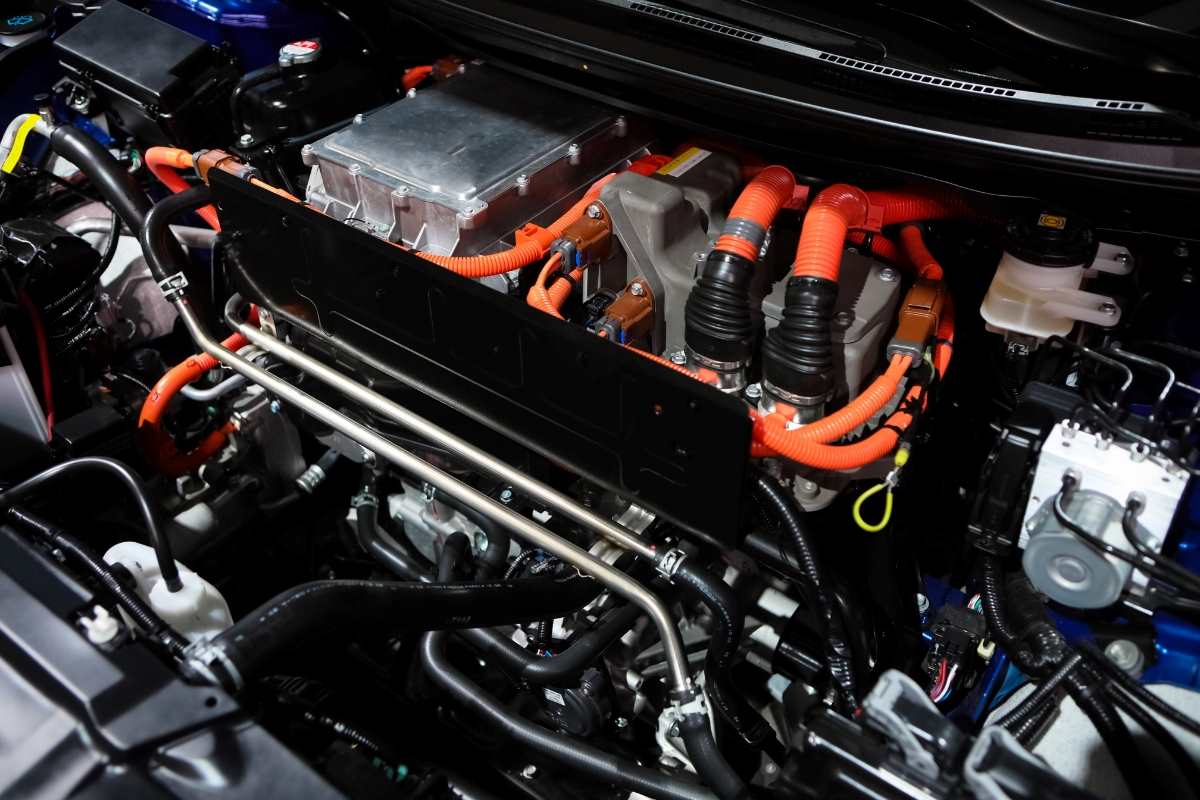
A powerful inverter is required to convert the rectified battery pack voltage into alternating current to supply the electric traction motor. While lithium-ion batteries generate a direct current only, the electric traction motors consume an alternative current; inverters come in place to fill that void.
This motor takes AC power from the inverter and mobilizes the EV as a traction motor. The electric traction motors have a clear advantage as compared to the DC motors in the fact that they are not needing to stress about either shifting the gears or the motor doing so.
The traction battery pack is aimed at storing energy from recharging the vehicle, to further utilize it for the motor and other power-consuming components of the vehicle. Most of the curricular electric vehicles have lithium-ion batteries in the traction battery pack because of advantages like fast recharge and low maintenance.
The powertrain of the electrical vehicle gives an inclusive architecture for a high-voltage electrical system for the operational vehicle. Usually, this includes an inverter, electric traction motor, reduction drive, and traction battery.
Electric vehicles come in various types, each designed to cater to different driving needs and preferences. Understanding the type of electric cars will help you in selecting the right option for your lifestyle. Below are the types of eclectic cars present in the market:
Battery Electric Vehicles also known as BEVs contain only an electric driving unit powered by energy stored in a battery creating no extended use of an internal combustion engine or gas. As such no tailpipe emissions are produced and there are no batteries on board hence all the energy is obtained from a grid.
Hybrid Electric Vehicles also referred to as HEVs possess a limited battery pack combined with a gasoline motor. These vehicles cannot be plugged in to recharge the battery but use regenerative braking as well as a generator driven by the gasoline engine to charge the batteries.
HEVs burn mostly gas but use their electric motor for short intervals to assist the engine when needed for enhanced fuel economy.
Plug-In Hybrid Vehicles refer to PHEVs that make use of an electric traction motor and gasoline engine which provides the advantage of both electric and gas vehicles. PHEVs can accept a charge from electrical mains and use electric power until their battery gets exhausted.
Once the battery power is low, the already-started gasoline engine comes into play and continues to propel the car.
Charging an electric car is straightforward and flexible, with options ranging from home charging setups to public charging stations. By connecting to an electric vehicle supply equipment (EVSE), drivers can easily recharge their batteries and ensure their car is ready for the road.
Below are some of the ways to charge an electric car:
Level 1 charging employs a traditional 120-volt outlet, and consequently does not demand any additional apparatus. Only 2 to 5 miles can be covered for every hour charged. It is useful for charging at home but not that efficient during short charging periods.
Level 2 charging systems connect to a 220 or 240-volt power supply and additional peripherals are required at homes or on the go. This method is significantly faster compared to Level 1 which gives about 10 to 25 miles when charged for an hour.
DC Fast Charging does not require an AC-DC inverter since its major charging component is located within the charging station, where AC is directly converted into DC. Level 3 methods can charge the battery pack of an EV in between 15 to 45 minutes.
Below are some of the benefits of having an electric car:
Perhaps the most prominent advantage of electric cars is the effect they have on the environment. They generate no harmful emissions which helps mitigate pollution and reduce your carbon footprint. This is very advantageous, especially in urban cities where air pollution is a critical issue.
In times when fuel costs are becoming more expensive and there are no signs of falling, purchasing an electric vehicle is one way to shield your finances from these exorbitant prices.
Maintenance of electric cars is often much cheaper than that of gas-powered cars. They do not require plumbing and regular oil changes or troublesome repairs on the engine. Because the motor, battery, and electrical parts of an EV are all considerably fewer in terms of moving parts, very little maintenance is necessary.
Gone are the days of long queueing at a gas station with detour trips made to refuel. With an electric vehicle, you’ll never know how costly refuelling costs will be because it can be done at home in smooth order. It usually takes 4-5 hours to charge a battery fully.
Driving an electric car is a breeze, especially if you find traditional gear changes cumbersome. Therefore, instead of using gears, cars use various buttons and pedals, which enhances the level of convenience by producing a lot less hassles and making driving much more fun.
Electric vehicles are very silent as there is no petrol engine to make noise. It can silence the driving experience which is sometimes sought from using electric vehicles and enhance the enjoyment of travelling, working for diesel engine noise relaxation.
Some of the drawbacks of having an electric car are:
Even though battery technology is improving, electric vehicles often have a shorter driving range compared to traditional cars. This can lead to range anxiety, especially on long trips or in areas where charging stations are few and far between.
The availability of charging stations can be limited, particularly in rural or remote areas. Although the number of stations is increasing, it still doesn’t match the convenience of gas stations. Additionally, charging an EV usually takes longer than refuelling a gas vehicle, which can be a drawback for some drivers.
Electric vehicles generally come with a higher initial purchase price, mainly due to the cost of the battery. However, potential savings on fuel and maintenance over time can help offset the higher upfront cost.
Over time, EV batteries can lose capacity, which might reduce driving range and performance. Replacing batteries can be costly, though prices are expected to decrease as technology advances and production scales up.
Although more electric vehicle models are becoming available, the selection is still relatively limited compared to traditional vehicles. This can make it harder for buyers to find an EV that meets their specific needs, preferences, and budget.
The production of EV batteries can have environmental downsides, such as habitat destruction, water pollution, and greenhouse gas emissions. Efforts are being made to reduce these impacts through better sourcing practices, recycling, and advances in battery technology.
Electric vehicles often have a lower resale value compared to their initial cost, due to reduced battery capacity over time. This lower selling price can be seen as a disadvantage compared to traditional vehicles, which typically retain higher resale values.
Electric vehicles are still relatively expensive, which limits their accessibility to a wider audience. This smaller user base can result in less frequent updates and higher costs for both manufacturers and consumers.
As electric vehicles replace traditional fuel-powered cars, countries that rely heavily on fuel sales might face economic challenges. A significant decline in fuel vehicle numbers could potentially lead to financial issues in economies dependent on fuel exports.
Charging an EV at home can increase your electricity bill, and setting up a home charging station involves high installation costs. Regular upgrades to the charging infrastructure might also contribute to higher overall expenses.
Electric vehicles have become a perfect alternative to gas-powered vehicles. They have multiple advantages and disadvantages which make them differ from other vehicle types. They have proven to be environmentally friendly and are famous among most people.
Some disadvantages of electric vehicles include:
The major benefits of electric vehicles include:
Hybrid electric vehicles offer:
Concerns about long-distance travel with electric vehicles include: