General
Life
Accessibility Options


General
General Products
Simple & Transparent! Policies that match all your insurance needs.
 Car Insurance
 Two Wheeler Insurance
 Commercial Vehicle Insurance
 Health Insurance
 Home Insurance
 Travel Insurance
 Business Insurance
Car Insurance
Two Wheeler Insurance
Commercial Vehicle Insurance
Health Insurance
Travel Insurance
Business Insurance
Car Insurance
Two Wheeler Insurance
Commercial Vehicle Insurance
Health Insurance
Travel Insurance


Scan to download

Life

Life Products
Digit Life is here! To help you save & secure your loved ones' future in the most simplified way.
 Term Life
 Savings Plan
 Retirement and Pension Plans
 Group Life Products
 Product Documents
Term Life
Savings Plan
Retirement and Pension Plans
Group Life Products
Product Documents
Term Life
Savings Plan
Retirement and Pension Plans
Group Life Products

Scan to download

Claims

Claims
We'll be there! Whenever and however you'll need us.
 Customer Support
 Motor Claims
Health Claims
Motor Claims
Health Claims
 Marine Insurance
 Grievance Redressal
Customer Support
Motor Claims
Health Claims
Marine Insurance
Grievance Redressal
Grievance Redressal
Customer Support
Motor Claims
Health Claims
Marine Insurance
Grievance Redressal
Scan to download
 General
 Life
General
Life
Life
General
Life
Renewals
Resources
Resources
All the more reasons to feel the Digit simplicity in your life!
Exclusive Features
 Transparency Report
Others
Exclusive Features
Transparency Report
Transparency Report
Others
Exclusive Features
Transparency Report
Scan to download


Our WhatsApp number cannot be used for calls. This is a chat only number.

 Grey Scale
 Readable Text
 Reset
Reset




10000+ Cashless Garages
7 Cr+ Policies Sold


Check Price
Bike insurance Online, starting ₹752
It's a brand new Bike
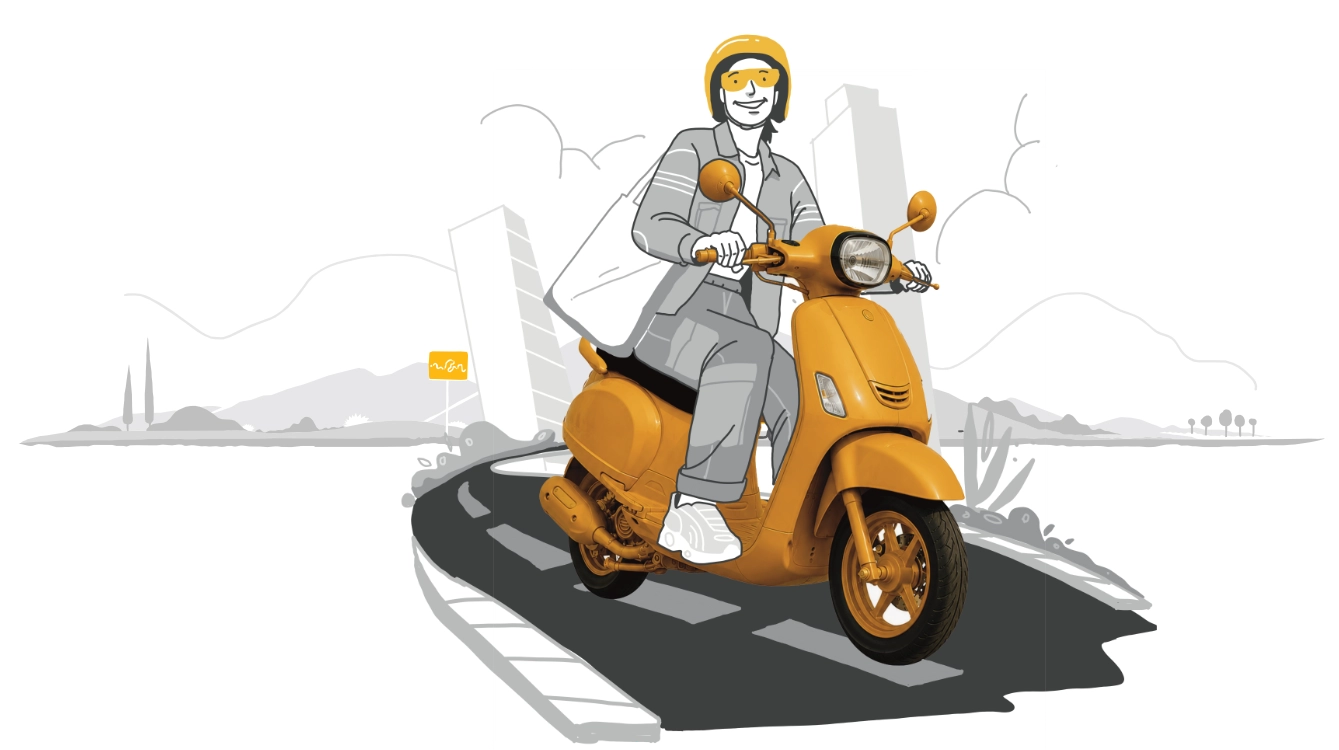
Motorcycles are becoming one of the most common means for daily commute. But they also allow you to enjoy a long and high-speed ride on a highway. However, riding a bike is not as easy as it may seem.
The mechanism of riding a bike is somewhat similar to driving a car. Keep reading further to know how to ride a bike.

Table of Contents

Check out the following steps and other essential aspects if you are wondering how to ride a motorcycle.
Safety equipment is essential when riding motorcycles. The minimum is a DOT-approved helmet, which should fit well and not move when you shake your head. If you shop for a helmet, select the full-face helmet for enhanced safety. For the upper extremities, consider getting a motorcycle riding jacket made of leather or synthetic material with armour on the elbows, shoulders, and back.
Wear strong gloves whose construction gives one a good grip while protecting the hands from impacts. Wear trousers made from abrasion-resistant material such as Kevlar-ware denim or leather for your lower body. To reemphasise, appropriate equipment dramatically lowers the risk of getting injured in the event of an incident.
Prepare yourself for owning a bike. One of the most beneficial things a new rider can do is take a motorcycle safety course. These comprise motorcycle courses and organised learning programs that may be conducted in local community colleges or by a motorcycle organisation. In most schools, rider training is done in class, with introductory lessons on motorcycle functions, traffic rules, and safety measures.
Then, you will get to the controlled practice area, where trainers teach you how to handle practical exercises. Some states allow exemptions or reductions in license requirements when completing these courses, including insurance rebates.
Any new rider must gain at least a basic understanding of specific motorcycle controls before riding. The left handlebar generally has the clutch lever and horn, while the right handlebar has the front brake lever and the throttle.
The rear brake pedal is right by your right foot, and you control the gear shifter with your left foot. Sit on the stationary bike and choose each control until your hands master the seat. This will generally take less than three minutes. It’s basic knowledge; one cannot ride safely without ensuring they comprehend the position and purpose of each control.
In truth, controlling the clutch is usually the most revelling aspect as one masters the primary coaxial control. It is responsible for the engagement of the engine and the transmission system through the clutch. Begin by positioning the bike in front of you with the engine turned off. Squeeze out the clutch lever and try to look for the ‘friction zone’ or when the clutch plate begins to grab.
Once comfortable, turn on the engine and use the low gear to move the bike forward without using the throttle. This exercise, commonly known as a “power walk, " explains how to engage and disengage the clutch.
When ready with the clutch, the next thing to do is start the engine. Check if you are neutral, and then you twist the starter button. While the engine is on, perform the “power walk” exercise. Gradually ease off the clutch while shifting the gear until the bike moves forward, then rerelease the clutch.
Stroll beside the bike when it is in motion. This will help you understand its weight and trim and how the bike reacts to clutch action. It is advisable to practice this until you can regulate the forward movement of the bike through the clutch alone.
Having chosen a starting point, try to get to an open space free of traffic. Select first gear. As you slowly ease off the clutch with your right hand, give the bike a little throttle with your left hand. Relax your feet on the pedals as the bike continues moving forward in the right direction to be ready to countersteer if the bike tips over.
Specifically, one needs to pay considerable attention to the speed and balance while riding the bike. Riding in a straight line is the most basic exercise, and it should be performed incrementally as the rider becomes comfortable.
Once you are rested and satisfied with what you did to the bike, and you’re sure you can ride it only in first gear, the next thing to do is learn how to shift. To shift up, roll off the throttle with your right hand, pull in the clutch with your left hand, shift up with your left foot, and then ease the clutch out while applying the throttle steadily. Continue to do this until you can bend and change leg position without having to look at your feet.
Also, use downshifting as you decelerate. Some essential things to remember include ensuring the clutch movement is smooth and that shifting is done without necessarily causing jerky movements.
Swerving a motorcycle and changing its direction involves so-called countersteering. At speeds below about 10 mph, you steer just like you would on a regular bicycle: counterintuitively, you lean in the direction you want to go towards. Thus, to turn left, you have to gently push the left handlebar backwards and vice versa for turning right.
This causes the bike to tilt in the left direction, which is the start of the turn. While turning, recall that your eyes should look through the turn to where you are headed.
Braking is fundamental to every ride, so its execution must be mastered. Practice using the front and rear brakes to ensure effective braking. Ease the brakes and maintain a steady pressure – abrupt staking on the brakes will lock the wheels.
Remember to change to a lower gear depending on the vehicle's current speed when slowing down. It is also essential to rehearse an emergency stop on a safe, clear road without skidding or locking the wheels.
To ride a motorcycle effectively, one requires considerable practice and lessons. Once you feel confident with your manoeuvring, you should continue practising in low-risk environments. Practice in areas such as gentle acceleration, proper and accurate gear shifting, and curve handling.
Pursuing higher-level riding lessons to enhance your abilities might also be beneficial. It is also important to acknowledge that each rider, no matter their level of experience, is constantly learning and refining their skills on bikes.
Ensure that you always wear the safety gear and ride safely!
Once you learn how to ride a motorbike, consider some safety measures. The safety measures to know while riding a motorcycle are listed below.
The steps and points above say everything about bike riding and the safeguard to follow. Now, you can learn how to ride a bike by following those easy steps.
One can ride a bike as a beginner by following tips:
To balance a motorcycle:
Your bike may be unbalanced due to:
View these components, and if you observe the following problems, it is advisable to seek the services of a mechanic for tune-up services.
The 4 steps to riding a bike are:
To get in shape for cycling:
You can get better at riding a bike by following the tips below: