General
Life
Accessibility Options


General

General Products
Simple & Transparent! Policies that match all your insurance needs.
 Car Insurance
 Two Wheeler Insurance
 Commercial Vehicle Insurance
 Health Insurance
 Home Insurance
 Travel Insurance
 Business Insurance
Car Insurance
Two Wheeler Insurance
Commercial Vehicle Insurance
Health Insurance
Travel Insurance
Business Insurance
Car Insurance
Two Wheeler Insurance
Commercial Vehicle Insurance
Health Insurance
Travel Insurance



Scan to download

Life

Life Products
Digit Life is here! To help you save & secure your loved ones' future in the most simplified way.
 Term Life
 Savings Plan
 Retirement and Pension Plans
 Group Life Products
 Product Documents
Term Life
Savings Plan
Retirement and Pension Plans
Group Life Products
Product Documents
Term Life
Savings Plan
Retirement and Pension Plans
Group Life Products

Scan to download

Claims

Claims
We'll be there! Whenever and however you'll need us.
 Customer Support
 Motor Claims
Health Claims
Motor Claims
Health Claims
 Marine Insurance
 Grievance Redressal
Customer Support
Motor Claims
Health Claims
Marine Insurance
Grievance Redressal
Grievance Redressal
Customer Support
Motor Claims
Health Claims
Marine Insurance
Grievance Redressal

Scan to download
 General
 Life
General
Life
Life
General
Life
Renewals
Resources

Resources
All the more reasons to feel the Digit simplicity in your life!
Exclusive Features
 Transparency Report
Others
Exclusive Features
Transparency Report
Transparency Report
Others
Exclusive Features
Transparency Report

Scan to download


Our WhatsApp number cannot be used for calls. This is a chat only number.

 Grey Scale
 Readable Text
 Reset
Reset




10000+ Cashless Garages
1.5 Cr+ Policies Sold


Check Price

Car insurance Online, Up to 90% Discount
It's a Brand New Car
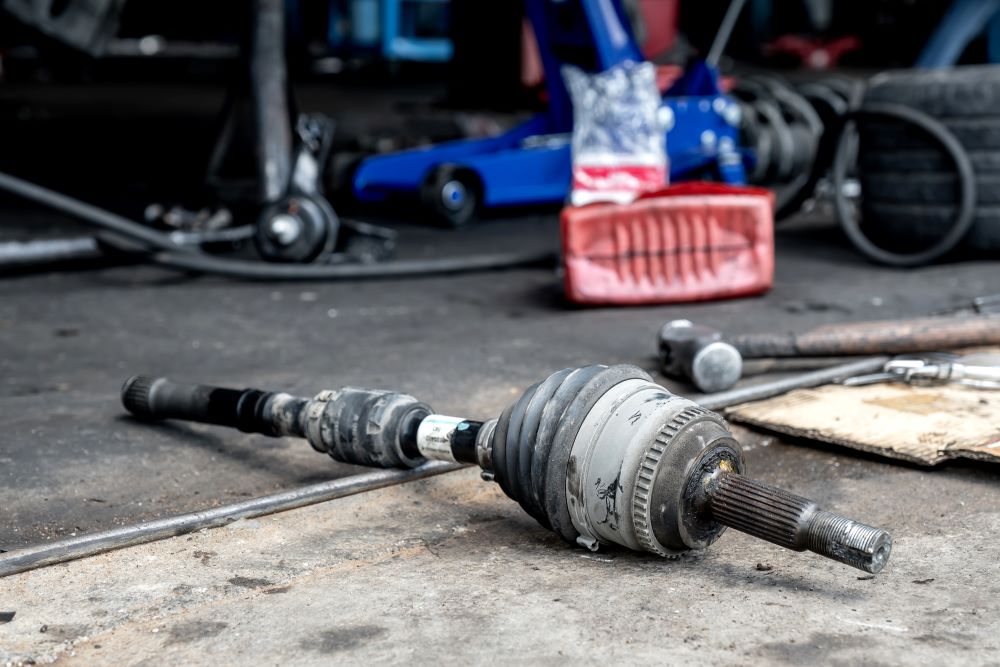
There are multiple parts in a car that work in conjunction to ensure proper and smooth operation. Failure of any can cause improper driving experience. One such important part is the drive shaft. If it breaks or fails to function properly, it can cause significant damage to other parts of a vehicle.
A drive shaft is a part of a drive train and goes by many other similar names, such as propeller shaft, drive line, and prop shaft. It is the component transmitting torque from the engine to the wheels. It is the shaft that causes your vehicle to move.
Drive shafts are used in various vehicles, including cars, trucks, buses, and motorcycles. It is a long, cylindrical metal shaft connecting the transmission or transfer case to the differential or axle assembly in a rear-wheel or four-wheel drive system. They are typically made of steel or aluminium and are designed to withstand high levels of torque and vibration.

A driveshaft is a rotating rod transmitting power from the transmission to the wheel axle. It does this by rotating a series of universal joints (U-joints) that allow the shaft to change angles as the suspension moves up and down.
Here is how a drive shaft works:
The driveshaft is typically made of strong, lightweight metal such as steel or aluminium. It is supported by two bearings, one at each end, which allow it to rotate freely.
The bearings are housed in yokes, flanged metal brackets that attach the drive shaft to the transmission and rear axle.
U-joints are located between the yokes. They consist of two yokes connected by a cross.
The cross is made of a flexible material such as rubber or metal, allowing the yokes to rotate independently.
As the suspension moves up and down, the driveshaft rotates.
The U-joints allow the drive shaft to change angles without breaking the power transmission.
This is important because the drive shaft must be able to change angles as the vehicle goes over bumps and turns.
If a drive shaft fails, the vehicle will not be able to move. Therefore, keeping the drive shaft in good condition is important by regularly inspecting it for wear and damage.
Multiple parts of a car drive shaft work together to make the whole process happen. Find out about them in detail below:
Universal Joints (U-Joints): These joints connect the drive shaft to the differential and allow for the rotation of the drive shaft while accommodating changes in angle and alignment. U-joints consist of a cross-shaped bearing connected to the yokes.
Drive shaft boots: The drive shaft boots are rubber covers that protect the U-joints from dirt, water, and debris. They also help to keep the grease inside the U-joints, which lubricates them and helps to prevent wear.
Slip Yoke: The slip yoke is located at one end of the drive shaft and connects it to the transmission or transfer case. It allows the drive shaft's length to change as the suspension moves up and down.
End Yokes: The yokes are the end fittings that connect the drive shaft to the transmission, differential, or transfer case. They provide a means for attaching the drive shaft securely to these components.
Shaft Tube: The main cylindrical tube that houses and protects the internal components of the drive shaft.
Centre Support Bearing (Carrier Bearing): In longer drive shafts, a centre support bearing provides additional support and reduces vibrations. It is typically mounted on a bracket in the centre of the drive shaft.
Balancing Weights: To minimise vibrations, drive shafts often include balancing weights. These weights are strategically placed along the drive shaft to counterbalance uneven mass distribution.
Flex coupling: A flex coupling is a flexible joint that allows the drive shaft to flex slightly. This can help absorb shock and vibration and extend the life of the drive shaft.
Flange: The flange is a flat, circular plate attached to the end of the drive shaft that connects it to the differential or axle assembly. It is usually bolted to the companion flange on the differential.
These are the main components that make up a typical drive shaft assembly. However, it's important to note that the drive shaft's specific design and configuration may vary depending on the vehicle's make, model, and drivetrain type.
There are several varied options when it comes to types of drive shafts. However, this component can be of three main types – Single Piece Shaft, Two or Three Piece Shaft, and Front Wheel Drive. Find more about these variations below:
A single-piece shaft, also known as a solid or one-piece shaft, refers to a type of shaft manufactured as a continuous, unbroken piece without any joints or connections.
Single-piece shafts are typically made from a single piece of material, such as steel or aluminium, machined to the desired specifications.
Uses: Single-piece shafts are commonly used automotive drivetrains, industrial machinery, power transmission systems, and rotating equipment.
The shafts prevent drive shaft damage caused by bending at high speeds. Four-wheel-drive vehicles and vehicles with a large distance between the axle and engine utilise two or three-piece shafts.
Dividing the drive shaft into two or three parts allows for speed reduction. When the shaft remains unbent, the floor or transmission tunnel above it lowers to create additional space for passengers or luggage.
Uses: It can be a valuable benefit for vehicles used for off-road driving or carrying large loads.
Front-wheel drive vehicles powers the front wheels by turning the front axle, propelling the vehicle forward.
They have all parts of their drive train in front of the vehicle. This includes the engine, transmission, differential, and axles. All these components are located in the front of the vehicle, so front-wheel drive vehicles are typically shorter than rear-wheel drive vehicles.
Their drive shafts are fitted with constant velocity (CV) joints. The transaxle, also called the axle-transmission unit, connects the axle to the transmission on a front-wheel vehicle.
Driveshafts offer multiple advantages, such as:
The drive shaft efficiently transfers power from the engine to the wheels, allowing the vehicle to move forward. It ensures a smooth and continuous power flow, enabling effective acceleration and overall performance.
You can optimise weight distribution by positioning the engine and transmission in the front of the vehicle and transferring power to the rear wheels through the drive shaft. This can improve handling, stability, and traction, especially in rear-wheel or all-wheel drive vehicles.
Driveshafts typically have a composition of strong materials, such as steel or aluminium alloy, making them sturdy and capable of withstanding high torque and rotational forces. They can handle the demands of heavy-duty applications and provide long-lasting performance.
Driveshafts are relatively straightforward in design, and one can easily inspect, repair, or replace them when necessary. This simplicity contributes to easier maintenance and reduced downtime during servicing or repairs.
Different vehicles, including trucks, SUVs, and high-performance sports cars, can use drive shafts. They provide flexibility in vehicle design and allow for different drivetrain configurations to meet specific performance requirements.
In some cases, using the driveshaft in a rear-wheel drive or all-wheel drive configuration can result in better fuel efficiency than front-wheel drive setups. This is due to reduced power losses and optimised weight distribution.
The advantages of drive shafts are specific to certain vehicle designs and configurations. Different drivetrain systems, such as front-wheel drive or electric drivetrains, have their unique advantages and considerations.
Like every other mechanism, the driveshaft has its drawbacks too. Check them out below:
Driveshafts are typically made of steel or aluminium, which can make them heavier than other types of drive systems, such as chain drives. It can add weight to the vehicle and reduce fuel efficiency.
Drive shafts are more expensive to manufacture than other types of drive systems. This is due to the use of more expensive materials and the complexity of the manufacturing process.
Driveshafts require regular maintenance, such as lubrication and inspection. It can be time-consuming and expensive.
Driveshafts can fail if they are improperly maintained or under excessive stress. It can cause the vehicle to lose power or become not drivable.
Drive shafts are not as flexible as chain drives. This can limit their ability to negotiate rough terrain or make sharp turns.
However, drive shafts' advantages outweigh their disadvantages. It is an efficient and reliable mechanism.
Here are some examples of drive shaft usage:
Automotive: Four-wheel drive vehicles and rear-wheel drive vehicles mostly use drive shafts. They transmit power from the engine to the differential, turning the vehicle's rear wheels.
Aerospace: Helicopters and aircraft use drive shafts, especially in transmission systems. They transfer power from the engine to the rotors or propellers.
Marine: Ships and boats also use drive shafts to deliver power from the engine to the propeller. They allow the propeller to turn, which propels the vessel through the water.
Industrial machinery: Different industrial machinery, such as agricultural machinery, conveyors, and manufacturing equipment, utilise drive shafts. They transmit power from the engine or motor to the working parts of the machinery.
Motorcycles and bicycles: Few bicycles and motorcycles use drive shafts as an alternative to belt or chain drives. They transmit power from the engine or motor to the rear wheel, which allows the bicycle or motorcycle to move forward.
Construction machinery: Different construction machinery utilises driveshafts, including cranes, loaders, and excavators. They transmit power from the engine or motor to the machinery's working parts, allowing these heavy-duty machines to move and operate.
Power generation: Power plants use drive shafts to connect generators and turbines. They transmit power from the generators to the turbines, generating electricity.
Check out the common signs and symptoms of a bad drive shaft and call a mechanic if you notice any without delay:
When the bearings and bushings fail or become worn, they affect the drive shaft's ability to rotate normally leading to squeaking, scraping, rattling, and clanking sounds.
Excessive drive shaft vibration can occur when the bushings or U-joint wear out. Improperly bolting down the drive shaft or having an unbalanced unit can also contribute to this issue .
If you experience difficulties turning, it may be because your vehicle's failing drive shaft. A damaged drive shaft limits your control over the car and the wheels' ability to turn properly.
When the drive train is defective, you may observe a significant increase in shuddering as you accelerate from a stopped position or increase speed.
You can easily detect a torn drive shaft cover by crawling underneath the car and looking for a crack or puncture in the cover. When a drive shaft cover is torn, it will usually cause grease to splash around the car's tire.
Overall, a drive shaft is a reliable and efficient component in a vehicle. However, you should remember to keep it clean and under regular maintenance to ensure its proper functioning. A faulty drive train can cause severe accidents if left untouched.