General
Life
Accessibility Options


General

General Products
Simple & Transparent! Policies that match all your insurance needs.
 Car Insurance
 Two Wheeler Insurance
 Commercial Vehicle Insurance
 Health Insurance
 Home Insurance
 Travel Insurance
 Business Insurance
Car Insurance
Two Wheeler Insurance
Commercial Vehicle Insurance
Health Insurance
Travel Insurance
Business Insurance
Car Insurance
Two Wheeler Insurance
Commercial Vehicle Insurance
Health Insurance
Travel Insurance



Scan to download

Life

Life Products
Digit Life is here! To help you save & secure your loved ones' future in the most simplified way.
 Term Life
 Savings Plan
 Retirement and Pension Plans
 Group Life Products
 Product Documents
Term Life
Savings Plan
Group Life Products
Product Documents
Term Life
Savings Plan
Group Life Products

Scan to download

Claims

Claims
We'll be there! Whenever and however you'll need us.
 Customer Support
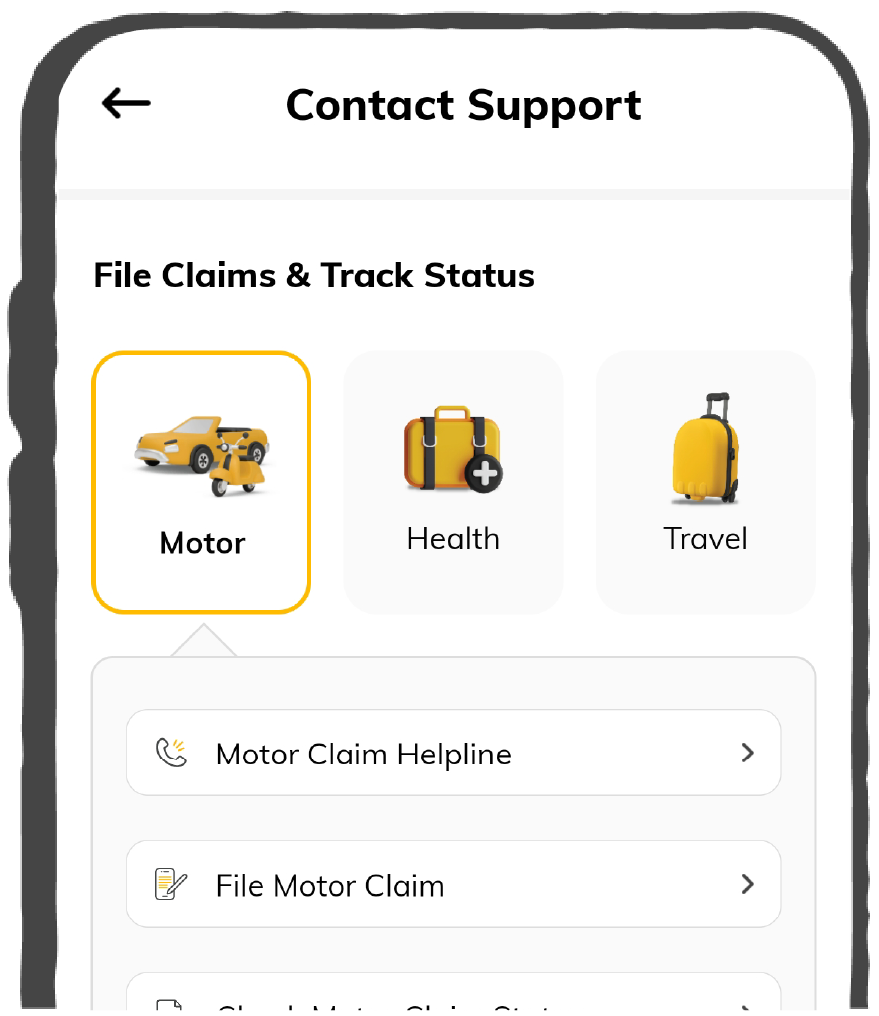
 Motor Claims
Health Claims
Motor Claims
Health Claims
 Marine Insurance
 Grievance Redressal
Customer Support
Motor Claims
Health Claims
Marine Insurance
Grievance Redressal
Grievance Redressal
Customer Support
Motor Claims
Health Claims
Marine Insurance
Grievance Redressal
Scan to download
 General
 Life
General
Life
Life
General
Life
Renewals
Resources

Resources
All the more reasons to feel the Digit simplicity in your life!
Exclusive Features
 Transparency Report
Others
Exclusive Features
Transparency Report
Transparency Report
Others
Exclusive Features
Transparency Report
Scan to download


Our WhatsApp number cannot be used for calls. This is a chat only number.

 Grey Scale
 Readable Text
 Reset
Reset




8 Crore+ Customers

Affordable Premium


A paramilitary force is a semi-militarized bunch that is not a member of a state's official armed forces but has an organisational structure, tactics, training, subculture and functions equivalent to those of a professional military.
Indian Paramilitary Forces are three entities that work closely with the Indian Armed Forces and are led by commanders from the Indian Army or Navy. However, no laws or government rules have defined them. The paramilitary forces in India are not military forces, but they are similar to the military's special operations units in terms of organisational structure and training.
The role of paramilitary troops in preserving internal security and aiding the regular armed forces is essential. Paramilitary forces are an important component of a country's security apparatus, supplementing the function of the armed forces in protecting the country's interests. The following are the roles and tasks of India's paramilitary forces:
Various paramilitary units in India perform critical roles in ensuring internal security, border security, and helping the regular armed forces. Here's a rundown of the sorts of paramilitary forces in India:
The Central Reserve Police Force(CRPF) is India's largest paramilitary organisation. It is in charge of internal security, counter-insurgency operations, and helping state police forces uphold law and order. The CRPF also provides election security and responds to natural disasters.
The Border Security Force (BSF) oversees border protection, especially along India's borders with Pakistan and Bangladesh. It is critical in preventing smuggling, illegal immigration, and cross-border terrorism. Border patrol, information gathering, and border infrastructure development are all responsibilities of the BSF.
The Central Industrial Security Force (CISF) protects critical infrastructure such as airports, seaports, power plants, and government buildings. It is in charge of combating terrorism, ensuring public safety, and ensuring security in sensitive regions.
The Indo-Tibetan Border Police (ITBP) patrols India's borders with China (Tibet). It is responsible for patrolling these high-altitude borders, conducting border surveillance, and ensuring security in mountainous areas. The ITBP also conducts disaster response and rescue missions.
The Sashastra Seema Bal (SSB) secures India's borders with Nepal and Bhutan. Its principal goal is to deter transnational crime, illegal activities, and insurgency. The SSB also performs intelligence and counter-terrorism missions.
The Assam Rifles are controlled by both the Ministry of Home Affairs and the Indian Army. It is largely responsible for preserving security and combating insurgencies in India's northeastern areas. Assam Rifles also helps with border management and civic action programmes.
The National Security Guard (NSG) is a specialised anti-terrorism organisation. It deals with high-risk security situations such as hostage rescue, counter-hijacking operations, and terrorist threats. The NSG is widely regarded as India's premier tactical reaction unit.
Individuals can take the following routes to be a part of the esteemed paramilitary forces of India.
For all 12th-pass applicants, recruitment in the Indian Para Military forces begins with independent exams given by various organisations (the BSF, for example). The age limit, physical qualifications, and selection process are similar to those of the above-mentioned exams. Complete information on recruitment through independent exams is widely available on all organisations' official websites.
The UPSC CAPF Assistant Commandant Exam is the sole way a candidate can join the Indian Paramilitary Forces as a Gazette Officer. The candidates will be selected on the basis of marks obtained by them out of a total of 600 marks and their performance in the Physical and Medical Tests.
|
Age |
20 to 25 Years |
|
Educational Qualifications |
Graduation from any stream |
|
Height |
Male 165 cm for Males and 157 cm for Females |
|
100 Meters Race |
Must be completed in 16 Seconds for males and 18 Seconds for female |
|
800 Meters Race |
Must be completed in 3 Minutes 45 Seconds for males and 4 Minutes 45 Seconds for females |
|
Long Jump |
3.5 Meters for males and 3 Meters for Females |
|
Short Put (In 3 Chances) |
4.5 Meters for males with 7.2 kg |
The SSC Constable GD Exam recruits constables for the Indian Paramilitary Forces. Exam eligibility and selection criteria are listed below:
|
Educational Qualifications |
Minimum 10th pass |
|
Age Limit |
Minimum age is 18, maximum age is 23 |
|
Height |
170 cm for Male and 162.5 cm for Females |
|
Race |
5 Km in 24 Minutes for males and 1.6 Km in 8 Minutes 30 Seconds for females |
|
Vision |
6/6 on 6/9 for distant and N6 on N9 for near |
The table below discusses the eligibility criteria to join the Indian Army regarding educational qualifications, age limit, and more.
|
Nationality |
Must be an Indian citizen or meet specific nationality requirements. |
|
Age Requirements |
Varied age criteria based on the entry scheme, ranging from 16.5 to 42 years. |
|
Educational Qualification |
Minimum qualification varies across entry schemes, typically from 10th pass to graduate degree holders. |
|
Physical Qualification |
Candidates need to meet prescribed physical standards in terms of height, weight, and fitness. |
|
Medical Standards |
Candidates must meet medical criteria, including visual acuity, overall health, and physical fitness. |
The pay scale for paramilitary applicants differs depending on their rank in the forces. A paramilitary candidate's annual wage ranges from ₹1.8lakhs to ₹4.5 lakhs, with medical benefits, free rations, and paid leave.
|
Rank in Paramilitary Force |
Salary (in ₹) |
|
Director-General |
2.25 lakhs |
|
Inspector General |
Up to 2.18 lakhs |
|
Senior Commandant |
Up to 2.15 lakhs |
|
Assistant Commandant |
Up to 1.77 lakhs |
|
Additional Director General |
Up to 2.24 lakhs |
|
Deputy Commandant |
Up to 2.08 lakhs |
|
Deputy Inspector General |
Up to 2.16 lakhs |
India's paramilitary forces, which include the CRPF, BSF, CISF, ITBP, SSB, Assam Rifles, and NSG, are critical in ensuring internal security, border protection, and combating terrorism. These forces majorly contribute to protecting the nation's interests, preserving law and order, and responding to emergencies.
With their specialised training, equipment, and operational capabilities, they are an important component of India's security apparatus, operating in tandem with the regular armed forces to protect the nation's and residents' safety and well-being.