General
Life
Accessibility Options


General

General Products
Simple & Transparent! Policies that match all your insurance needs.
 Car Insurance
 Two Wheeler Insurance
 Commercial Vehicle Insurance
 Health Insurance
 Home Insurance
 Travel Insurance
 Business Insurance
Car Insurance
Two Wheeler Insurance
Commercial Vehicle Insurance
Health Insurance
Travel Insurance
Business Insurance
Car Insurance
Two Wheeler Insurance
Commercial Vehicle Insurance
Health Insurance
Travel Insurance



Scan to download

Life

Life Products
Digit Life is here! To help you save & secure your loved ones' future in the most simplified way.
 Term Life
 Savings Plan
 Retirement and Pension Plans
 Group Life Products
 Product Documents
Term Life
Savings Plan
Retirement and Pension Plans
Group Life Products
Product Documents
Term Life
Savings Plan
Retirement and Pension Plans
Group Life Products

Scan to download

Claims

Claims
We'll be there! Whenever and however you'll need us.
 Customer Support
 Motor Claims
Health Claims
Motor Claims
Health Claims
 Marine Insurance
 Grievance Redressal
Customer Support
Motor Claims
Health Claims
Marine Insurance
Grievance Redressal
Grievance Redressal
Customer Support
Motor Claims
Health Claims
Marine Insurance
Grievance Redressal
Scan to download
 General
 Life
General
Life
Life
General
Life
Renewals
Resources

Resources
All the more reasons to feel the Digit simplicity in your life!
Exclusive Features
 Transparency Report
Others
Exclusive Features
Transparency Report
Transparency Report
Others
Exclusive Features
Transparency Report
Scan to download


Our WhatsApp number cannot be used for calls. This is a chat only number.

 Grey Scale
 Readable Text
 Reset
Reset



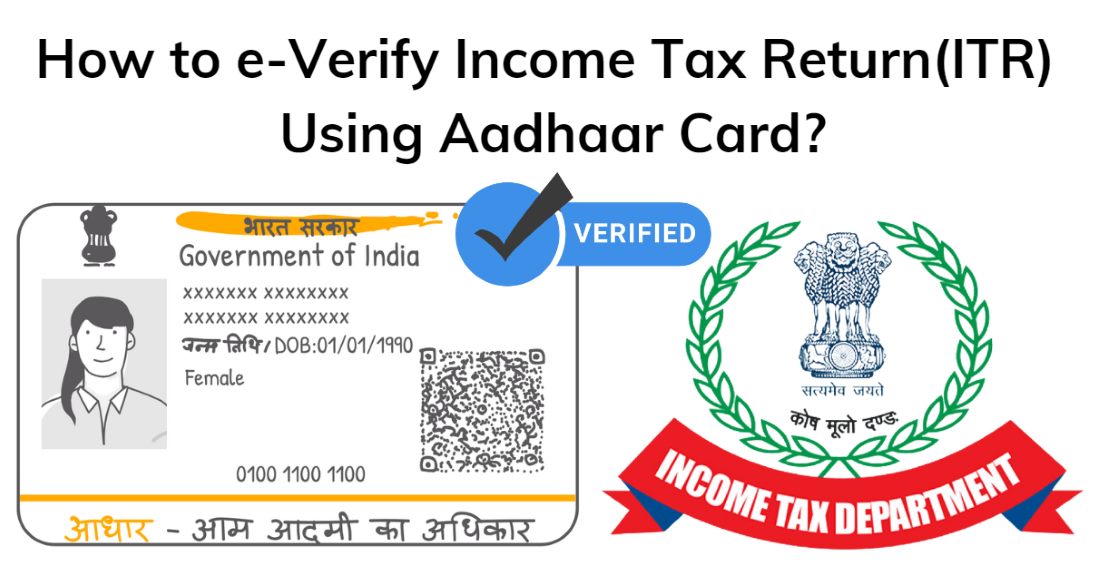
ITR E-verification via Aadhaar OTP simplifies the process and helps maintain security. It is one method one can use to validate their ITR, and it is exclusively for Aadhaar card users. This is important since Section 119 of the income tax law states that if a taxpayer fails to verify the ITR within 30 days of filing it, then the ITR will be deemed invalid.
This process of signing does not require a physical signature or even the submission of hard copies of documents, thus making it easy and paperless. Continue reading to learn how to E-verify ITR using Aadhaar OTP and the essential details.

Table of Contents

The Income Tax Return (ITR) Appendix is another name for Electronic Verification of ITR – it is a method for verifying information in a return faster and better. Notably, it does away with the necessity of physically affixing signatures and then posting the ITR-V to the CPC in Bengaluru.
The e-verification provided an official assertion from the taxpayer's side confirming that all information entered in the ITR is accurate to her/his best knowledge. It also eliminates formalities regarding signatures and physical documents, which are required for the entire process and are entirely digital and paperless.
e-Verification can help the Income Tax Department verify that the documents it receives are authentic. It also offers taxpayers an efficient and secure way of ascertaining the status of their papers.
Verifying the ITR is essential. Once the ITR has been verified, taxes can be filed, and if not filed within the specified period, the taxes cannot be filed again. Through its latest notification, the Income Tax Department compelled individual taxpayers to validate the ITR filed within 30 days from August 01, 2022.
If this is not done within 30 days, the return will be deemed to have not been filed, and accordingly, the Income Tax Department will not entertain it. Therefore, your tax department will not proceed to the following processing level while the taxpayer's verification process is still ongoing.
If the ITR is not e-verified within the said period, the Income Tax Department has a right to issue a notice of failure to e-verify the ITR. This underlines the importance of the verification process, as it checks the legitimacy of the information submitted to the tax return service.
Here are a few simple steps to e-verifying your return using an Aadhaar Card:
Step 1: File an e-tax return through the official website of the Income Tax Department of India.
Step 2: Go to the ‘e-file’ option on the home page, then go to the ‘Income Tax Returns’, and under this option, select ‘e-verify return.
Step 3: Locate the latest ITR for e-Verification.
Step 4: Choose ‘I would like to e-verify using OTP on the mobile number registered with Aadhaar.’ Please ensure that your PAN is linked to Aadhaar and your mobile number is registered with Aadhaar.
Step 5: Tick the box near ‘I have read the instructions and guidelines and agree with them’ and click ‘Generate Aadhaar OTP.’ Please remember that the OTP is active for 15 minutes only.
Step 6: Type the received OTP and press the ‘Submit’ button. You will see a confirmation message on the screen, and a confirmation acknowledgement will be sent to the provided email address.
Let’s discuss how to e-verify ITR using EVC:
Step 1: Visit the ’e-File’ page on the Income Tax official website
Step 2: Users can type ‘Generate EVC’ to get a 10-digit code through their registered Email ID and Registered Mobile Number.
Step 3: Once your ITR has been filed, select the ‘I already have an EVC to E-verify my return’ option
Step 4: If you don’t have EVCs, click ‘No EVC required and would like to generate EVC.’
Step 5: Move onto the next page, where you must type in the 10-digit EVC.
Access the acknowledgement once all the details in your return are successfully validated.
Through the EVC method, one can E-verify ITR without necessarily linking Aadhaar with PAN. This affirms that the tax return filing is authentic and allows for validating the tax returns through electronic means. If the Aadhaar OTP does not work or you have not registered for EVC, another way is to forward a physically signed ITR-V to the CPC manually.
The Aadhaar OTP e-Verification of Income Tax Returns (ITRs) is a secure method that makes validating tax returns fairly easy and efficient. This paperless approach makes verification easier and complements the government’s drive to prolific digitisation.
The last and most crucial step in the filing process is the E-verification using Aadhaar OTP, making the declaration valid and correct according to the law on the tax filing procedure.