General
Life
Accessibility Options


General

General Products
Simple & Transparent! Policies that match all your insurance needs.
 Car Insurance
 Two Wheeler Insurance
 Commercial Vehicle Insurance
 Health Insurance
 Home Insurance
 Travel Insurance
 Business Insurance
Car Insurance
Two Wheeler Insurance
Commercial Vehicle Insurance
Health Insurance
Travel Insurance
Business Insurance
Car Insurance
Two Wheeler Insurance
Commercial Vehicle Insurance
Health Insurance
Travel Insurance


Scan to download

Life

Life Products
Digit Life is here! To help you save & secure your loved ones' future in the most simplified way.
 Term Life
 Savings Plan
 Retirement and Pension Plans
 Group Life Products
 Product Documents
Term Life
Savings Plan
Retirement and Pension Plans
Group Life Products
Product Documents
Term Life
Savings Plan
Retirement and Pension Plans
Group Life Products
Scan to download

Claims

Claims
We'll be there! Whenever and however you'll need us.
 Customer Support
 Motor Claims
Health Claims
Motor Claims
Health Claims
 Marine Insurance
 Grievance Redressal
Customer Support
Motor Claims
Health Claims
Marine Insurance
Grievance Redressal
Grievance Redressal
Customer Support
Motor Claims
Health Claims
Marine Insurance
Grievance Redressal
Scan to download
 General
 Life
General
Life
Life
General
Life
Renewals
Resources
Resources
All the more reasons to feel the Digit simplicity in your life!
Exclusive Features
 Transparency Report
Others
Exclusive Features
Transparency Report
Transparency Report
Others
Exclusive Features
Transparency Report
Scan to download


Our WhatsApp number cannot be used for calls. This is a chat only number.

 Grey Scale
 Readable Text
 Reset
Reset



Buy Individual Health Insurance Online

9000+
Cashless Hospitals

3.8 Crore+
Lives Insured

8 Lacs+
Claims Settled
I agree to the Terms & Conditions

Get Exclusive Porting Benefits
Check Prices

Buy Health Insurance, Up to 20% Discount
Port Existing Policy
9000+
Cashless Hospitals
3.8 Crore+
Lives Insured
8 Lacs+
Claims Settled
An Individual Health Insurance Plan is a type of health insurance policy that covers one person with their own fixed sum insured. This means the entire coverage amount is reserved only for that individual and is not shared with anyone else.
You can buy separate individual plans for each family member, where each person gets their own coverage, benefits, and claim limit under their respective policy.
For example: If Mr. Rahul buys an individual health insurance plan of ₹10 lakh for himself and a separate ₹10 lakh plan for his spouse. During hospitalisation:
In simple terms, an individual health insurance plan ensures that one person gets full and dedicated medical coverage without depending on or sharing it with others.
Individual health insurance is becoming increasingly important in India due to the rising cost of medical treatment and changing healthcare needs, especially for individuals who want reliable and uninterrupted coverage for themselves.

Treatments for even common illnesses can be expensive in Tier 1 cities. Medical inflation in India is increasing between 11% to 14% every year (1). A dedicated individual cover ensures your expenses are handled without compromising money.

Conditions like diabetes, hypertension, and heart issues are now seen even in younger individuals. Chronic Obstructive Pulmonary disease was the leading cause of death after heart disease in India (2), making personal coverage necessary.

Since healthcare costs in India are rising much faster than income growth, creating a widening gap between what people earn and what they may need to spend on treatment. An individual health insurance plan helps bridge this gap by ensuring your coverage keeps pace with rising treatment costs.

Many individuals depend solely on group health insurance provided by their employer, but this coverage ends when you switch jobs, retire, or take a career break. Hence, having your own individual health insurance ensures continuous and reliable protection.

Starting early with an individual plan helps maintain continuity benefits like waiting period completion, lower premium and renewability, which becomes crucial later in life.

In a family floater, one major claim can reduce coverage for others. However, an individual plan avoids this risk by keeping your coverage fully intact. You don’t have to share your coverage with others.

Individual health insurance is ideal for anyone seeking personalised health coverage tailored to their specific needs and sum insured.
Whether you’re a young professional starting your career, a freelancer with no employer coverage, or a businessman looking for personal protection, an individual policy can offer different, tailored benefits. However, individuals who want better coverage options than their employer insurance should also consider buying an individual policy.
You may start with a family floater plan and upgrade later to individual plan if your medical needs are low, affordability is a concern, or you have corporate health insurance.
The ideal sum insured for an individual health insurance plan should be from ₹10 lakh and can go up to ₹25 lakh or more, depending on your city, life stage, and health risks, so that it can comfortably cover at least one major hospitalisation without exhausting your sum insured.
Here’s a practical breakdown to help you choose the right sum insured in health insurance based on your age:
Here’s the right sum insured based on your life situation:
Disclaimer: These are broad indicative ranges, not financial advice. The right sum insured depends on age, medical history, lifestyle, city of residence, premium, hospital reference, and rising healthcare costs. It is advisable to know your family’s specific needs and read policy terms before making a final decision.
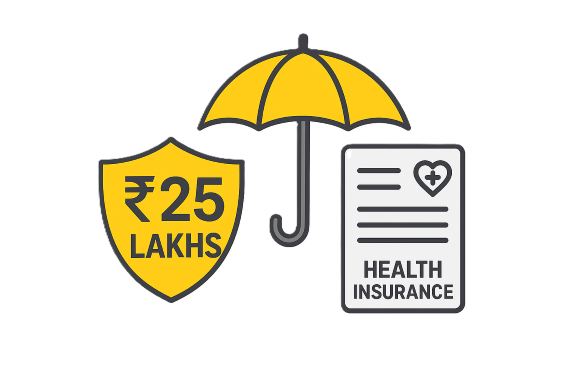
A ₹25 lakh sum insured is highly recommended because:
Bonus Point: Opting for a higher sum insured early on can also help you lock in better premiums while you're still young and healthy. It’s an investment in your future self.
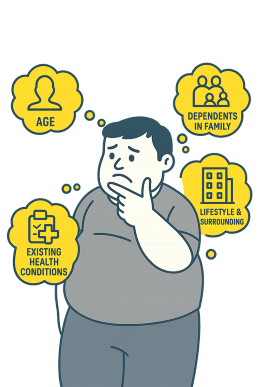
It is important to choose an accurate sum insured under your individual health insurance plan because of the rising healthcare cost. Here are some factors that will help you choose the right sum insured:
Choosing the right type of health insurance depends on who is covered, how the sum insured is used, and how stable the coverage is over time. Here’s a clear comparison to help you decide:

Choosing the right health insurance plan depends on your life stage, number of family members, health conditions, and financial responsibilities. Each type of plan serves a different purpose, so the decision should be based on how you want your coverage to work in real-life situations.
Choose an Individual Health Insurance Plan if:
*You want dedicated coverage for each person, without any sharing or dependency
*Any of your family member has pre-existing diseases or require frequent medical needs, increasing the chances of repeated claims
*You want long-term certainty, where your coverage remains fully available regardless of others’ usage
Choose a Family Floater Plan if:
*You are a young family with low medical risk, where the chances of multiple members needing hospitalisation at the same time are low
*You want a cost-effective way to cover multiple family members under a single policy
*You are just starting your health insurance journey and want basic protection for your family
A practical approach is not to rely on just one plan. Many individuals today combine an individual base policy for long-term security and a family floater for shared protection. This ensures you are covered across both planned and unexpected situations, without gaps.

Shubham Sinha
Product Manager - Health

Coverages
Double Wallet Plan
Infinity Wallet Plan
Worldwide Treatment Plan
Important Features
This covers for all hospitalisation expenses including due to an Illness, Accident, Critical Illness or even pandemics like Covid 19. It can be used to cover for multiple hospitalisations, as long as the total expenses are up to your sum insured.
You need to wait for a defined period from the first day of your policy to get covered for treatment related to any non-accidental illness. This is the Initial Waiting period.
Exclusive Wellness Benefits like Home Healthcare, Tele consultations, Yoga and Mindfullness and many more available on our App.
We provide a back-up Sum Insured which is 100% of your Sum Insured amount. How does Sum Insured Back Up work? Suppose your policy Sum Insured is Rs. 5 lac. You make a claim of Rs.50,000. Digit automatically triggers the wallet benefit. So you now have 4.5lac + 5 lac Sum Insured available for the year. However, one single claim, cannot be more than the base Sum Insured as in the above case, 5 lac. .
 Digit Special
No claims in the Policy year? You get a bonus -an additional amount in your total sum-insured for staying healthy & claim free!
Different categories of rooms have different rents. Just like how hotel rooms have tarrifs. Digit plans give you the benefit of having no room rent cap, as long as it is below your Sum Insured..
Health insurance covers medical expenses only for hospitalisations exceeding 24 hours. Day care procedures refer to medical treatments undertaken in a hospital, requiring less than 24 hours due to technological advancement such as cataract, dialysis etc.
Digit Special
Get a world class treatment with the Worldwide Coverage! If your doctor identifies an illness during your health examination in India and you wish to get a treatment abroad, then we’re there for you.You’re covered!
We pay for your health check-up expenses upto the amount mentioned in your Plan. No restrictions on the kind of tests! Be it ECG or Thyroid Profile. Make sure you go through your policy schedule to check the claim limit.
There may be emergency life-threatening health conditions which may require immediate transportation to hospital. We absolutely understand this and reimburse for expenses incurred for your transportation to a hospital in airplane or helicopter.
Digit Special
Co-Payment means a cost sharing requirement under a Health Insurance Policy that provides that the Policyholder/Insured will bear a specified percentage of the admissible claims amount. It does not reduce the Sum Insured. This percentage depends on various factors like age, or sometimes also on your treatment city called zone based copayment. In our plans, there is no age based or zone based Co payment involved.
Get reimbursed for the expenses of road ambulance, in case you are hospitalised.
This cover is for all expenses before and after hospitalisation such as for diagnosis, tests and recovery.
Other Features
The disease or condition that you are already suffering with and have disclosed to us before taking the policy and has been accepted by us has a waiting period as per plan opted and mentioned in your Policy Schedule.
This is the amount of time you need to wait for, until you can make a claim for a specific illness. At Digit it is 1-3 years and starts from the day of policy activation. For the full list of exclusions, read Standard Exclusions (Excl02) of your policy wordings.
If You sustain an Accidental Bodily Injury during the Policy Period, which is the sole and direct cause of Your Death within twelve (12) months from the date of accident, then We will pay 100% of the Sum Insured as mentioned in Policy Schedule against this cover and as per plan opted.
Digit Special
Your organ donor gets covered in your policy. We also take care the pre and post hospitalisation expenses of the donor. Organ donating is one of the kindest deeds ever and we thought to ourselves, why not be a part of it!
Hospitals can go out of beds, or the patient’s condition may be rough to get admitted in a hospital. Don’t panic! We cover you for the medical expenses even if you get treatment at home.
Obesity may be the root cause of so many health issues. We absolutely understand this, and cover for Bariatric Surgery when it is medically necessary and advised by your doctor. However, we DONOT cover if hospitalisation for this treatment is for cosmetic reasons.
If due to a trauma, a member has to be hospitalised for a psychiatric treatment, it will be covered under this benefit, upto INR 1,00,000. However, OPD consultations are not covered under this. The waiting period for Psychiatric Illness Cover is same as Specific Illness waiting period.
Before, during & after hospitalisation, there are many other medical aids & expenditures such as walking aids, crepe bandages, belts, etc.,which need your pocket’s attention.This cover takes care of these expenses that are otherwise excluded from the policy.

Pre-Natal & Post-Natal Expenses
Pre-natal and post-natal medical expenses are not covered, unless they lead to hospitalisation.

PED Before Waiting Period
In case of a pre-existing disease, unless the waiting period is over, the claim for that disease or illness cannot be made.

Hospitalisation without Doctor’s Recommendation
Any condition you get hospitalised for that doesn’t match the doctor’s prescription is not covered.
Enhance your individual health insurance policy with add-ons at Digit. These add-ons are subject to underwriting approval and your eligibility at the time of purchase or renewal. Here’s a list of add-ons available that provide additional layers of protection beyond the basic coverage of your policy:
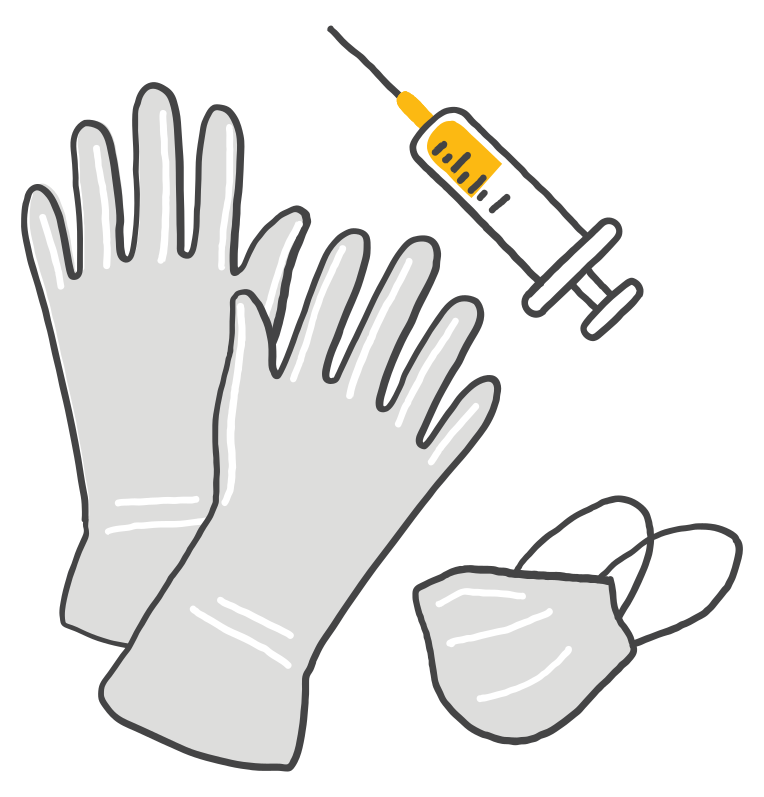
Consumable Cover
Pay 10% extra premium and we will also cover your non-medical expenses once your base claim is approved. This is best suited for people who want to minimise out-of-pocket expenses on items like gloves, syringes, and other non-medical costs.

Pre-existing Disease/Specific Disease/Initial Waiting Period Modification
You can reduce your pre-existing disease waiting period to up to 2 years. This is best suited for individuals with existing health conditions who want quick coverage for treatment.

Network Hospital Discount
Opt for treatment at one of our network hospitals and receive a 10% discount on your premium with this add-on cover. However, co-payment will be applicable if you get hospitalised in a non-network hospital. This is best for people who are comfortable using network hospitals and want to reduce their premium cost.
Your health insurance plan with Digit extends several exclusive benefits that enhance your coverage. Here are the key benefits:
* These add-ons are subject to underwriting approval and your eligibility at the time of purchase or renewal


An individual health insurance plan offers dedicated, reliable, and long-term financial protection by ensuring that your entire coverage is reserved only for you, without any dependency on others.

You Get the Full Coverage
The biggest advantage is that your entire sum insured is available for your medical needs only.

No Risk of Coverage Exhaustion by Others
In case of multiple hospitalisations, you don’t have to worry about your coverage being used by family members.
Better Suitability for Individuals with PED
If you have pre-existing diseases, lifestyle risks, or higher chances of medical treatment, an individual plan ensures you have adequate and uninterrupted coverage.
Long-Term Security
Individual plans offer lifelong renewability, helping you build benefits like waiting period completion, no-claim bonuses, and policy continuity, which are crucial in later years.

Independent Claim Experience
Your claims are evaluated based on your own policy usage, without being affected by others’ claim history. This ensures a more predictable and transparent claims process.

Saves Tax
You can claim income tax deductions on the premium you have paid through different sections while filing your income tax up to ₹25,000 under a old tax regime.

The premium for an individual health insurance plan can start from a few thousand annually and vary depending on the sum insured, city you live in, add-ons, health risks, etc.
Let’s look at a real-world example to understand how premiums in health insurance change based on the sum insured.
Suppose you are 25 years old, living in Bangalore (a Tier 1 city), and planning to buy an individual health insurance plan. Here’s an approximate idea of how your premium may vary for Infinity Wallet Plan at Digit with different coverage amounts:
Note: The premium values mentioned are for Tier 1 cities only. Actual premiums may differ based on factors such as age, medical history, location, chosen benefits, and insurer underwriting.
You must always check the eligibility criteria before buying an individual health insurance policy. Here are the general eligibility criteria to get individual health insurance.
Buying an individual health insurance policy online from Digit is a quick and fully online process designed to help you get covered in just a few steps. Follow these simple steps to buy an individual health plan:
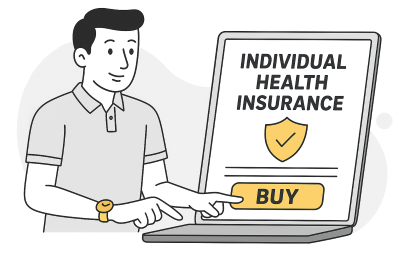
Enter Basic Details
Visit the Digit app or website. Enter your PIN code and mobile number, select your preferred health insurance plan and provide age details, family members covered, etc.
Choose Plan & Add Member Details
Compare & select the plan, sum insured, add-on covers and apply any available discounts to get the final premium amount. Further, provide the member details for everyone you’re covering under your policy.
Make Payment & Submit KYC
Once done, proceed to make the premium payment and submit your KYC documents to complete the purchase process.
Final Review & Processing
Now, your application undergoes a brief review process. Digit may request a health declaration, lifestyle information, or medical details & reports if required. Now, based on your medical underwriting, your policy will be issued and sent to your email. You can also access it anytime through the Digit app.
When purchasing an individual health insurance policy, insurers typically require some basic documents for verification. Below is a list of optional documents that can be needed at the time of purchasing a policy:

Identity/Age Proof
✔ Aadhaar Card
✔ PAN Card
✔ Passport
✔ Voter ID
✔ Driving License
✔ Birth Certificate

Address Proof

Income Proof

Previous Medical Reports (If any)

KYC Documents
✔ PAN Card (for financial verification)
✔ Aadhaar Card (for identity and address verification)
✔ Photograph and bank details (optional)
Get cashless treatment at 9000+ hospitals across India
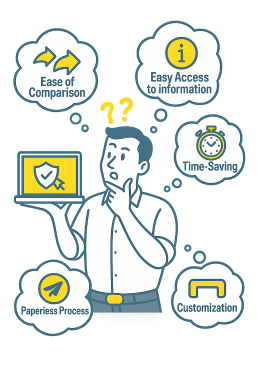
Buying individual health insurance online has become the preferred choice for many individuals because it offers speed, transparency, and better control over your decision-making. Some benefits of buying an individual health insurance plan online include:
Once you’ve decided your coverage, the next step is to evaluate the policy carefully. These checks help ensure that your plan is easy to use, reliable during claims, and free from surprises. Here are some things you must remember before buying any individual health insurance policy:

Apart from safeguarding your health, an individual medical health insurance also benefits you in maximizing your savings further by giving you the benefit of tax exemptions. This can be done in the following ways:
#Remember: To claim tax exemptions on your health insurance, it’s necessary that all payments towards your health insurance premium must be made through bank transfers, debit/credit cards or online/net banking methods since cash payments won’t be considered for your tax savings.
Individual health insurance has become a practical necessity in today’s environment, where medical costs are rising and health risks are becoming more unpredictable. Having a plan dedicated to you ensures that your coverage remains fully available, without being affected by family usage or external factors like job changes.
The key to making the most of an individual health insurance plan lies in choosing the right coverage, understanding your needs, and evaluating policies carefully before buying. Starting early not only helps you lock in lower premiums and better benefits but also ensures you are financially prepared for future healthcare needs.

A single person can save on health insurance by:


Senior Marketing Associate
Srishti is a skilled content writer with 4+ years of experience in the insurance world. She simplifies tricky terms, explains policies clearly, and writes content that instantly connects with customers. Her skills make insurance easy to understand and truly helpful for everyone.



Chief Marketing Officer
Vivek comes with over 15 years of experience across different industries like FMCG, e-commerce and insurance. His expertise in the online space and consumer behaviour understanding is bringing new insights to Digit in making insurance simple.