General
Life
Accessibility Options


General

General Products
Simple & Transparent! Policies that match all your insurance needs.
 Car Insurance
 Two Wheeler Insurance
 Commercial Vehicle Insurance
 Health Insurance
 Home Insurance
 Travel Insurance
 Business Insurance
Car Insurance
Two Wheeler Insurance
Commercial Vehicle Insurance
Health Insurance
Travel Insurance
Business Insurance
Car Insurance
Two Wheeler Insurance
Commercial Vehicle Insurance
Health Insurance
Travel Insurance



Scan to download

Life

Life Products
Digit Life is here! To help you save & secure your loved ones' future in the most simplified way.
 Term Life
 Savings Plan
 Retirement and Pension Plans
 Group Life Products
 Product Documents
Term Life
Savings Plan
Retirement and Pension Plans
Group Life Products
Product Documents
Term Life
Savings Plan
Retirement and Pension Plans
Group Life Products

Scan to download

Claims

Claims
We'll be there! Whenever and however you'll need us.
 Customer Support
 Motor Claims
Health Claims
Motor Claims
Health Claims
 Marine Insurance
 Grievance Redressal
Customer Support
Motor Claims
Health Claims
Marine Insurance
Grievance Redressal
Grievance Redressal
Customer Support
Motor Claims
Health Claims
Marine Insurance
Grievance Redressal
Scan to download
 General
 Life
General
Life
Life
General
Life
Renewals
Resources

Resources
All the more reasons to feel the Digit simplicity in your life!
Exclusive Features
 Transparency Report
Others
Exclusive Features
Transparency Report
Transparency Report
Others
Exclusive Features
Transparency Report
Scan to download


Our WhatsApp number cannot be used for calls. This is a chat only number.

 Grey Scale
 Readable Text
 Reset
Reset



9000+ Cashless Hospitals

Up to 20% Discount


Check Prices
Buy Health Insurance, Up to 20% Discount
Port Existing Policy
Over the years, the Indian Government has devised multiple initiatives to facilitate a better livelihood for the poor. One of them is the Mahatma Jyotiba Phule Jan Arogya Yojana (MJPJAY). It is one of the many schemes aiming to make healthcare easily accessible to the economically backward masses.
Not sure if this scheme can benefit you?
Well, here is a detailed discourse on the “what, how, and for whom” of this government initiative. Read on for a thorough understanding!

Table of Contents

The Mahatma Jyotiba Phule Jan Arogya Yojana is a healthcare coverage scheme launched by Maharashtra’s State Government. It was initially introduced as the Rajiv Gandhi Jeevandayee Arogya Yojana. The scheme aims to provide affordable and quality medical care to individuals below or marginally above the poverty line.
This healthcare scheme also covers surgical procedures and related consultation and hospitalisation expenses.
The MJPJAY scheme was first launched in July 2012. It was valid only in 8 districts of Maharashtra. Later, the scheme became functional in all 35 districts from November 2015. Since then, anyone holding a valid document could avail of free healthcare services from network hospitals.
Here is a list of features of the Mahatma Jyotiba Phule Jan Arogya Yojana. Have a look!
If you want to check the accessibility of such healthcare benefits near you, look up the list of network hospitals. It is available on the official website of the State Health Assurance Society. You can find several private and government-enrolled hospitals on this list. All of these can offer you the benefits of Mahatma Phule Arogya Yojana.
The primary benefits of MJPJAY are noticeable from the extensive treatment coverage it offers. This includes diagnosis, medication, surgeries, follow-up treatment, and expert consultation.
Following is a detailed list of benefits that policyholders can avail from this scheme:
In addition to the above-mentioned Mahatma Jyotiba Phule Jan Arogya Yojana benefits are the extended upper ceiling for renal transplant. In this case, beneficiaries can avail a maximum of Rs.2.5 lakhs for operation.
Want to know what other medical procedures you can avail of for free under the MJPJAY scheme?
Keep reading!
Let us check the list of medical procedures covered under the Mahatma Jyotiba Phule Jan Arogya Yojana.
The following surgical procedures are available with the MJPJAY scheme. Look at the list below to see in details:
The MJPJAY scheme takes care of these other procedures as well. Check the list below to get a detailed description:
General medicine is a broad term for common illnesses and medical conditions. This also falls under the MJPJAY Scheme.
Generally, most insurance plans come with specific exclusions. However, no such Mahatma Jyotiba Phule Jan Arogya Yojana disease list is available for this scheme, explicitly mentioning procedures not covered under the scheme. Instead, there are specific conditions mentioned under which certain medical treatments are provided.
If you belong to an APL or BPL family, you can get all the above treatments covered under MJPJAY by registering for the scheme. However, you need to consider the eligibility requirements before moving on with the process.
The Mahatma Jyotiba Phule Jan Arogya Yojana eligibility requirements demand individuals meet the following parameters to qualify as beneficiaries:
Here is a list of all mandatory documents that you need to submit to qualify for the MJPJAY scheme.
Any of the following KYC photo IDs:
To register a child born after issuing a health card, his/her authorised birth certificate, photo with either parent, and the parent’s yellow, orange, or white ration card must be issued.
Once you have checked your eligibility and gathered all Mahatma Jyotiba Phule Jan Arogya Yojana documents, proceed with the registration process.
In case you do not have a clue as to how to avail of Mahatma Jyotiba Phule Jan Arogya Yojana online registration, here is a step-by-step guide.
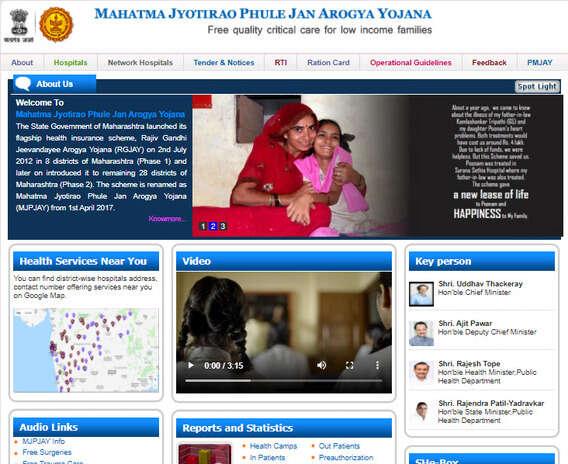
Upon completing the above procedure, you will be successfully registered under this insurance scheme. After that, you can raise a claim anytime you need to avail of medical treatment.
You can apply for the MJPJAY card in person at a local government health facility by contacting an Aarogyamitra, who is the scheme representative. They will assist you in obtaining the MJPJAY health card.
To apply for an MJPJAY card online, follow these steps:
Following is a step-by-step overview of the claim procedure for the Mahatma Jyotiba Phule Jan Arogya Yojana scheme.
After completing the medical procedure, the network hospital will share all essential details like diagnostic reports, treatment summary, and final bill with the insurer. The latter will verify all submitted documents to initiate claim settlement.
The MJPJAY Scheme offers various medical packages for the benefit of the common people. Check the list below to find the main packages under MJPJAY Scheme:
The steps below should help you access the hospital list associated with the MJPJAY. To find a list of hospitals under the Mahatma Jyotiba Phule Jan Arogya Yojana (MJPJAY), follow these steps:
Step 1: Visit the Official Website: Go to the official website of the Maharashtra State Government or the specific health department handling the MJPJAY.
Step 2: Search for MJPJAY Information: Look for a section dedicated to the Mahatma Jyotiba Phule Jan Arogya Yojana or a health insurance section.
Step 3: Locate the Hospital List: A link or document should list the empanelled hospitals under the scheme. This might be a downloadable PDF or an online directory.
Step 4: Contact the Local Health Office: If you have trouble finding the information online, visit or contact your local health office or district collector’s office for assistance.
Step 5: Check with Insurance Providers: Sometimes, insurance companies collaborating with the scheme also have lists of network hospitals. Check with them for more details.
To undergo hospitalisation under the Mahatma Jyotiba Phule Jan Arogya Yojana (MJPJAY), confirm your eligibility for the scheme. Then, identify an empanelled hospital by checking the official MJPJAY website or contacting local health offices. Obtain pre-authorisation from the insurance provider or hospital insurance desk for planned admissions by submitting the necessary documents.
Present your MJPJAY card upon arrival at the hospital to begin the admission process. The hospital will manage the claim process with the insurer, and you should ensure all treatments and procedures are covered. Upon discharge, review and settle any bills as per the scheme’s guidelines and collect your discharge summary and related documents.
The toll-free helpline number and address of MJPJAY are:
Toll-Free Number: 1800-233-2200 / 155 388
Address: Jeevandayee Bhavan, ESIC Hospital Compound, Near Worli Naka, Behind Poddar Hospital, Ganpat Jadhav Marg, Worli, Mumbai - 400018.
Purchasing the best health insurance plan in India is now necessary due to the escalating healthcare costs. Now that you are well acquainted with the detailed registration and claim procedure delay no more. Check your eligibility and enrol yourself and your family under the MJPJAY scheme at the earliest to avail yourself of optimum benefits.